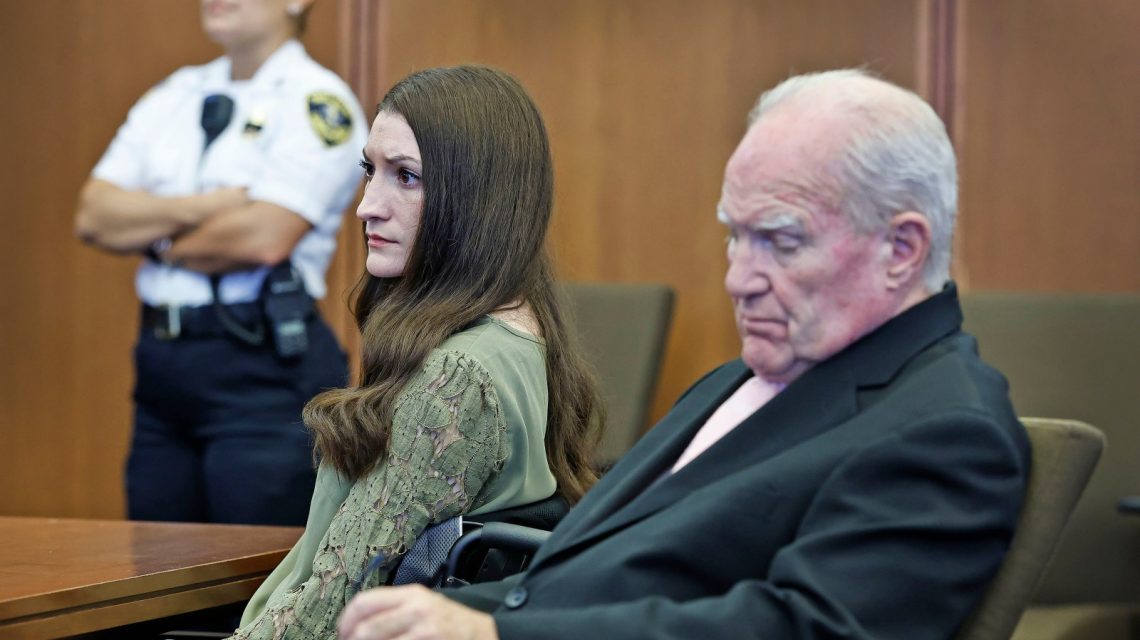
A Massachusetts judge has denied Lindsay Clancy’s attempt to dismiss murder charges against her, paving the way for a potential retrial. The case involves the deaths of her three children and has garnered significant attention.
On Thursday, Plymouth Superior Court Judge William F. Sullivan rejected the defense’s motion for a required finding of not guilty following September’s mistrial. Under Massachusetts law, this type of motion asks a judge to evaluate whether prosecutors have presented enough evidence for a reasonable jury to convict.
Defense attorney Kevin Reddington contended that the prosecution failed to prove two critical elements: that Clancy killed her children and that she was criminally responsible at the time of the acts. However, Judge Sullivan ruled that the prosecution’s evidence was sufficient for a reasonable jury to find Clancy guilty beyond a reasonable doubt.
“There was evidence introduced, both physical and circumstantial, that would permit a rational trier of fact to find beyond a reasonable doubt the elements of the charge of murder,” Sullivan stated.
This decision does not equate to determining Clancy’s guilt or innocence. Rather, it signifies that the evidence from the first trial fulfills legal sufficiency to proceed to a new jury trial.
The ruling is seen as a win for prosecutors, who argue that Clancy premeditated the killings of Cora, 5, Dawson, 3, and Callan, 8 months, on January 24, 2023, while her husband was away from their Duxbury home.
Evidence Supporting the Ruling
Prosecutors presented both physical and circumstantial evidence, indicating that Clancy was alone with the children during the period of the alleged crimes. Her husband, Patrick Clancy, testified about leaving the house for errands and returning to find evidence of violence before discovering the children in the basement.
Medical examiners reported that the children died from asphyxia or complications related to mechanical asphyxia, with allegations that they were strangled using exercise bands.
Judge Sullivan also dismissed the defense’s objections regarding Clancy’s criminal responsibility. Both sides conceded that Clancy suffered from a severe mental illness during the incident, but the debate focused on whether her illness prevented her from recognizing the wrongfulness of her actions or adhering to legal standards.
Three prosecution experts claimed Clancy retained awareness and control, notwithstanding differing opinions from defense experts. Sullivan emphasized that resolving these opposing views falls within a jury’s responsibilities.
Next Steps
A hearing slated for November 2 will address unresolved issues, including Clancy’s motion to prevent a retrial on double jeopardy grounds and the defense’s demand for an inquiry into Michael Desronvil, the juror who opposed convicting Clancy.
Prosecutors have yet to confirm whether they will pursue a retrial. Their possible actions include attempting another first-degree murder trial, opting for lesser charges, such as second-degree murder or manslaughter, or possibly dropping the case. Should a retrial be ordered, a new jury would decide Clancy’s guilt regarding the murder charges and her mental state at the time.
This article is part of ongoing coverage of the case. Further updates are expected.
 Botched Execution Leaves Tennessee Killer Christa Pike Hospitalized
  Christa Pike’s Failed Execution Highlights Ongoing Issues with Lethal Injection
  Judge Dismisses Charges Against David Hearn
  Ex-NYPD Sergeant’s Guilty Plea for Impersonating ICE Officer
  Tennessee Execution of Christa Pike Halted Amid Unprecedented Complications
  Execution Set for Christa Pike After Supreme Court Lifts Delay