Residents in the Americas are in for a treat as the moon takes center stage in a dazzling celestial display. Following a recent solar eclipse that spanned Greenland, Iceland, and Spain, the moon will now undergo an extensive partial eclipse on Thursday night into Friday, with Earth’s shadow covering an impressive 96% of its surface.
The moon has been gaining attention, especially after NASA recently sent the Artemis II astronauts on a record-setting flyby. This mission is part of plans to land on the moon and establish a base there with humans and robots in the upcoming years.
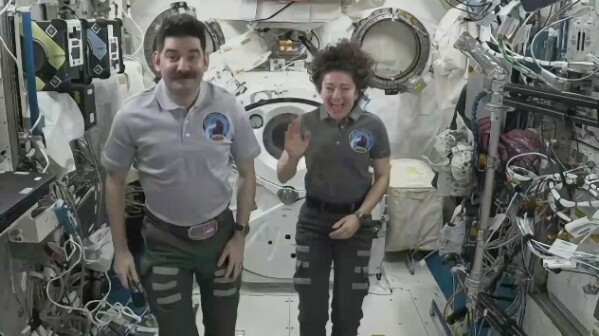
According to NASA astronaut Jack Hathaway, stationed on the International Space Station, the pace of the space program is not slowing down, highlighting the exciting developments in space exploration.
This partial lunar eclipse will be visible to billions of people across North and South America, Europe, Africa, and the Middle East, weather permitting. In contrast to the solar eclipse visible only in parts of Europe, this lunar event will reach a broader audience. Although the eclipse will be partial, Earth will still cast a reddish-orange shadow on the moon.
The entire event will span 5.5 hours, with the peak occurring just after midnight EDT. Nearly a billion people in the U.S., Canada, and Central and South America will be able to see the complete event. Meanwhile, more than 3 billion more—44% of the world’s population—will be able to view parts of it. In Europe, Africa, and the Middle East, the moon will set early, cutting the spectacle short for viewers there.
Jessica Meir, commander of the International Space Station, expressed the unique advantage astronauts have in observing cosmic wonders like eclipses and auroras from space.
This year has featured four eclipses, including a total lunar eclipse over the Americas, Australia, and eastern Asia in March. The next total lunar eclipse won’t occur until New Year’s Eve 2028, with Asia and Australia in prime viewing positions. Observers in the Americas will have to wait until 2029 for the next full lunar eclipse.
The Associated Press Health and Science Department receives support from the Howard Hughes Medical Institute’s Department of Science Education and the Robert Wood Johnson Foundation. The AP is solely responsible for all content.
 Ice Age Mastodon Tooth Unearthed in California Creek
  The Unique Challenges of the Pumpkin Toadlet
  Animal Self-Medication Insights
  Carlo Rovelli’s Perspective on Physics and Ultimate Reality
  Department of Defense Legal Waiver Promotes UAP Disclosure
  NASA’s Challenges Amid Goddard Space Flight Center Relocations