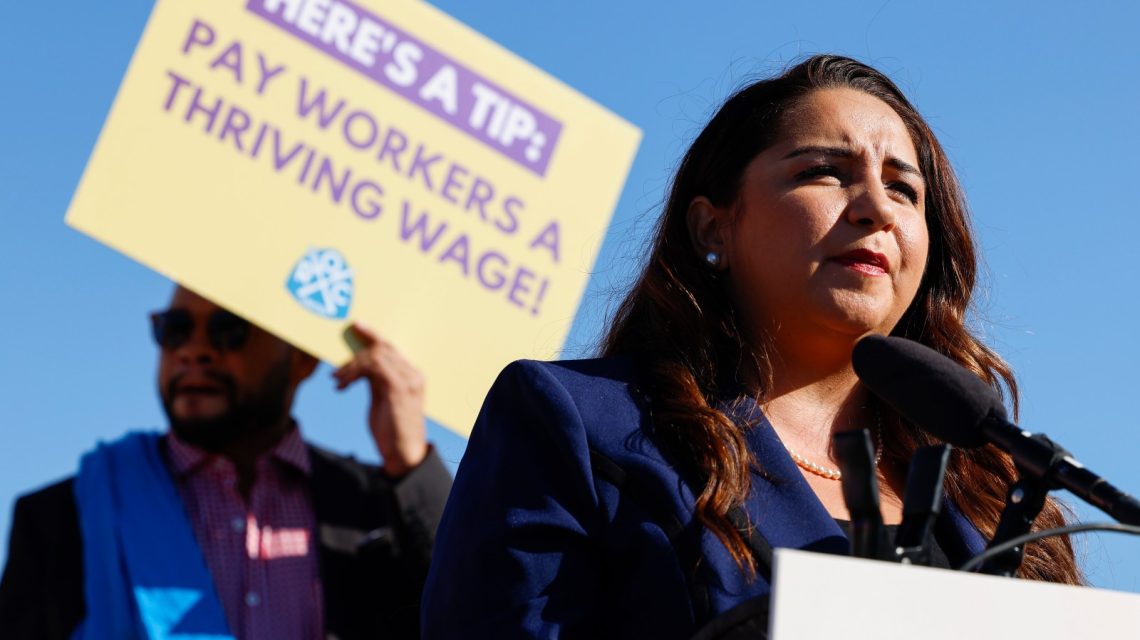
Introduction of the Living Wage for All Act
A bill proposing to raise the federal minimum wage to $25 an hour has been under consideration in Congress for nearly six months. With the legislative session approaching its end, lawmakers face a tightening timeframe to advance this proposal. Introduced on April 28 by Illinois Democratic Representative Delia Ramirez, the Living Wage for All Act, or H.R. 8555, aims to gradually increase the federal minimum wage over the next few years with distinct deadlines for large and smaller employers. In June, Connecticut Democrat Senator Chris Murphy expressed intentions to introduce a Senate version of the bill.
Key Provisions of the Bill
According to the bill, the minimum wage would gradually increase, hitting $25 an hour by 2031 for large employers and by 2038 for smaller employers. Large employers are defined as those with at least $1 billion in annual revenue or 500 or more employees nationwide. They would incrementally raise the minimum wage while meeting specific annual targets. Smaller employers would have a more gradual schedule, reaching annual targets at a slower pace.
The legislation also proposes linking the minimum wage to two-thirds of the national median hourly wage, meaning it would adjust annually to reflect changes in median wages once this level is reached. Additionally, lower minimum wages for tipped workers, younger workers, and certain workers with disabilities would be phased out, aligning them with the standard minimum wage over time. For tipped workers, this involves gradually increasing the minimum amount employers must directly pay, eventually phasing out the current system where tips count towards fulfilling minimum-wage obligations.
Current Status and Support
The bill currently has 32 cosponsors, all Democrats, including Representatives Rashida Tlaib of Michigan, Ro Khanna of California, and Pramila Jayapal of Washington. Representative Ramirez emphasized the necessity to address both affordability and wage crises, highlighting that despite record-high earnings by companies, working individuals struggle to survive on current wages.
Multiple labor unions and advocacy groups support the bill, emphasizing its importance in helping workers keep pace with the cost of living. Service Employees International Union President, April Verrett, endorsed Representative Ramirez’s proposal, recognizing it as a significant step toward achieving livable wages driven by workers’ demands.
Criticism and Challenges
Critics argue the proposal could adversely impact the economy. A study by the right-leaning Employment Policies Institute, cited by The Daily Signal, estimates that a $25 federal minimum wage might lead to approximately five million fewer jobs, significantly affecting the hospitality sector and workers aged 16 to 24. The institute’s research director, Rebekah Paxton, cautioned against high mandates that could further increase living costs for many Americans.
While the federal minimum wage currently stands at $7.25 an hour since 2009, numerous states and local governments have adopted higher rates. As of July 2026, the Department of Labor records 30 states and the District of Columbia with minimum wages surpassing the federal rate.
Legislative Future
The legislative future of the Living Wage for All Act remains uncertain. It has yet to be discussed in a committee hearing. If not approved before the conclusion of the 119th Congress in January 2027, the bill must be reintroduced in the next Congressional session.
 Ohio Socialist Candidate Criticizes Super PAC Mailers
  Trump’s $5,000 Check Proposal: Analysis and Reactions
  Federal Agents Conduct Search at Rep. Ilhan Omar’s D.C. Home
  Ohio Manufacturing and the Trump Effect
  New York Police Department to Review Use-of-Force Policies
  Trump’s Diesel Deal with Russia: A Controversial Move