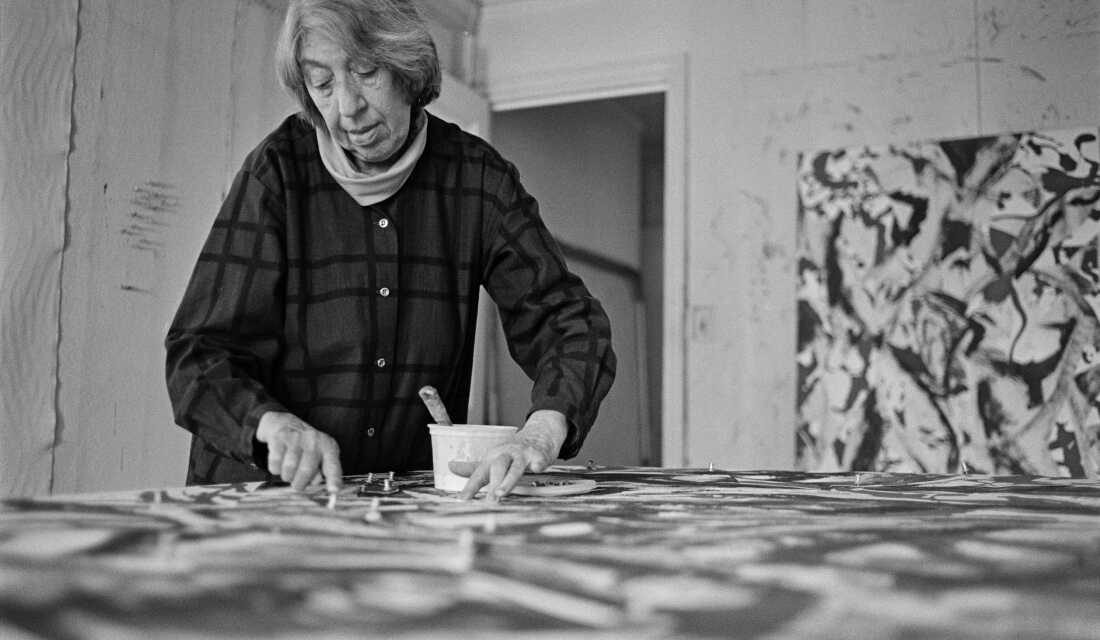
In a 1978 interview, Lee Krasner was asked about her activities while her husband, Jackson Pollock, was gaining fame. She simply said, “I was working all the time.” This statement reflects her dedication and work ethic. A 1981 photo captures Krasner immersed in her creative work.
Currently, a significant exhibition titled Past Continuous is taking place at the Metropolitan Museum of Art in New York. It features both Jackson Pollock and Lee Krasner. Pollock’s renowned “drip” paintings share the spotlight with Krasner’s work, allowing her to finally receive recognition in her own right.
The exhibition highlights more than 120 pieces, with 74 from Krasner and 48 from Pollock. Viewers are immediately drawn to a 1955 Krasner collage. Brinda Kumar, one of the exhibition curators, describes her collages as pivotal moments in Krasner’s career. One such work, Bald Eagle, showcases a vibrant mix of colors, borrowing from Pollock’s discarded pieces of the time.
The exhibition encourages a comparison between the works of Krasner and Pollock. It displays how Krasner’s collages stand alongside Pollock’s famous drip paintings. Curator David Breslin points out that while these works share a space, they retain their distinct histories, much like individuals in relationships do.
One of Pollock’s classics, Convergence from 1952, is strategically placed to benefit from natural light, evoking a modern gallery’s energy. This exhibition implicitly engages with the public perception of Pollock as a genius and Krasner as a supportive partner. Krasner was aware of these narratives but remained steadfast in her work.
Krasner was also mindful of her place as a female artist. Despite Pollock’s more prominent career, she took steps to shape her journey. Krasner chose to live in Springs, NY, away from the distractions of Manhattan, providing Pollock space for his art while she painted in more constrained conditions.
Reinvention was key to Krasner’s artistry and life. Born Lena Krassner in Brooklyn, she came from a Ukrainian Jewish background with no art influence. She changed her name several times, ultimately becoming Lee Krasner. An integral figure in New York’s art community, she kept evolving her style, often embracing new ideas every few years.
Journalist Mary Gabriel notes that unlike Pollock, Krasner’s style was in constant evolution, reflecting a commitment to exploration in art. Her works, like the detailed “Little Images” from the late 1940s, paved the way for more expansive pieces, particularly after Pollock’s death in 1956.
Pollock’s life was marked by struggles with alcoholism and personal issues, including infidelities. After his death, Krasner managed his legacy prudently, significantly raising the sale price of one of his notable pieces, Autumn Rhythm (Number 30). This set a new standard in modern art valuations.
In the exhibition, Autumn Rhythm finds a fresh backdrop, enhancing the visualization of its swirling elements. Krasner, invigorated post-Pollock, took over his studio barn. She produced expansive and jubilant artworks, as observed in The Seasons, a 17-foot wide painting filled with organic shapes and vibrant colors.
This show, titled Krasner and Pollock: Past Continuous, runs at the Met until January 31, allowing Krasner to claim her rightful place in art history.
 Exploring Troye Sivan’s New Album: ‘She’s the Best’
  George Clooney Discusses Heartbreaking Loss of Presley Gerber
  LA Knight’s Last Stand at Money in the Bank
  WWE Women’s Tag Team Championship Changes Hands on SmackDown
  Roman Reigns Retains Title Against LA Knight at Money in the Bank
  Thrilling Moments at WWE Money in the Bank 2026