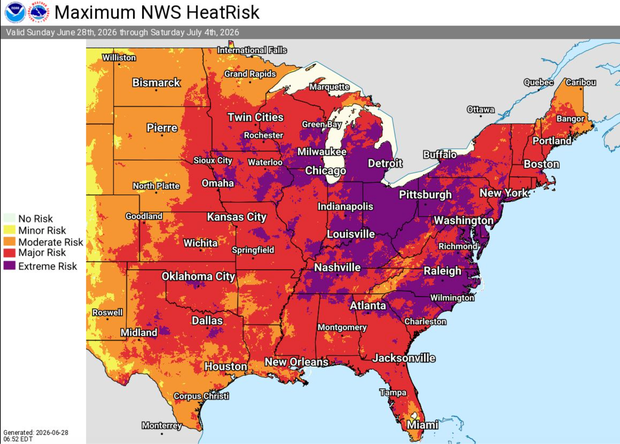
The National Weather Service has issued warnings of a significant heat wave sweeping across a large part of the United States this week. This comes as temperatures climb with the upcoming July Fourth holiday, exacerbated by high humidity levels.
Several regions including the lower Great Lakes, mid-Atlantic, and the Mississippi and Ohio River valleys will experience several days of high temperatures. Major cities like New York, Philadelphia, Washington, and Baltimore on the East Coast, as well as Midwestern and Great Lakes cities like Chicago, St. Louis, and Detroit will feel the heat. The South will also see high temperatures, affecting cities such as Dallas, Little Rock, and Memphis.
The heat is expected to persist into next weekend across the Great Plains, Southeast, and mid-Atlantic. Officials note that this marks the first widespread heat wave of the summer, affecting over half the country. While the central and eastern U.S. overheats, the Four Corners area will face dangerous fire weather conditions. Severe thunderstorms and flood concerns stretch from the Rockies into the Mid-Atlantic.
The National Weather Service predicts temperatures will soar well into the 90s and low 100s Fahrenheit (mid to high 30s Celsius). High humidity will push heat indices to between 100 and 110 degrees Fahrenheit (40 to 43 Celsius), reaching up to 115 F (46 C). Nighttime lows, ranging from 70 to 80 degrees Fahrenheit (21 to 26 Celsius), will offer little relief.
A heat index map released on June 28, 2026, by the National Weather Service, shows extreme heat across the eastern two-thirds of the U.S.
The heat index combines temperature and humidity to indicate how conditions feel, highlighting risks during extended exposure or intense activities. Phoenix, Las Vegas, central Texas, and much of the southwest already experience heat around 100 degrees F.
During high temperatures, the weather service advises limiting outdoor activities, staying hydrated, and ensuring access to air-conditioning. According to the CDC, heat affects everyone. Overheating signs include muscle cramps, dizziness, excessive sweating, breathing difficulty, headaches, weakness, and nausea.
While much of the U.S. swelters, the West remains unusually cool, with the Northwest and northern Rockies seeing temperatures 20-35 degrees below average.
Similarly, Europe has faced extreme heat, with Germany recording a new high of 106 degrees Fahrenheit over the weekend. Other affected countries include Switzerland, the Czech Republic, Denmark, and France, where numerous drownings occurred as people sought relief in water sources.
 Nikole Hannah-Jones Reflects on Educational Choices for Her Daughter
  Life and Challenges at Chennai’s Kasimedu Fishing Harbour
  Chicago Bears Eye Potential Move to Indiana: A Look at the Developments
  Amazon Offers Discounts to Employees at Whole Foods
  Inside the American Airman Rescue Mission in Iran
  Trump Comments on China’s Surveillance Amid Reports of Aid to Iran