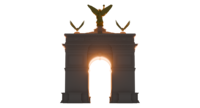
Washington, D.C. is known for its carefully planned geometry and sight lines. Among these is Arlington National Cemetery, visible from the Lincoln Memorial and separated by the Potomac River. President Donald Trump has proposed a 250-foot arch that would significantly alter this space.
Effect on Arlington Cemetery
The Washington Post conducted an analysis using a detailed digital 3D model. This model predicts that the arch’s shadow would touch burial sites in Arlington on 284 days each year. Famously, it would obscure Kennedy’s eternal flame on 18 of these days and his memorial on 50 days. The Military Women’s Memorial would see shade on 109 days. Shadows would also move across graves of veterans from numerous wars and headstones of formerly enslaved individuals, affecting over 75,000 graves in total.
Most days, shadows would recede by 8 a.m. when the cemetery opens, except for 26 days when they linger longer. While the White House views the arch as an enhancement to the visitor experience, others express concerns about its impact.
Design Concerns
Many historians and architects are troubled by the arch’s massive size and its proximity to the cemetery. The design, they argue, disrupts the historic character and planned spacing of Washington’s landmarks. Neil Flanagan, an architect and historian, emphasizes that the open space between significant structures is as important as the landmarks themselves.
Others, like historian Micki McElya, focus on the symbolism. She believes that casting shadows on a military cemetery is uncomfortable, even if brief.
Casting Long Shadows
The Post’s analysis also shows that at sunset, the arch’s shadow would stretch across Arlington Memorial Bridge, reaching additional monuments. In the morning, Kennedy’s grave is shadowed in spring and summer, while in the evening, Lincoln’s memorial is shaded in fall and winter. Parts of the Martin Luther King Jr. Memorial and the Reflecting Pool would also see shadows.
These shadows, while theoretically benign, take on heavier meanings in such historic spaces. For example, the VoteVets advocacy group argues the arch overwhelms the cemetery with its shadow, particularly on visits by families to loved ones’ graves.
Legal and Policy Considerations
The proposed arch, taller than Paris’s Arc de Triomphe, faces legal challenges. A lawsuit from veterans argues the arch harms the cemetery’s experience. The Trump administration is considering changing laws to allow construction surpassing current height limits.
Meanwhile, an eternal flame is proposed for the arch, casting additional shadows on significant memorial sites, emphasizing the ongoing debate about the project’s importance and appropriateness.
Methodology
The Washington Post’s analysis based its 3D model on plans submitted for the arch. Using lidar data from the U.S. Geological Survey, it simulated shadows by day and season using Blender tools and NOAA sun positioning data. They compared results to real satellite images for accuracy. Tree shadows were excluded for clearer analyses of the impact on graves.
This investigation and resulting story were managed and edited by a team of experts and journalists dedicated to depicting the monument’s potential consequences on historical grounds accurately.
 Chicagoans Debate Daylight Saving Time Amid Legislative Stalemate
 Central Park Rape Incident and Political Silence Create Controversy
 Helicopter Rescue Saves Stranded Climbers in California Mountains
 MAGA Supporters in Michigan Rally Behind Trump Amid Challenges
 Illinois Man Charged for Threatening Congress Members
 La Grange Park Pilot Project Aims for Pedestrian-Friendly Enhancements