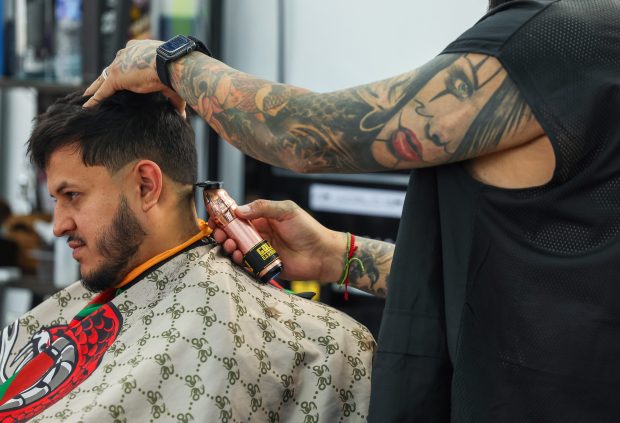
Springfield — In the aftermath of federal immigration raids in Chicago last fall, local immigrant-owned businesses have faced significant challenges. Erick Camargo, who runs a hair salon in the city, experienced a dramatic drop in walk-in customers, from around 40 daily to as few as five. During the operation known as Midway Blitz, Camargo locked doors during business hours to prevent entry by agents. Some barbers opted to work from home. Customers at Epic Studio Barbers & Stylist in the Belmont Cragin neighborhood became cautious, arriving alone and quickly entering the salon to avoid interactions with immigration officers.
Two community figures—a young boy selling chocolate to care for his blind parents and a woman selling tamales—were detained and have not been seen since. Camargo empathized with customers who stayed away, understanding their fear. He chose not to encourage them to visit, as he felt responsible for their safety.
Six months on, the fallout from the raids has left businesses in immigrant neighborhoods struggling to recover. Policymakers in Illinois are contemplating ways to assist businesses like Camargo’s. Two proposals are under consideration. One suggests establishing a $50 million grant program managed by the Illinois Department of Commerce and Economic Opportunity (DCEO). The other, which cleared the House, proposes a loan program for small businesses during declared “economic shocks”—defined by reduced foot traffic, sales drops, workforce disruptions, and business closures. Following models from states post-COVID-19, DCEO would offer loans up to $50,000, at a fixed 2% interest over five years, with an initial six-month grace period on repayments.
Both initiatives are limited to small businesses. Grant eligibility is capped at 25 employees, while the loan program applies to businesses with up to 50 employees and annual revenue under $3 million. Camargo’s salon could benefit from both proposals, although his business remains impacted. Bills continue to arrive, and costs have risen.
Senator Mike Simmons, a Democrat from Chicago sponsoring the grant program, believes it offers vital direct help to businesses unable to absorb debt. Simmons highlighted the prolonged impact of the raids, emphasizing support for affected neighborhoods.
Nonetheless, the proposals face uncertainty. Governor JB Pritzker’s budget did not allocate new spending. In the legislative session’s closing days, fiscal demands and a potential deficit challenge lawmakers. A spokesperson for DCEO noted support for small business aid, but further funding would need budget adjustments.
Efforts to assist businesses harmed by immigration sweeps extend beyond Illinois. A study by Los Angeles County indicated that 44% of interviewed businesses lost more than half their revenue following similar raids. Minneapolis observed $81 million losses among small businesses due to Operation Metro Surge. Minnesota lawmakers approved a $100 million loan program, stalled due to a party-line deadlock in the House.
A Challenging Environment
Chicago’s two-month operation, targeting alleged criminal immigrants, resulted in 2,500 deportations and 3,800 detainments. Most of the detained individuals had clean criminal records. Only 1.5% were convicted of violent felonies or sex offenses, per a Chicago Tribune analysis. The operation followed comments by President Trump labeling Chicago as a “hellhole” and “war zone,” criticizing sanctuary policies for safety concerns.
The operation’s economic repercussions were immediate. Marcos Carbajal, co-leader of Carnitas Uruapan in Pilsen, described the situation as a “nightmare.” Sales at his Pilsen and Gage Park locations fell 25% to 30%. Little Village, known as “Mexico of the Midwest,” saw a 40% drop due to arrests of locals, including vendors and citizens.
Carbajal took measures such as locking doors, customer screening, and tracking ICE alerts. He reduced operating hours, trimmed costs, and relied on reserves to manage financial impact. Business operations turned negative, with ongoing sales losses.
Others shared similar struggles. An unnamed plant distributor and nursery owner faced a decrease in landscaping jobs and public traffic. Security measures and emergency contact updates became necessary.
According to the owner, the industry might have retained more individuals if safety was assured during that traumatic period. Despite unknown precise losses from Operation Midway Blitz, widespread impact is acknowledged by Hilda Alvarez Rodriguez at the Illinois Hispanic Chamber of Commerce. The operation’s end, coinciding with winter and rising inflation, complicated recovery.
Alvarez Rodriguez noted widespread income reductions and staffing cuts, turning many establishments into “ghost towns” during the operation’s duration.
Andres Solarte from the Illinois Hispanic Chamber of Commerce anticipates better insight on revenue losses through forthcoming tax filings. Solarte champions the loan program as necessary for ongoing Chicagoland recovery, improving economic resilience statewide. He calls for vital state assistance to help businesses endure the repercussions.
Solarte articulated that businesses don’t seek handouts, but instead require adequate means to manage challenging conditions.
 Debate Over ICE Action in Austin Escalates
  Hayden Panettiere’s Cause of Death Ruled Accidental Due to Drug Toxicity
  Two Pilots Killed in Helicopter Crash Fighting Yosemite Park Wildfire
  Alarming TSA Discovery: Hidden Object Found in Flashlight
  Homeland Security Takes Action Against Voter Fraud
  Evacuation Orders Issued in La Verne Due to Battery Fire