A significant milestone was reached at UC San Diego, where doctors successfully used $20,000 humanoid robots to perform remote gallbladder surgery on a pig. This demonstration of artificial intelligence suggests new ways to address surgeon shortages and enhance global healthcare access. However, the use of artificial intelligence in such capacities raises questions about privacy and security, particularly with innovations like the $8,000 home robot for chores.
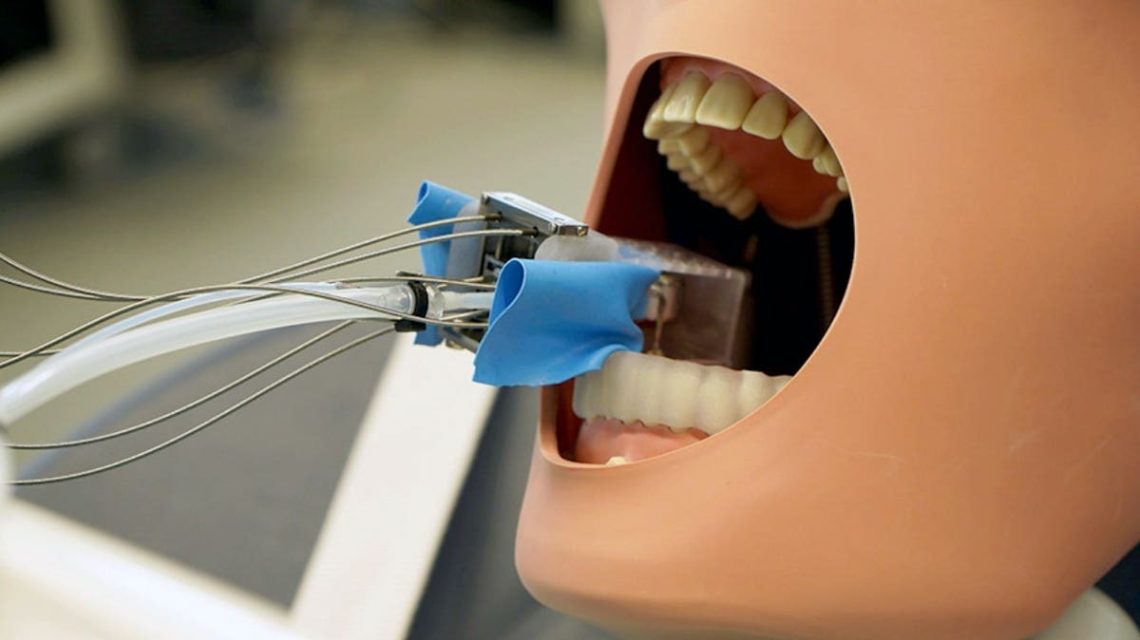
Advancements aren’t limited to surgical applications. At the University of Basel in Switzerland, researchers are developing a small dental robot named MIR, or Miniature Intraoral Robot. This prototype, designed to assist in preparing teeth for crowns, aims to minimize dental visits and optimize procedures through a digital workflow.
Nobody hears ‘you need a crown’ and feels excited.
MIR could revolutionize dental care by preparing teeth more efficiently. The idea might be daunting, but innovations like these could reduce the need for multiple dentist appointments.
MIR: A New Dental Approach
The MIR device connects to larger external motors and control mechanisms via flexible drive shafts, cables, and tubes, keeping the bulk outside the mouth. The University of Basel underlines that this approach aims to create a streamlined, digital treatment workflow for tooth preparation. The robot’s ability to fit comfortably in an open mouth is crucial to its potential success.
The development team is integrating sensors and cameras into MIR to monitor treatments in real-time, an essential step before the robot becomes viable for patient use.
How MIR Operates
MIR works by attaching to a dental splint that fits the patient’s mouth, allowing the robot to move synchronously with the patient. Typically, it employs a wider drill for initial surface reduction and a finer one for detailed work along the sides of teeth.
Tests on synthetic tooth models showed that positional errors were minimal, under 0.2 millimeters, even without sensors. Forces during operation were kept low, comparable to the gravitational force of a small water bottle.
Challenges and Prospects for MIR
The MIR is not yet ready for dental practice. Further refinement is needed to ensure the robot’s positioning is accurate and self-aware. Added sensors and monitoring systems will be crucial for its development.
MIR is a collaboration by researchers from the University of Basel, the University of Zurich, and several industry partners. Funded by Innosuisse, findings have been published in reputable journals, highlighting its research significance.
While dental robots like MIR are advancing, widespread adaptation into practical dentistry remains on the horizon. The innovation promises faster and more precise dental treatments.
Technology continues to change areas like dentistry, offering potential for improving patient experiences and reducing visit frequency. Although MIR is in prototype stages, its development underscores ongoing efforts to digitize and refine medical processes.
 Medical Diagnosis Errors: Understanding the Crisis
  Data Centers Stir Controversy in Texas Amid Growth Boom
  Lymphatic Drainage and Ice Sculpting: Emerging Wellness Trends
  The Technology Rivalry: Trump’s Meeting with Xi and the AI Ecosystem Clash
  Ways to Protect Your Finances from Cyber Threats
  Interview with Nvidia CEO Jensen Huang: AI Outlook and Business Strategy