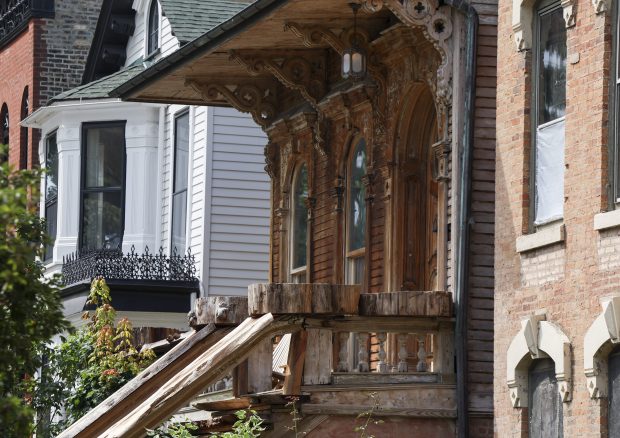
Elizabeth and Hunter Case imagined a serene family life in their Old Town home, foreseeing children filling the open spaces and holiday traditions taking root. Instead, they faced unexpected challenges: medical appointments and legal battles, anticipating the problems might have been avoided with more attention to their neighbor’s activities.
Unauthorized Changes to Historic Property
The issue centered on an Old Town property owner making unlawful alterations, impacting both its historical significance and the safety of residents. Known as the Wacker House, this building has graced Chicago’s North Side for over 150 years, surviving the Great Chicago Fire. Despite its historic protection, unauthorized work overshadowed the structure, confirmed by neighbors and city records.
Starting in 2023, the ongoing construction led to over two dozen service requests to city departments, three stop work orders, and a federal inspection. For the Cases, who live next to this landmark, the concern went beyond preserving history as the construction invaded their lives.
Health Concerns and Legal Struggles
In the early days of construction, the Cases noticed their child, then just a toddler, was affected by lead poisoning. They attribute this to their neighbor’s improper removal of lead paint. Despite numerous pleas to authorities, they faced persistent inaction. “It just felt like we were spinning our wheels,” Elizabeth stated.
The local group, Old Town Triangle Association, joined in the effort to stop the modifications, urging action against the ongoing construction. Attempts to reach the homeowner, Michael Gancarz, have been unsuccessful.
The Historical Legacy
The Cases, living in Old Town since 2021, chose their home for its unique character and storied past. The neighborhood, initially settled by German immigrants in the 1850s, included Frederick Wacker, a prominent Chicago brewer. The Wacker House, rebuilt after the Great Fire, anchors the historical Old Town Triangle District, a notable landmarked area.
Lead Exposure Risks
Renovation signs appeared in 2022, with the Cases growing concerned as visible paint removal progressed the following spring. Their daughter was only seven months old when they noticed dust and debris from the neighboring construction.
“Hi! I hate to be the annoying neighbor, but we are concerned about the amount of dust and airborne debris from the paint stripping. It’s everywhere, and we are nervous about the baby spending time outside,” Elizabeth messaged to Amelia Gancarz.
Their communication about the situation broke down, further strained by family worries. In late fall, the child’s blood test revealed elevated lead levels, prompting immediate inspections by local health authorities. The findings pointed to lead hazards both at the Cases’ property and the Wacker House.
Efforts and Responses
Despite stop work orders and city intervention, unauthorized construction continued. The Cases moved temporarily as their home underwent cleaning and independent lead assessment revealed extensive contamination traced to the neighboring property’s construction.
Deborah Schwartz from Lurie Children’s Hospital explained that lead exposure can lead to serious long-term effects such as neurological damage and reduced IQ, with varied impacts among children.
Enforcement and Frustration
Chicago’s landmark ordinance requires thorough vetting for building permits on historic properties, yet enforcement was lacking. Since 2012, two renovation permits were issued, each specifying no structural work and adherence to existing conditions. Numerous complaints regarding violations piled up with city departments.
The Cases sought intervention from local officials but faced limitations in enforcement, exacerbated by the homeowner’s non-compliance. They turned to federal agencies, including the EPA, but lacked insight into investigation proceedings.
Continued Struggles
By 2024, the Cases returned home, their daughter’s condition improving. Despite ongoing construction, temporary stop work orders, and legal threats, significant measures toward resolution remained elusive, leaving them disenchanted by seemingly inadequate responses to their plights.
Currently, the Old Town Triangle Association rallies support to enforce landmark protections. As authorities pursue enforcement, the Cases watch with guarded optimism. Their experience highlights complex challenges in private property governance.
Though weary from their ordeal, their resolve endures. They focus on nurturing a safe, welcoming home for their growing family, acknowledging this as within their control as they navigate the lingering impacts of the past years.
 Historic Church Transformed Into Los Angeles Boutique Hotel
  Amazon Offers Discounts to Employees at Whole Foods
  Hidden Fees in Real Estate Transactions: A Growing Concern
  Trump’s Childhood Home Sells for Nearly $2 Million After Renovation
  Luxury Five-Bedroom Home with Rooftop Deck in Edgewater
  Trump’s Housing Affordability Agenda Faces Challenges