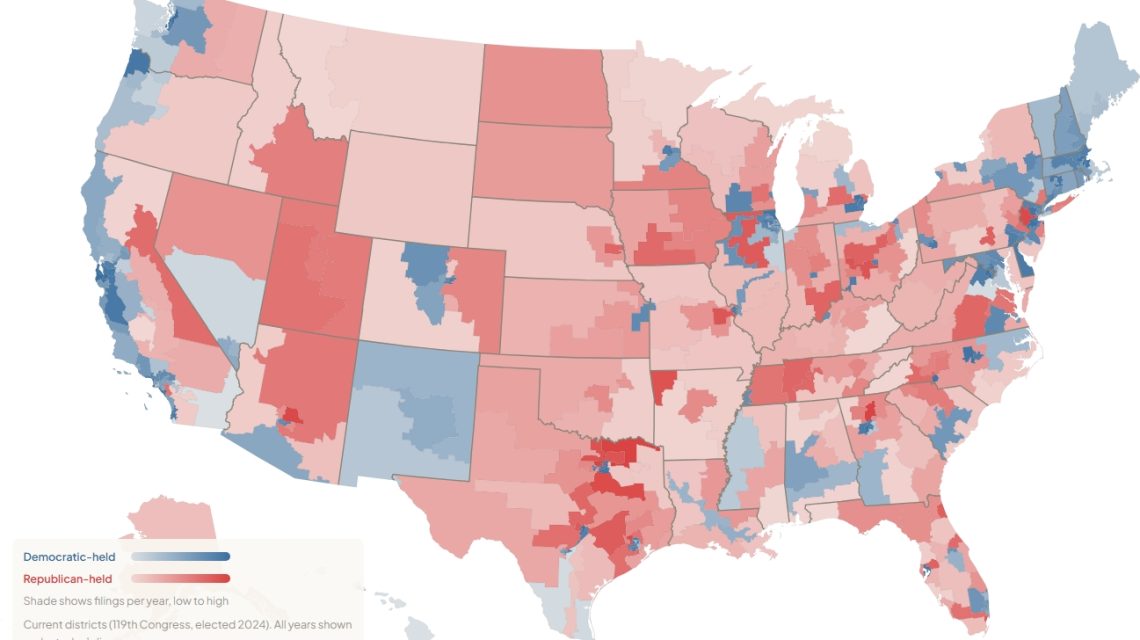
An analysis of federal labor data reveals that Democratic congressional districts accounted for substantially more certified H-1B labor filings compared to Republican-held districts over the past decade. LayoffHedge, a data analysis firm, mapped nearly 6.9 million certified Labor Condition Applications (LCAs) to current congressional districts. They found that Democratic districts were associated with 5.17 million filings from fiscal 2015 to the second quarter of fiscal 2026. In contrast, Republican districts accounted for 1.69 million filings. Additionally, four vacant districts contributed 56,596 filings.
Despite this overall trend, the pattern of growth differed. The eight districts with the fastest growth in H-1B filings between fiscal 2019 and fiscal 2025 were all represented by Republicans from Texas. This data, however, reflects only certified LCAs and not the number of visas issued or individual workers. Notably, a single LCA can request multiple workers, and a worker might be associated with multiple filings due to extensions or changes in employment.
“The data shows where employers asked to place the work. It does not show that either party causes or drives H-1B usage,” a spokesperson for LayoffHedge stated to Newsweek.
These findings emerge as the Trump administration seeks to enforce stricter immigration rules, impacting the H-1B program. The administration has transitioned the H-1B lottery system to prioritize higher-paid workers, applied existing biometric screening fees to certain H-1B extension petitions, and proposed eliminating a 60-day grace period for laid-off H-1B workers remaining in the U.S. A proposal to impose a $100,000 fee on some new H-1B applications was blocked by a federal court.
MAGA movement advocates argue that the H-1B program sometimes displaces American workers unnecessarily. Supporters argue that limiting skilled foreign workers could hinder U.S. companies in the global market.
A LayoffHedge spokesperson highlighted that the location of work, not always discussed, is embedded in each filing, which they mapped to congressional districts. Democratic-held districts, especially those in major tech and business centers, had the highest concentrations of filings. The top Democratic district, California’s 17th, represented by Rep. Ro Khanna, had 323,966 filings. New York’s 12th District, with Rep. Jerrold Nadler, followed with 259,001 filings, and California’s 16th, represented by Rep. Sam Liccardo, had 233,165 filings.
Among Republican districts, Texas’ 4th District, with Rep. Pat Fallon, led with 106,892 filings. Georgia’s 7th District, represented by Richard McCormick, had 96,705, while Texas’ 24th District, represented by Beth Van Duyne, had 81,784. Together, the ten top-ranking districts saw 1,727,766 filings, a count slightly exceeding all 219 Republican districts’ total of 1,694,909 filings. This high concentration illustrates a distribution pattern specific to certain districts rather than a general trend across parties.
Including nonvoting Del. Eleanor Holmes Norton’s at-large district in D.C., which recorded 38,814 filings, contributes to the Democratic totals. Without D.C., 212 voting Democratic districts had 5,133,801 filings. The analysis based its figures on current congressional district boundaries, not necessarily the party in charge when filings were made.
LayoffHedge affirmed mapping 99.5% of records, using ZIP codes and geographic files, but excluded irreconcilable data. Their research showed that 40 districts accounted for half of all filings, 55.3% originating from the 50 largest districts. Democratic districts were primarily in tech and business hubs, while staffing firms dominated filings in the highest-volume Republican districts. These classifications were internally developed by LayoffHedge, not drawn from Labor Department data.
Newsweek editors John Fitzpatrick and James Debens are handling this story.
 Opposition to Border Infrastructure in West Texas Raises Concerns
  Senator Marshall Criticizes Fauci Over Vaccine Concerns
  Jennifer Balkcom Named GOP Nominee for North Carolina’s 11th District
  Impact of Anti-Immigration Policies on U.S. Economy and Society
  Justice Department Opinion on Executive Privilege for Private Advisers
  Haley Stevens Supports Abdul El-Sayed After Primary Loss in Michigan