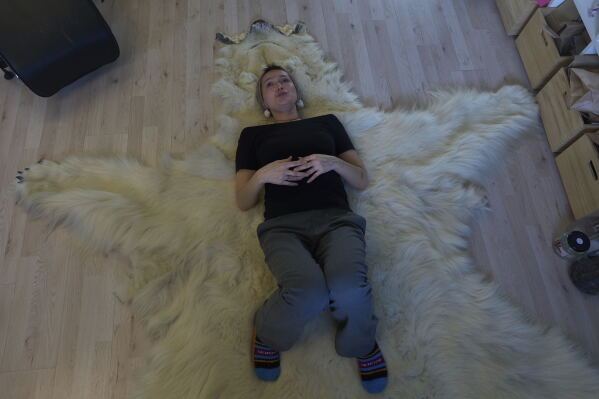
In Nuuk, Greenland, Aviaja Rakel Sanimuinaq sits on the pelt of a polar bear her family hunted. Proud of her heritage, she participates in a movement to revive Inuit traditions and spirituality. As a shaman with Inuit facial tattoos, Sanimuinaq practices spiritual healing to connect individuals with their ancestors and address generational trauma. Her studio in the capital stands as a testament to ancient wisdom in today’s world.
Across Greenland, there is a revival of pre-Christian Inuit customs, such as drum dancing and cultural tattoos. For many, this resurgence represents a reclamation of ancestral roots. It also serves as a challenge to the influence of European Christian missionaries who began colonizing Greenland in the 18th century. These missionaries sought to suppress Inuit traditions, branding them as pagan. Sanimuinaq shares, “Christianity’s sacredness remains in my eyes, alongside Buddhism, Hinduism, and my ancestral work.” Her studio, adorned with seal skulls, raven feathers, and medicinal herbs, supports her spiritual endeavors. Through her work, the angakkoq or shaman communicates with the spiritual realm known as “silam aappaa.” She believes that recognizing the legitimacy of her culture is essential for equality and space in society.
The Inuit have survived in Greenland’s harsh, remote landscapes for generations, relying on hunting seals, whales, and polar bears. Traditional Inuit religion is animist, rooted in the belief that all elements of nature possess spirits deserving respect, as noted by Gill and Alistair Campbell in their travel book “Greenland.” Although around 90% of the 57,000 Greenlanders identify as Inuit, the majority belong to the Lutheran Church, brought to Greenland by a Danish missionary over 300 years ago. Today, Greenland remains a semi-autonomous part of Denmark, with growing calls for independence, fueled partly by global attention after political events involving former U.S. President Donald Trump.
This awakening is seen as empowering for Greenlanders. “We no longer have to stay silent,” says Sanimuinaq. “Our voice can be heard. We now enjoy greater freedom.” The significance of “Tunniit,” the traditional tattoos, extends beyond physical appearance to spiritual and social values. According to Asta Mønsted, a professor at the University of California, Berkeley, who studies Inuit oral history, missionaries linked tattoos to paganism. During earlier colonization, tattoos along with drum songs were categorized as superstitions, and subsequently suppressed.
Mønsted explains that drums and tattoos held immense importance to Inuit cosmology and social practices. Drum songs facilitated conflict resolution and entertainment, while tattoos marked crucial life phases, protecting against ailments and malevolent spirits. Despite the suppression, some regions preserved these customs secretly.
Resistance to tattoos meant many Greenlanders avoided them for fear of societal repercussions. Therecie Sanimuinaq Pedersen, Aviaja’s mother, recounts her grandmother concealing her tattoos with soot to avoid alienation. Only in recent times did both of them adopt the tattoos, reclaiming their heritage. “The tattoos on my face connect me to my ancestors,” says Therecie, noting the joy of encountering others with these tattoos today.
Drum duels, or “qilaat,” once resolved conflicts through songs and exaggerated body movements. These performances entertained and determined outcomes based on community laughter. Societal judgment sometimes led to exile from the community, a dangerous fate in Greenland’s icy terrain.
Greenland’s political status evolved over the years, transitioning from a colony to a semi-autonomous region with home rule. The transition from colonial rule to self-governance has empowered Greenlanders to address previous abuses. These include the forced relocation of Inuit children and imposed population control measures during the 1950s and later. As Greenland faces a higher profile on the world stage, many residents re-embrace Indigenous traditions to advocate for independence and cultural integrity.
Naja Parnuuna, a singer-songwriter, highlights the significance of this cultural resurgence. “Our culture is deeply spiritual,” she says. “I want to reconnect with it and inspire my peers.” Although influenced by Western perceptions during her youth, she now takes pride in her roots and incorporates Inuit drums and traditions into her songs. Her father, Markus Olsen, shares this sentiment. He integrated drum dancing in church services, despite risking dismissal, to restore the drum’s cultural significance. Inspired by global justice movements and figures like Martin Luther King Jr., he recognizes the need for cultural and social justice.
Parnuuna draws strength from her father’s actions, channeling them into her music as an expression of identity and heritage. “It’s vital to embrace our roots, fostering self-respect and a positive outlook on life,” she concludes. Through embracing tradition, Greenlanders find a path to cultural revitalization and community empowerment.
 Canada’s Tariff on Chinese Electric Vehicles: Business Influence and Security Concerns
  Princeton Students Aid UN in Creating Digital Privacy Standards
  Exploring the Lucas Museum of Narrative Art
  The Cost of Challenging Beijing
  Tensions Escalate in Iran Conflict as Global Leaders Weigh Options
  White House Approves F-35 Sales to Saudi Arabia Amidst Regional Tensions