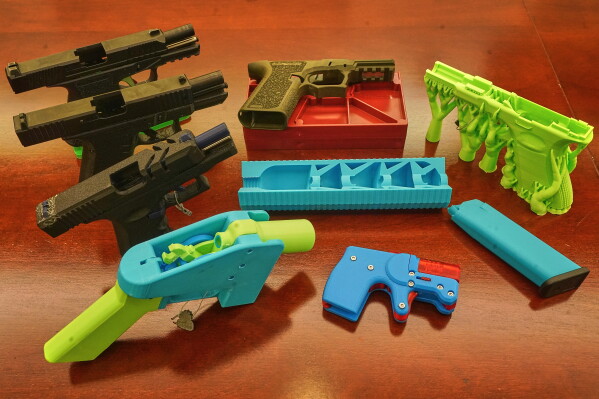
A pioneering law in New York seeks to mandate that 3D printers sold for home and business use include technology to prevent the creation of firearms. California is also considering similar measures. This initiative targets the latest method of manufacturing untraceable ghost guns, which are increasingly linked to criminal activities. However, doubts remain about the efficacy of this technology and its potential impact on privacy and constitutional rights.
State Actions Against Ghost Guns
Currently, about a third of U.S. states have moved to ban or regulate self-assembled firearms without serial numbers to bypass background checks required from federally licensed dealers. The new approach in New York and California focuses on the equipment used, not the individuals creating the weapons. By imposing standards for 3D printers, these efforts could influence industry practices. This regulatory model may appeal to other states led by Democrats, which often have stricter gun laws, including bans on certain semiautomatic weapons.
3D Printer Market and Ghost Gun Concerns
Over the past two decades, 3D printing technology has become more widespread. From 2012 to the present, the number of 3D printers globally has surged from 30,000 to more than 3 million. Consequently, the industry’s value has grown from approximately $2 billion to $26 billion annually, according to Bill Decker, executive chairman of the Association of 3D Printing. Although some printers cost thousands of dollars, others are available for a few hundred dollars. These devices can produce various items, including toys and airplane parts, and crucially, they can create firearm parts from digital blueprints.
Firearms manufactured with 3D printers are increasingly found at crime scenes. A U.S. Department of Justice report noted an increase in untraceable, privately made guns recovered in crimes, from around 1,600 in 2017 to nearly 27,500 in 2023. However, the report did not specify how many of these weapons originated from 3D printers.
Potential Technology to Block Firearm Production
Legislative proposals in New York and California intend to form expert panels to develop standards for detecting and blocking firearm blueprints during the 3D printing process. The technology would scan digital designs, compare them against a database of firearm parts, and prevent printing if similarities are found. Although the study initiates soon, the actual requirement for 3D printers to include such technology might not be enforced until 2029, depending on feasibility.
The concept resembles a smartphone app that recognizes plants from photos, as highlighted by Solomon Diamond, an engineering professor at Dartmouth College. Julian Chultarsky, a technical account manager at Physna, emphasized the technical readiness of geometric search algorithms to tackle this issue.
Challenges and Criticisms
Despite support from the Association of 3D Printing for new legislation, critics like Decker argue that the measures are more symbolic than practical. Criminals may alter designs or shift production methods to circumvent the rules. Aggressive enforcement might also accidentally block legitimate items. Rory Mir from the Electronic Frontier Foundation points out that such algorithms often incorrectly target and block legitimate content. Additionally, using cloud-based AI for search functions threatens privacy.
Debate on Right to Bear Arms and 3D Printing
3D printers offer a pathway for those who cannot legally buy firearms, such as minors and felons, according to gun safety proponents. Presently, 11 states ban 3D-printed guns, while six others require serial numbers. By preventing the actual 3D printing, it could be harder to circumvent these laws.
Gun advocates like the National Rifle Association (NRA) argue that home-built firearms have historically been a part of American tradition. They contend that new measures impede law-abiding citizens from engaging in constitutionally protected activities.
 Google Fined for Breaching EU Privacy Rules
  AI-Powered Malware Raises Concerns Over Security
  Debate Continues Over Virginia’s Data Center Energy Plans
  Trump Suggests Renaming AI to ‘Super Intelligence’
  The Rise of Data Centers and AI Development
  How China Uses AI to Challenge U.S. Dominance