
Understanding Gerrymandering in U.S. Politics
As the United States prepares for the upcoming midterm elections, nearly 35 million Americans will cast their votes in newly redrawn congressional districts. This change comes amidst ongoing debates over the creation of political maps. On the occasion of the nation’s 250th anniversary, the practice of gerrymandering is under scrutiny.
The Origins and Influence of Gerrymandering
Senior correspondent Judy Woodruff explores how gerrymandering has shaped American politics for centuries. This technique involves configuring electoral district boundaries to favor particular political parties. Despite its age, gerrymandering remains a potent political tool. It significantly affects election outcomes and legislative representation.
About Judy Woodruff
Judy Woodruff has an extensive background in covering political affairs. She served as an anchor and managing editor for the PBS News Hour. With a journalism career spanning over five decades, she has reported for networks such as NBC, CNN, and PBS.
Contributions by Lorna Baldwin
Lorna Baldwin has contributed as a producer at PBS NewsHour for nearly twenty years. Her diverse reporting portfolio includes topics like Flint, Michigan’s water crisis, tsunami readiness in the Pacific Northwest, and poverty politics in North Carolina. Internationally, Baldwin has reported on sea turtle nest poaching in Costa Rica and featured the unique architecture of Rotterdam. She has also covered notable landscape artist Piet Oudolf’s work.
 HHS Proposal to Regulate Compounded Peptide Drugs
 Federal Judge Rejects DOJ Request on Suspected Noncitizen Ballots
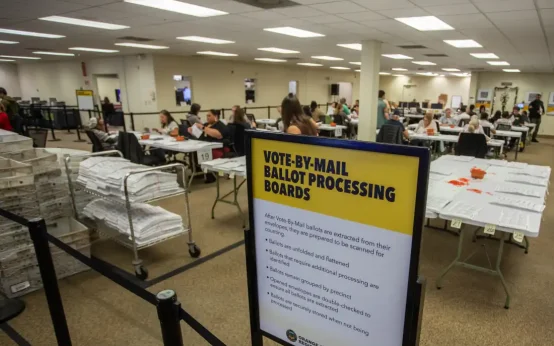 Federal Judge Denies DOJ’s Request to Segregate California Ballots
 Federal Judge Blocks Trump Administration’s Request in California Ballot Case
 Senate Race Heats Up: Democrats Eye Retaking Control
 Flávio Bolsonaro Labels Himself ‘President-Elect’ in Exile