In Northwest Indiana, economic challenges are affecting a significant portion of households. According to the latest Asset Limited, Income Constrained, Employed (ALICE) report, 39% of households struggle to afford basic needs. These essentials include housing, childcare, food, transportation, healthcare, and technology. This percentage equates to 114,782 households in the region. Across the state of Indiana, 38% of households—more than 1 million families—face similar difficulties.
ALICE households earn below the cost of living but above the federal poverty line. This positioning means these families do not qualify for assistance programs. Common professions among ALICE households include childcare workers, nursing assistants, and cashiers. From 2007 to 2024, the ALICE essentials index in Indiana rose by over 61%, surpassing the Consumer Price Index’s increase of 52%.
United Way Northwest Indiana President and CEO Chris White emphasizes the organization’s focus on addressing the needs of ALICE populations.
Even with wage increases, costs are rising “faster and faster,” White explains. In May, consumer inflation rates reached 4%. He challenges, “Whose paycheck got 4% bigger last month?” Indicating widespread financial strain, White points out difficulties in urban and rural areas alike.
To live in Indiana in 2024, a single adult requires a minimum income of $28,764 annually, while a family of four needs $74,028. These amounts nearly double the federal poverty thresholds of $15,060 for an individual and $31,200 for a family of four.
A detailed look at Northwest Indiana shows disparities. In Lake, Porter, Jasper, Newton, and Starke counties, 27% of households fall below the ALICE line, although above federal poverty levels. Moreover, 12% are below the federal poverty threshold. Lake County has the most households under the ALICE category, with 82,388 families, while Porter County follows with 22,396.
The report also highlights racial disparities. In Northwest Indiana, 57% of Black households and 41% of Hispanic households are in poverty or under the ALICE threshold. Statewide, 72% of single women-led households are below the ALICE level, with similar challenges faced by 49% of men-led households.
While targeted interventions offer short-term relief, the report argues for long-term stability solutions.
It calls for coordinated actions covering household support, community infrastructure, employer practices, and public policy to alleviate persistent hardships.
There is acknowledgment of efforts at the state level to reduce costs. These include Gov. Mike Braun’s temporary gas tax relief. However, high prices for rent, groceries, utilities, and healthcare persist across the state and nation.
White notes that discussions about struggling families often focus on entry-level positions. Yet, financial pressures are felt at all income levels. Families in Lake and Porter counties need annual earnings between $81,000 and $83,000. Despite notable salary increases over the last decade, cost escalations often outpace these raises.
There are concerns about federal support cuts affecting families hovering above poverty levels. White highlights the issue where benefits are abruptly withdrawn once families cross the poverty line threshold.
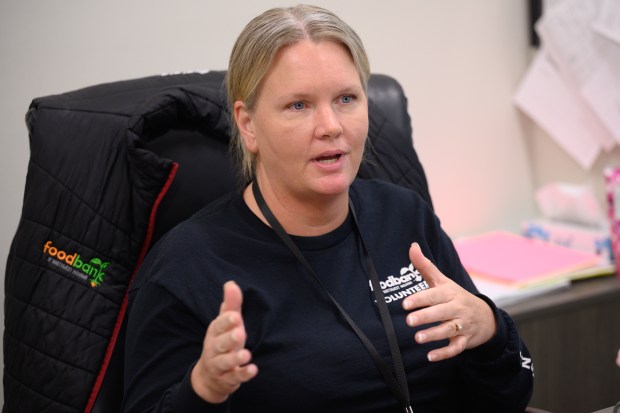
The Food Bank of Northwest Indiana actively addresses hunger across income levels, according to Vice President of Operations Tricia Sheaks. It serves 60,000 people monthly, distributing 900,000 pounds of food. The organization expects to deliver over 11.4 million pounds this year, surpassing previous records.
Food bank demand reflects rising living costs. Sheaks notes increased recipients due to elevated gas, food, and overall expenses.
She emphasizes the universal right to food access, advocating for healthy options like fresh produce.
Funded by various donors, including grocery stores and restaurants, the food bank also deploys 150 food pantries and regional smart food lockers.
Community Action organization CoAction sees growing demands for assistance mirroring report findings, says Director Lauren Zurbriggen. ALICE households struggle daily to meet basic requirements such as utilities and food.
“The ALICE report numbers validate what CoAction observes daily,” Zurbriggen states.
With several families heavily reliant on credit to manage their budgets, loan applications have seen an increase.
In recent months, the demographic for aid has shifted, displaying employed and family-raising individuals seeking financial relief.
The North Township Trustee’s Office reports a significant rise in utility assistance demands. Deputy Chief Virginia Carter outlines increasing requests regarding NIPSCO bill support.
St. John Township emphasizes the importance of offering long-term financial solutions alongside immediate aid, according to Trustee Cathy Lareau.
Lareau stresses the common misunderstanding of the depth of family struggles within communities.
She believes the ALICE report sheds necessary light on more widespread economic challenges than perceived.