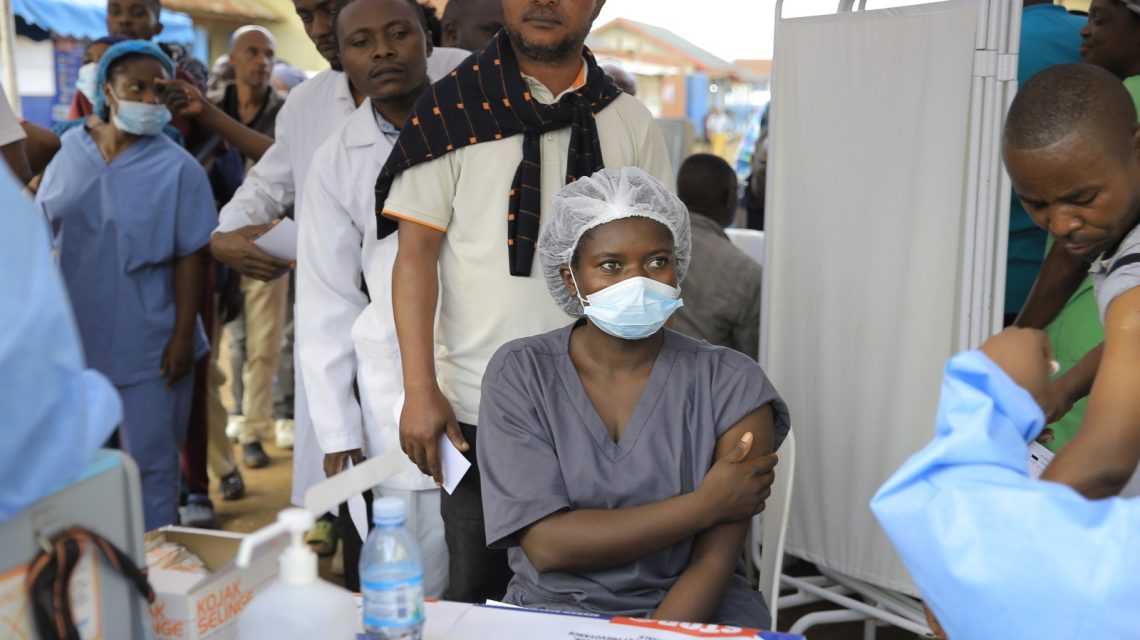
Nigeria has reported its first confirmed Ebola case in Abuja. The patient arrived from Uganda and was admitted to a private hospital before testing positive. According to Nigeria’s Health Ministry, health officials are tracing 44 people who had contact with the patient.
Nine cases have also been confirmed in Kenya, all within one known cluster. Health authorities indicate there is no spread beyond the known contacts of the first patient. This highlights the virus’s ability to cross borders.
Current Outbreak in the Democratic Republic of the Congo
The Democratic Republic of the Congo (DRC) is at the center of a much larger outbreak, with 9,066 confirmed cases and 4,381 deaths as of October 11. The crude case-fatality rate stands at 48.3 percent.
The outbreak, caused by the Bundibugyo virus, began in May and has also affected Uganda. The World Health Organization (WHO) reported that no approved vaccine or specific treatment exists for Bundibugyo virus disease, though early supportive care can improve survival rates.
Low Risk for the United States
The Centers for Disease Control and Prevention (CDC) stated that no Ebola cases linked to the current outbreak have been reported in the United States. The likelihood of spread to the U.S. is considered very low, with minimal risk to the public and travelers.
A WHO spokesperson underscored the importance of maintaining preparedness measures in nearby countries to quickly detect and investigate cases, activate response teams, and ensure cross-border coordination.
Kenya’s health ministry has received supplies, including protective equipment and testing materials, valued at about $70,000 USD to aid screening and response efforts. At present, there are no advised travel or trade restrictions with the DRC, Uganda, or Kenya.
Nigeria’s First Ebola Case
This first confirmed case in Nigeria signals a new challenge in the regional fight against the outbreak. The patient contracted Ebola after arriving from Uganda, where the disease was previously declared controlled.
In Kenya, all nine confirmed cases are linked to known contacts of the first patient, indicating no spread beyond this group. Authorities are focusing on contact tracing and observation of the 44 identified contacts.
Kenya’s Ongoing Situation
Kenya confirmed its ninth case recently, involving a family member of the first patient, who was already in quarantine. As of Tuesday, Kenyan authorities placed 134 individuals in quarantine linked to these cases.
The U.S. State Department has advised travelers to reconsider visiting Kenya, citing health risks and other concerns.
Ebola Mortality and Incubation
Ebola is a severe disease, often fatal, with an average case-fatality rate of about 50 percent. The current outbreak in the DRC has a crude case-fatality rate of 48.3 percent.
The incubation period for Bundibugyo virus ranges from two to 21 days, placing an emphasis on early detection and care.
International Spread and Risk
The DRC outbreak ranks as the second-largest on record. The situation extends beyond local boundaries, notably affecting Kenya and previously touching Uganda. The WHO rates the risk of spread very high within the DRC and high for neighboring countries.
The CDC maintains that no cases have been reported in the U.S., and the risk remains low. Meanwhile, the WHO continues to recommend vigilance, monitoring, and collaboration to mitigate further spread.
 Efforts to Free American Teacher Held in Russia
 Escalating Conflict Prompts U.S. Warnings in Middle East
 British Police Arrest Suspects in Alleged Iranian Plot
 Trump’s Influence in Israeli Elections and Netanyahu’s Political Future
 Dr. Vanessa Kerry Appointed as WHO Special Envoy for Health Resilience
 Egyptian Parliament Weighs Authorization for Military Support to Saudi Arabia