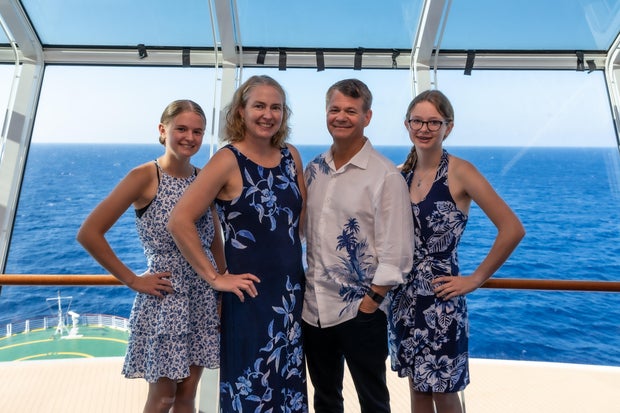
Dr. Sara Whittingham initially shrugged off her bouts of forgetfulness and occasional mid-sentence pauses. As an Air Force veteran, mother of two, and anesthesiologist, she attributed it to a hectic life. Her recent relocation from Utah to Ohio and the ongoing COVID-19 pandemic seemed to offer reasons for such lapses. Even her new stiffness seemed a typical sign of aging, having recently turned 46.
One evening in November 2020, during a family movie night, her husband noticed her arm trembling. “Like any doctor might do, I turned to Google,” Whittingham recounted. Her search brought up article after article about Parkinson’s disease. Initially, disbelief set in; for Whittingham, Parkinson’s seemed improbable at her age. Undeterred, she sought out a neurologist the very next day at the Cleveland Clinic, where she worked.
“He confirmed the diagnosis in the middle of my workday,” Whittingham said. The unexpected confirmation felt like a punch to the gut, halting the visions she held for her future.
Parkinson’s Disease and Exercise
Parkinson’s disease is a progressive condition impacting the nervous system. Signs start subtly, like Whittingham’s tremors, but escalate over time, explains the Mayo Clinic. Following her diagnosis, Whittingham found her mind consumed by fears of declining quality of life, accompanied by anxiety and depression.
She then discovered a study on cycling’s effects on Parkinson’s progression. A former runner with activity curtailed by her symptoms, the opportunity to participate appealed to her. “It ended up being a lifeline,” Whittingham noted. Increased cycling enhanced her well-being and reanimated her zest for life.
“The more I started riding the bike, the better I felt,” she expressed. “I felt like I was coming back to life.”
The study, led by Dr. Jay Alberts, noticed that aerobic exercise might alter Parkinson’s trajectory. Notably, patients cycling at 75 rotations per minute or more for at least 30 minutes several times weekly could slow disease progression. Alberts deemed it an “exercise prescription for Parkinson’s disease.”
Unlike traditional treatments directed by neurologists, this approach gave patients some control. Dr. Ben Walter, Whittingham’s neurologist, explained that exercise’s benefits likely stem from multiple factors. It not only counters physical symptoms but bolsters brain health too.
Participating in the study marked a new path for Whittingham. A few months in, her husband entered a half triathlon, involving running, biking, and swimming. Whittingham joined his swim practices and secretly registered, ultimately outperforming her husband in the race. Her ambitions only grew from there.
In 2023, she completed the Ironman World Championship. “I never, ever thought that would be something I would be able to accomplish,” Whittingham said. The moment she crossed the finish line and heard her name called as an Ironman three years post-diagnosis was indescribable.
“Set the Most Outrageous Goal”
Whittingham joined another study in 2025, this one exploring community exercise’s impact on Parkinson’s patients. The project examines changes when patients exercise in communal settings rather than isolated at home.
“Once you’re there, our energy feeds off each other,” Whittingham shared. “Seeing how the community inspires each other has been truly powerful.”
Beyond the trial, Whittingham continues to race and participated in a U.S. Paralympic Team qualifying event in 2024.
Whittingham has also embraced advocacy, speaking at a Michael J. Fox-hosted policy forum and joining a National Institutes of Health advisory council. She is crafting a book about her experience and hopes her story can inspire others.
“The brain is such a miraculous, adaptable organ,” she stated. “You don’t need to finish an Ironman, but set the most outrageous goal you can think of. Whether or not you achieve that goal isn’t the point. Taking small steps makes you stronger and gives you a purpose.”
 The Journey of Annelise Camp: A Family’s Battle and Tragic Loss
  Understanding N95 Respirators: What You Need to Know
  Ethan Suplee’s Journey to Sustainable Weight Management
  MaineHealth Board Votes to Close Maternity Unit at Lincoln Hospital
  My Unexpected Journey Through Cancer
  Life and Lessons Learned After a Rare Cancer Diagnosis