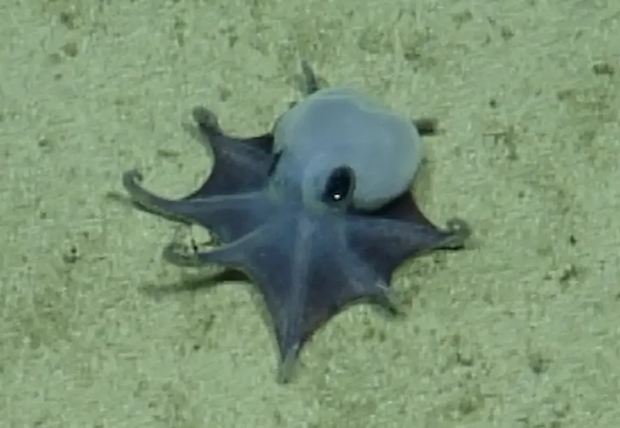
Scientists recently discovered a striking octopus species on the ocean floor near the Galapagos Islands. Controlled by experts, a submersible revealed a small octopus, vibrant blue like the ocean. An enthusiastic scientist exclaimed, “He’s tiny! It’s blue!” upon first seeing the cerulean cephalopod. The Charles Darwin Foundation team had succeeded in discovering a new octopus species approximately 5,900 feet beneath the sea’s surface.
Renowned octopus specialist Janet Voight was called to identify the novel species. Initially, Voight, based at the Field Museum of Natural History in Chicago, had to rely solely on photographs. Later, she received the preserved specimen through mail, expressing excitement over its unique beauty.
The new species, located 5,800 feet deep near Isla Darwin, intrigued Voight as the nearest known octopus of similar shape resides off Uruguay’s coast in a different ocean. To describe the new species ordinarily requires dissecting to examine its mouth, beak, teeth, and parts. However, the team had only a single specimen, prompting Voight to avoid dissection.
“We only had the one specimen, so I didn’t want to take it apart,” Voight explained.
Instead, experts at the Field Museum performed CT scans, producing thousands of X-ray images to compile into a 3D octopus model revealing its internal structure. “There’s nothing like spending the day looking at something no other human has ever seen,” stated Stephanie Smith, head of the Field Museum’s X-ray lab.
The newly identified species, termed Microeledone galapagensis, distinguishes itself through more than its blue coloration, which is considered rare in nature. It is notably smaller within the Megaleledonidae family, typically associated with larger members residing in Antarctica’s surrounding Southern Ocean.
Voight commented on the octopus’s unique anatomy, “Its stubby little arms with only one row of suckers set it apart from most octopus we are familiar with.” Even among species with similar arm traits, its coloration and smooth back skin further distinguish it.
The octopus’s back is light blue, while its underside holds a “very deep purple” hue. Voight speculates this color pattern offers protection. If the octopus captures prey that emits light, this illumination may attract predators. “So the octopus puts its dark-colored web over the prey item, keeping itself safe,” Voight explained.
Discovering new octopus species in the deep sea is surprisingly common, mainly in unexplored areas, which constitute a significant portion of the ocean floor. Voight remarked, “If you took all the land on Earth and pieced it together, you would not cover the Pacific Ocean.” The first sightings occurred in 2015 near Darwin Island, named in honor of the scientist who developed evolutionary theory after visiting the Galapagos.
It’s the first new octopus species Voight led a team to describe, marking a milestone in her four-decade career studying octopus evolution. Her findings were published in the journal Zootaxa. With around 300 octopus species globally distributed across oceans, discoveries are ongoing. Notably, scientists identified four new octopus species in 2024 near Costa Rica.
 Reassessing the Central Role of Rome in the Roman Empire’s Road Network
  Fire Amoeba Discovery Challenges Limits of Complex Organisms
  Impact of Sleep Types on Disease Risk
  Ice Age Mastodon Tooth Unearthed in California Creek
  The Unique Challenges of the Pumpkin Toadlet
  Animal Self-Medication Insights