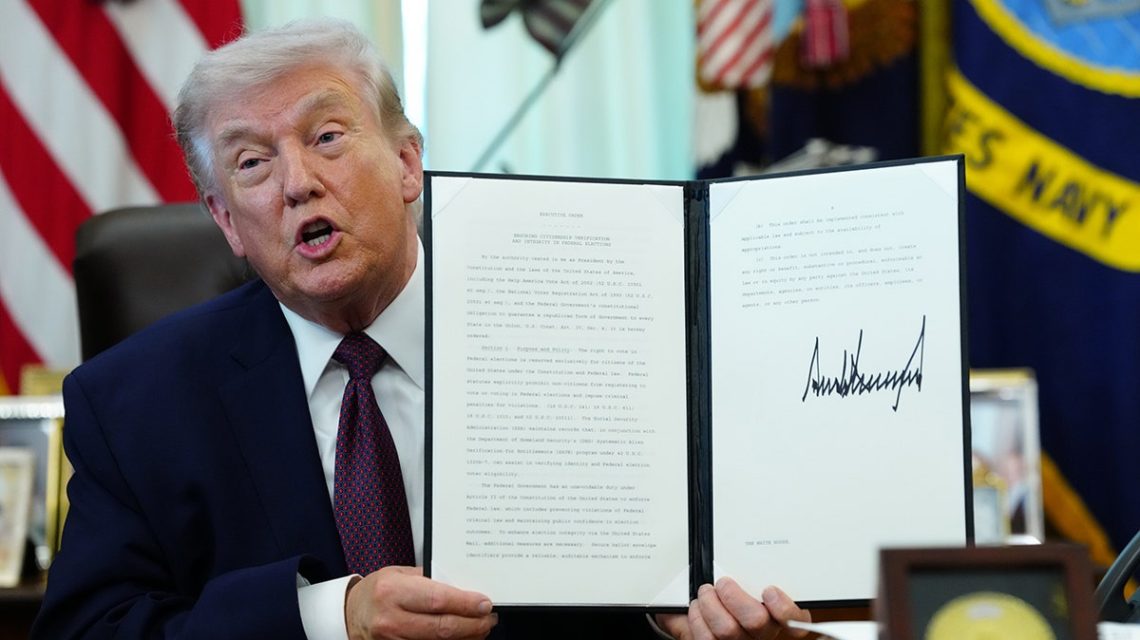
President Donald Trump faces a significant legal challenge regarding potential changes to federal mail-ballot rules. Legal experts are uncertain if his administration can implement these changes before the 2028 presidential election. In March, the president issued an executive order for the Postal Service to establish new mail ballot guidelines. These include standardized ballot envelopes with specific designations and unique barcodes. The order empowers the Postal Service to reject non-compliant ballots or those from unverified mail voters.
On September 14, the Supreme Court denied lifting a preliminary injunction blocking these rules from taking effect before the midterm elections. The debate now focuses on whether Trump’s changes can be enforced prior to 2028.
The ruling’s outcome largely depends on how the Supreme Court interprets the balance of authority between the president’s regulatory powers and states’ rights to manage elections. Florida State University law professor Michael Morley suggested that if the Court views the president’s actions as a federal election regulation attempt, it will likely disallow the new rules. The president, according to Morley, lacks constitutional authority in this domain without specific Congressional delegation.
“If seen as a federal election regulation attempt, the Court is likely to invalidate it,” Morley commented.
Alternatively, should the Court regard the rules as routine postal administrative requirements, the outcome might differ. Morley noted that in this scenario, the rules might be upheld as necessary postal management tools.
The Supreme Court voted 7-2 to uphold the injunction against Trump’s order. Justices Clarence Thomas and Samuel Alito dissented. Justice Brett Kavanaugh, despite recognizing the Postal Service’s potential authority, concluded that enforcing the rule close to an election could breach federal law. This decision suggests that many justices doubt the administration’s likelihood of success regarding the rule’s legality.
Stephen Richer from the Cato Institute believes the Constitution doesn’t empower the president to regulate elections. Instead, Congress and states hold such authority. Richer’s position reflects a common perspective challenging the administration’s actions.
Some view the Court’s decision as procedural rather than a complete administrative rebuke. Chad Mizelle from the America First Policy Institute emphasized Justice Kavanaugh’s acknowledgment of the Postal Service’s authority, citing insufficient time as a primary concern, not a substantive legal issue.
“It’s about the timing, not a ruling on the law,” Mizelle clarified.
President Trump expressed disappointment over the injunction, framing it as a setback for Republicans and an enabler of potential election fraud. He reiterated these concerns on Truth Social, denouncing what he perceives as inadequate mail voting standards.
Despite isolated election fraud cases, Grandscale fraud in US mail voting hasn’t been documented. Ilya Shapiro from the Manhattan Institute pointed out that the debate revolves around who sets the mail voting rules, whether it’s the states, Congress, or a federal postal agency.
 Voter Sentiment Against President Rises in Recent Poll
  Media Backlash Against Trump’s Press Exclusions
  U.S. Considers Belarus for Potash Purchases to Cut Fertilizer Costs
  Gov. JB Pritzker Reveals Type 2 Diabetes Diagnosis and Weight Loss Journey
  Trump’s Media Ban Affects Event Coverage
  A Critical Perspective on National Spending and Healthcare from Representative Eric Burlison