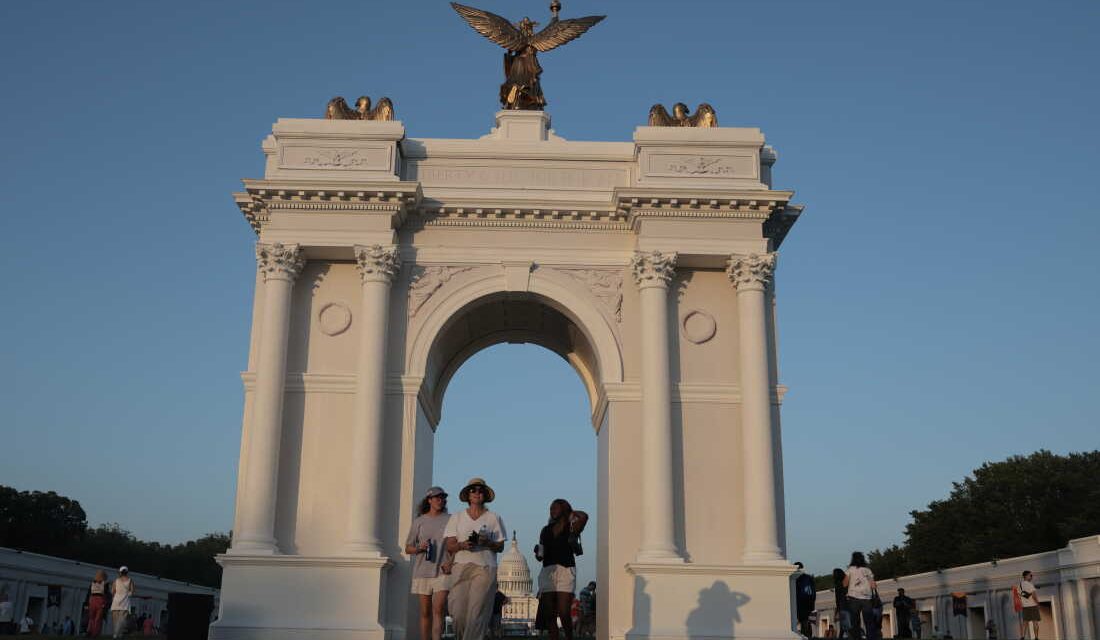
A planned replica of President Trump’s proposed arch was displayed at the Great American State Fair in July. Joe Raedl/Getty Images hide caption toggle caption Joe Raedl/Getty Images
The Trump administration intends to begin construction on a proposed 250-foot arch near Washington, D.C.’s National Mall. This is happening despite lacking essential approvals and amidst ongoing lawsuits. Interior Secretary Doug Burgum announced on social media that excavation work for the Great Triumphal Arch and Military Observation Deck will commence within the next two weeks. However, the project awaits final approval from the National Capital Planning Commission and reviews mandated for aviation safety and historic preservation.
Critics argue that the Trump administration is hastening the arch approval process, potentially bypassing necessary procedures. Historic preservation experts have voiced their concerns over weakened protections for historic sites. The White House asserts that initial work does not require approval and promises to seek final authorization from relevant entities.
The arch’s purpose has been debated, with President Trump noting it was for himself, while the administration later said it honors the nation’s 250th anniversary. Burgum highlighted its architectural significance, relating it to Arlington Cemetery and the U.S. capital in a social media post accompanied by renderings of the structure.
The arch has faced scrutiny since its inception, with approval from federal panels under Trump allies despite numerous negative public comments and a pending lawsuit. In early 2021, nonprofit Public Citizen, architectural historian, and Vietnam War veterans sued to halt construction, claiming the arch would desecrate Arlington National Cemetery and demanded congressional approval. Trump maintains that congressional consent is unnecessary.
Plaintiffs have requested a 14-day restraining order to prevent the administration from proceeding with the arch’s construction, as Nicolas Sansone, the attorney leading the case, described preliminary work at Memorial Circle as premature and lacking legal basis. Despite executive branch assertions, the National Capital Planning Commission has not approved the structure and will not meet until October.
The arch, intended to be twice the height of the Lincoln Memorial, has raised concerns about financial costs, impacts on funeral processions, and safety issues related to Memorial Circle’s proximity to Ronald Reagan Washington National Airport.
Rep. Don Beyer emphasized opposition from constituents in his district, describing the project as a gridlock-inducing and narcissistic endeavor. Critics also contend the arch would disrupt views between Arlington National Cemetery and the Lincoln Memorial, violating D.C.’s height limits.
Despite a National Park Service report acknowledging potential disruptions to historical significance of nearby sites, the administration insists on locating the arch at Memorial Circle due to the project’s purpose.
With the midterm elections approaching, Beyer speculates Republican loss of control in Congress might threaten the project’s continuation. He views the Vietnam veterans’ lawsuit as a potential means to halt progress.
On the same day as Burgum’s announcement, the Trump administration moved to dismiss the lawsuit concerning the arch, citing a Supreme Court ruling related to the White House ballroom case. The ruling indicated the plaintiff lacked standing, allowing construction without review of legality. Government lawyers claim the arch case lacks concrete injury grounds.
The Supreme Court decision, according to Sansone of Public Citizen, strengthens veterans’ case as they regularly visit Arlington National Cemetery. He noted that monument construction is not urgent, pointing out the announcement as premature.
Beyer predicts widespread protests if construction begins and anticipates the arch could have a brief existence due to subsequent presidential administrations. He suggests that potential backlash may lead to its removal.
 Ken Paxton’s Campaign Funding and Polls
  Inside the Secret Deals Powering the President’s Push to Deport Migrants to Countries Not Their Own
  Independence of Research from Political Agendas
  Sen. Roger Marshall Denies Allegations of Political Attack
  Concerns About Food Safety Reach Critical Levels
  Court Blocks Trump’s Mail-Ballot Rules Ahead of Elections