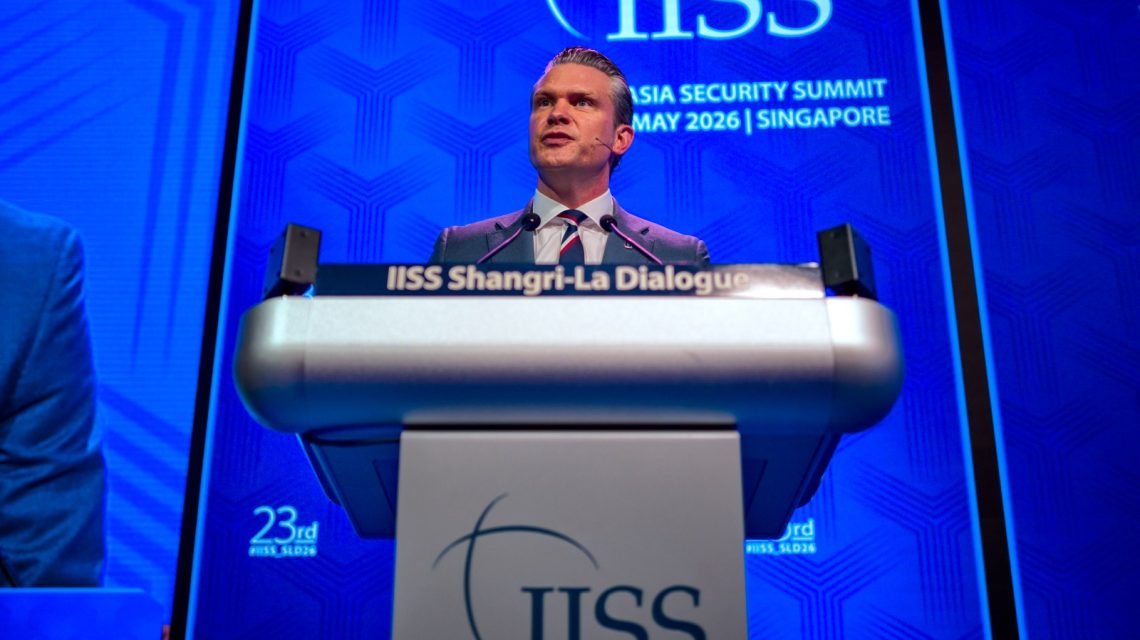
U.S. Secretary of Defense Pete Hegseth delivered a typical speech at the Shangri-La Dialogue on May 30. While he addressed the defense of the “First Island Chain,” he avoided mentioning Taiwan directly, a key issue in the Indo-Pacific region.
Hegseth’s comments to reporters about respecting China’s ambitions drew criticism. China’s aspirations include annexing territories and controlling international waters and airspaces. This sentiment reflects President Donald Trump’s previous comments after his Beijing summit with Chinese President Xi Jinping, where he labeled Taiwan merely as a “negotiating chip.” This undermined American credibility in Asia.
In response, China conducted military operations near Taiwan and the Scarborough Shoal, asserting unfounded sovereignty over parts of the South China Sea. American leaders have struggled to firmly address Chinese aggression, causing concern in the region.
Following Hegseth’s speech, Japanese Defense Minister Shinjiro Koizumi asked Hegseth in public if the U.S. commitment to the region was “unwavering.” According to Lance Gatling from Nexial Research, this inquiry highlighted a new, assertive approach by Japan’s national security circle, suggesting that Japan is ready to answer regional security questions, aligning with U.S. and Asian allies.
Regional cooperation initiatives such as the Japan-U.S.-Australia weapons production collaboration, the AUKUS submarine partnership, and the Quad alliance involving Australia, Japan, the U.S., and India showcase these closer ties. New partnerships like JAROKUS and JAROPUS further illustrate increased regional unity.
Indonesia, a key strategic partner, recently signed a Major Defense Cooperation Partnership with the U.S., reinforcing maritime security through the critical Strait of Malacca. This agreement, as noted by James Fanell of the Geneva Centre for Security Policy, helps protect strategic sea routes from Chinese influences.
Despite not being part of formal alliances, Taiwan’s security remains vital for the region. Japan’s Prime Minister Sanae Takaichi claimed an attack on Taiwan would threaten Japan’s security, asserting Japan’s readiness to respond. Despite Chinese objections and threats, Takaichi maintained her stance, securing political support.
While Hegseth’s reassurances in Singapore were welcomed, the region awaits clearer support from President Trump. Regional nations remain vigilant in light of ongoing tensions.
Gordon G. Chang, author of Plan Red: China’s Project to Destroy America and The Coming Collapse of China, provides these insights.
 Suspected Iranian Drone Plot Pushes U.S. to Evacuate Bombers from British Airbase
  Brett McGurk Discusses Hostage Negotiations and New Book
  Suspected Drone Plot Leads to Evacuation of U.S. Bombers
  Afghanistan’s Economic Crisis and the Impact on Youth
  Jesse Marsch: From U.S. Soccer to Canadian National Team
  Trump and Waltz Point to Immigration in France’s Riots