Contested Election Results in Colombia
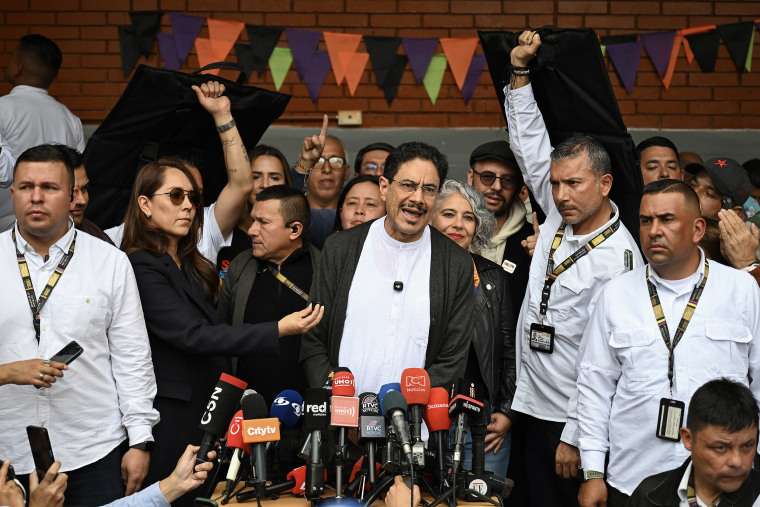
On Sunday, Colombia’s outgoing president raised concerns about the country’s election, which resulted in his supported candidate, Iván Cepeda, advancing to a runoff against right-wing competitor Abelardo de la Espriella. Neither candidate secured over 50% of the vote in the initial round, with de la Espriella, of the Defensores de la Patria party, leading at over 43%, and Cepeda, of the incumbent Pacto Histórico party, trailing slightly above 40%.
President Gustavo Petro, endorsing Cepeda, refused to accept the preliminary results from the country’s electoral authority. He alleged that flaws in the software used by private companies to count votes and claimed that around 800,000 IDs, not included in the official census, were added to the system. Cepeda also questioned the count, insisting that there were miscalculations and inconsistencies.
“Today, we secured 10 million votes that were miscounted in Colombia,” Cepeda stated in Bogotá, pushing for verification of the discrepancies.
Elections and International Observations
Colombia’s National Civil Registry releases preliminary results before reaching final conclusions. Its head, Hernán Penagos, mentioned that this year’s congressional election count achieved 99.8% precision compared to the final results—a historic accuracy. Juanita Goebertus, Director for the Americas at Human Rights Watch, described the electoral system as independent and reliable. She criticized the president for creating undue skepticism and encouraged international support for the National Civil Registry.
According to Goebertus, de la Espriella and Cepeda were advancing to the second round, and respecting the election outcomes was crucial.
The Road to the Runoff
The upcoming runoff, set for June 21, is between Cepeda, a left-wing senator known for negotiating Colombia’s 2016 peace deal, and de la Espriella, a lawyer and political newcomer endorsing U.S. President Donald Trump. The latter aims to implement strict measures against crime.
“We will defeat tyranny and absolutism,” de la Espriella declared, after confirming his move to the runoff stage.
Paloma Valencia, a candidate from the conservative Centro Democrático party, was predicted to be a significant contender but ended with less than 7% of the votes, disqualifying her from the race. Valencia, a critic of Petro’s administration, endorsed de la Espriella, potentially delivering her backing to his campaign.
Reflection on Petro’s Presidency
The election, perceived as a reflection on President Petro’s policies, comes a decade after Colombia’s peace agreement with FARC rebels. The accord aimed to end the long-standing conflict, but violence has resurged, exacerbated in the election lead-up with political violence and attacks.
Formerly a Marxist revolutionary and Colombia’s first modern leftist president, Petro’s relationship with Trump has been tumultuous. Yet, after a notable meeting in February, the two appeared to find common ground. Despite this, U.S. officials have expressed reservations about Cepeda, suggesting that support for de la Espriella might be more beneficial.
Sen. Bernie Moreno, a staunch Trump advisor on Colombia, commented on the pivotal nature of these elections, suggesting they would set the direction for the nation. Moreno plans to observe the election’s final round to ensure it proceeds fairly and securely.
“Democracy won today, but the work isn’t done yet. There’s a runoff in three weeks, and, at the request of the CNE, I’ll return to oversee the final round,” Moreno posted post-election.
The next few weeks will test Colombia’s resolve in navigating political challenges as it approaches an election that holds significant implications for its future direction.
 Turkey’s Ambitions and Regional Dynamics: The Mecca Joint Defense Agreement
  Trump’s Second Term Transformation of Washington
  Washington’s AI Concerns and the Promised Technological Future
  Efforts to Restrict Voter Registration Funding Trigger Concerns for Nonprofits
  American Workers’ Confidence and Economic Challenges
  Mary Peltola Challenges Sen. Dan Sullivan Over Rising Costs and Federal Aid