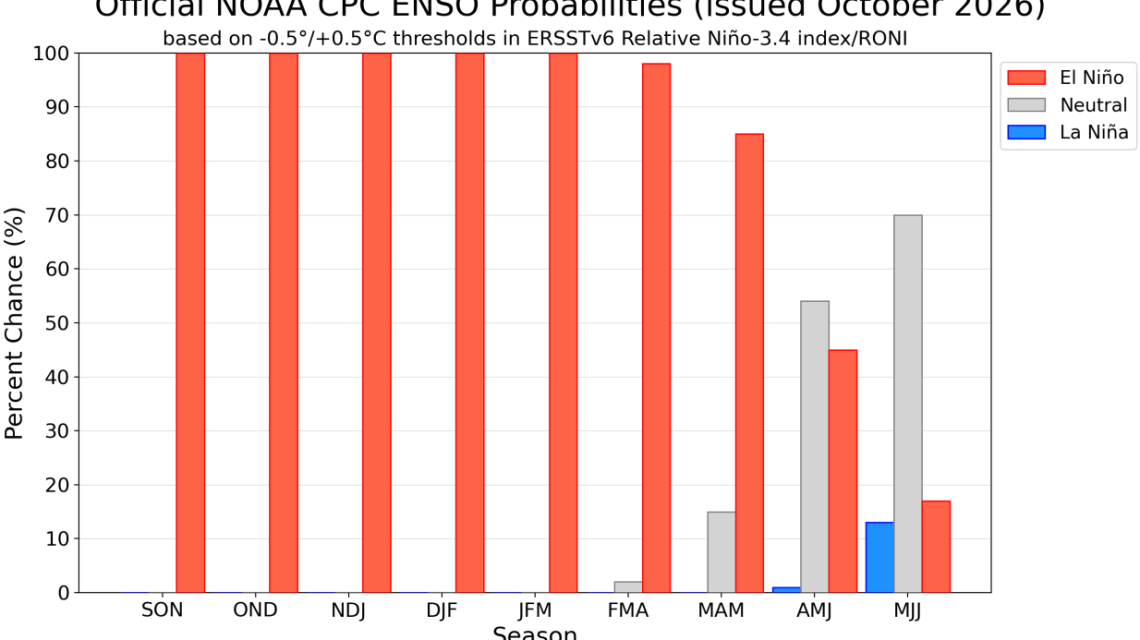
The current El Niño is anticipated to become one of the most intense on record. Recent updates from the National Oceanic and Atmospheric Administration (NOAA) suggest that this weather pattern continues to gain strength. Forecasters predict a ‘strong-to-very strong’ El Niño event from January through March.
According to NOAA’s Climate Prediction Center, various models confirm the intensification of El Niño through the end of the year. Experts believe the event could surpass previous El Niño episodes recorded since 1950. While high expectations of experiencing El Niño impacts exist, they are not assured.
Last month, Columbia University’s climate scientist, Azhar Ehsan, highlighted a chart indicating a ‘100% to 99%’ probability of El Niño persisting through spring. His assertion suggested certainty regarding the event’s duration. Supportively, NOAA’s Climate Prediction Center forecasts El Niño’s presence will extend for six months, although a La Niña pattern could follow.
The Climate Prediction Center’s data displayed El Niño probabilities across monthly intervals, with significant developments projected.
The World Meteorological Organization projects El Niño will peak in December. Reports highlight sea-surface temperatures might reach unprecedented heights between now and December.
Celeste Saulo, Secretary-General of the World Meteorological Organization, explained during the Global Heat Forum that El Niño does not inject new heat into the planet. Instead, it releases stored oceanic heat, often correlating with warmer years, such as the expected impact on 2024.
Meteorologist Brian James of Nexstar emphasizes El Niño’s substantial effects on upcoming weather patterns. Northern U.S. regions could experience drier and warmer conditions, whereas southern locations might encounter cooler and wetter climates.
Daniel Swain, a researcher at the California Institute for Water Resources, expressed serious concerns about the current El Niño’s scale in the context of the warming climate. California is preparing for the associated weather impacts, with Los Angeles crews already mobilizing.
Ehsan noted similarities between the current situation and the 1997 El Niño, one of the strongest ever. That year marked significant weather extremes and was the second-warmest, seventh-wettest winter since record-keeping began in 1895. The ongoing El Niño aligns with such historic patterns, ushering in potential for disruptive weather changes.
 Organic Farming with Bokashi in Zambia
  Tropical Storm Isaias Expected to Develop in Gulf of Mexico
  Coyotes Caught on Camera at Southern California Cabin
  Advancements in Nuclear Power for America’s Energy Needs
  Tickborne Alpha-gal Syndrome Impacting Martha’s Vineyard
  Collapse of Holei Sea Arch on Hawaii’s Big Island