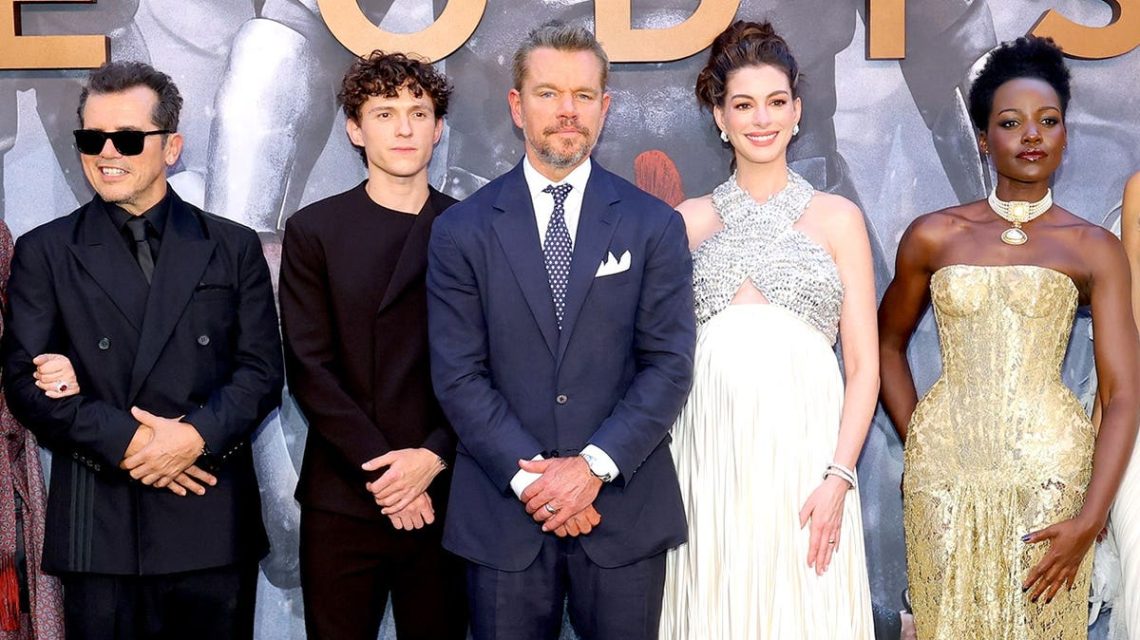
Christopher Nolan’s film “The Odyssey” offers viewers a visual feast with its retelling of Homer’s ancient epic. The film guides audiences through Odysseus’ encounters with a series of mythical creatures as he struggles to return home. This major box-office success is praised for its stunning visuals and is recommended for theater viewing.
Joel P. Christensen, provost and senior vice president for academic affairs at the CUNY Graduate Center, and a professor of classics, spoke to Fox News Digital about the film. He assures that audiences do not need to have read Homer’s “The Odyssey” to follow Nolan’s narrative, which provides sufficient context.
Unlike many modern blockbusters that feature a single main villain, this journey introduces a variety of monsters and supernatural threats, making each stop unique and suspenseful.
Christensen emphasizes the importance of portraying the mythological creatures that punctuate Odysseus’ journey across the ancient world.
Polyphemus
Polyphemus is the most renowned Cyclops in “The Odyssey.” This giant traps Odysseus and his crew in his cave and devours several of the men. According to Encyclopaedia Britannica, the name Polyphemus translates to “rich in songs and legends” or “widely talked about.” Odysseus blinds Polyphemus with a sharpened wooden stake, enabling him and the remaining crew to escape.
This encounter is significant as Polyphemus is a son of Poseidon, which leads the sea god to curse Odysseus’ voyage home.
Laestrygonians
The Laestrygonians are giant cannibals who destroy almost all of Odysseus’ fleet by enticing them into their harbor and hurling massive boulders at them. In Book 10, they devastate Odysseus’ ships at the harbor of Telepylus. Odysseus manages to flee onboard his last ship, setting sail to the island of the sorceress Circe.
Circe
Circe, a powerful sorceress, encounters Odysseus on the island of Aeaea. She is the daughter of Helios, the sun god. Circe famously transforms Odysseus’ men into pigs, but she cannot curse Odysseus. Instead, she falls in love and assists him in navigating his journey home.
The sequence where Circe turns Odysseus’ men into pigs is remarkable for its visceral impact, Christensen notes. While unsettling, it reveals the duality of humans as creatures in disguise.
Sirens
Sirens in Greek mythology are half-bird, half-woman beings that lure sailors to their doom with their enchanting song. Circe warns Odysseus about the sirens in Book 12. To protect his crew, Odysseus plugs their ears with beeswax and has himself tied to the ship’s mast, allowing him to hear the song without succumbing to it.
Scylla and Charybdis
Scylla and Charybdis are two infamous sea monsters presenting Odysseus with a formidable challenge. These creatures trap him in a narrow strait. Scylla seizes sailors from passing ships on one side, while Charybdis creates a massive whirlpool on the other. Odysseus follows Circe’s advice to sail near Scylla, sacrificing six men, but allowing the rest to escape.
Calypso
Calypso, a nymph, holds Odysseus captive on the mythical island of Ogygia. She falls in love with him and prevents his departure for years. Zeus commands Calypso to release Odysseus, leading her reluctantly to assist in building a raft for his continued journey home.
A Scholar’s Perspective
Like any adaptation of a sprawling ancient epic, Nolan’s movie condenses elements of Homer’s tale. Christensen highlights that while visually stunning, the film’s depiction of some mythological characters diverges from the original. Changes to Polyphemus and Circe, for instance, reshape the Cyclops into more of a monster and reduce Circe’s agency.
Nolan reduces repetitions seen in “The Odyssey,” limits scene lengths, and minimizes divine depictions. Despite these edits, the epic’s iconic mythological figures remain central to the narrative.
Christensen concludes by reminding viewers that film and epic poetry are distinct mediums. The adaptation demands a shorter, visual format, resulting in necessary changes:This is Nolan’s ‘Odyssey,’ not Homer’s.
 Jennifer Aniston’s Relationship Insights from Relationship Experts
  Kim Kardashian Shares Esophagitis Diagnosis Amid Personal Concerns
  Duncan Sheik, Singer-Songwriter and Broadway Composer, Dies at 56
  Engelbert Humperdinck Reflects on Life-Saving Shoelace During Army Service
  Chad Gilbert of New Found Glory Dies at 45
  Gorillaz and Macklemore Respond to Controversy Over Israel-Palestine Statements