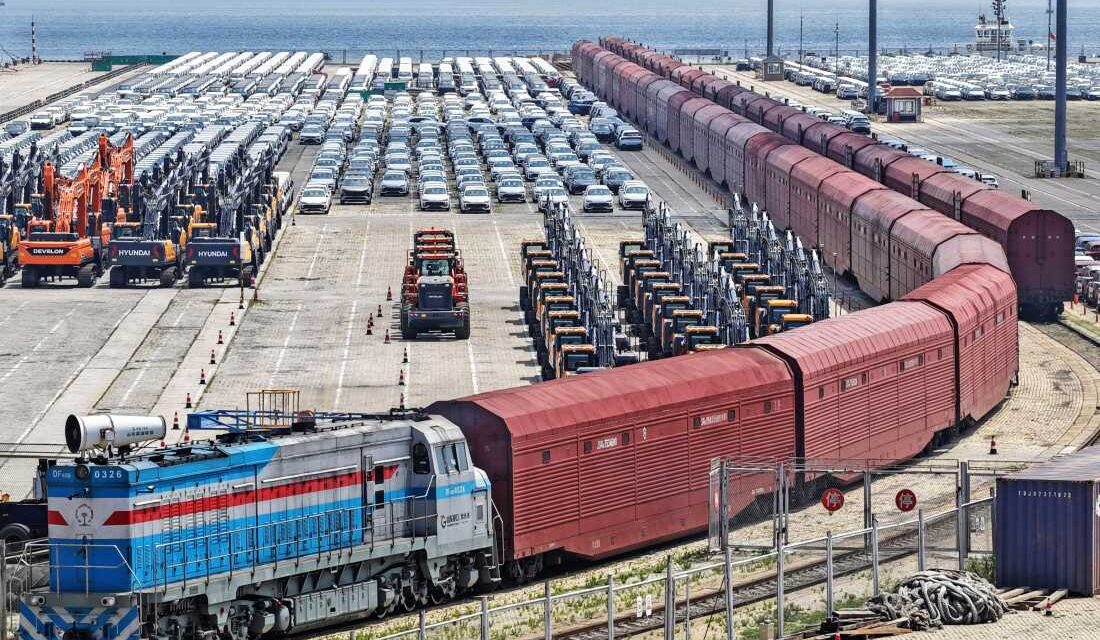
Heavy equipment and cars were prepared for shipment by rail in Yantai, eastern China’s Shandong province, on June 20, 2026.
China’s economic growth slowed significantly to a 4.3% annual rate in the April-June quarter, marking the weakest performance in over three years. This was reported by the government on Wednesday. Despite a surge in exports fueled by a boom in artificial intelligence and strong global demand for Chinese electric vehicles, the growth rate fell short of the 5% pace seen in January-March.
An ongoing war in Iran has not heavily impacted China’s economy. However, rising energy prices have increased global inflation. Exports increased by 17.6% in the first half of the year and 27% in June, as per customs data. Still, domestic spending and investment have lagged, limiting the boost from export manufacturing. The economy has struggled to regain momentum since the COVID-19 lockdowns.
“This was the slowest growth in any quarter since the lockdown-impacted fourth quarter of 2022,” said Lynn Song, chief economist for Greater China at ING Bank, in a note.
Economists express concerns about China’s economy becoming unbalanced. While heavy investments support frontier technologies like AI and robotics, lower-value manufacturing and service industries suffer. High-tech product exports, such as electric vehicles and computer chips, have risen due to substantial government support, as China prioritizes advanced technology development.
China’s global trade surplus reached a record $1.2 trillion last year, drawing criticism from other countries over trade imbalances. State subsidies are often blamed for the oversupply of exported goods. Industrial output by value increased by 5.4% year-on-year in the first half.
Like other countries, China faces challenges with AI and robotics expansion regarding job creation. Household spending has decreased amid a property slump and job uncertainty.
Eswar Prasad, an economics professor at Cornell University, noted the increasing imbalance in China’s growth model. Boosting domestic demand remains challenging with weak consumer confidence. Mao Shengyong, from China’s National Bureau of Statistics, highlighted the imbalance between strong supply and weak demand.
While focusing on high-tech manufacturing, China aims to build a robust domestic market and maintain stable employment. Investment in fixed assets dropped by 5.7% year-on-year, and retail sales climbed by only 1.3%. Housing prices continued declining.
Wei Li, Head of Multi-Asset Investments at BNP Paribas Securities (China), described China’s economy as undergoing a “significant transition.” For 2026, leaders targeted a growth of 4.5% to 5%, lower than the previous year’s 5%. Overall growth for the first half was 4.7%.
The International Monetary Fund raised China’s annual growth forecast by 0.2 percentage points to 4.6%, predicting 4.1% growth in 2027.
 Navigating the Challenges of Third-Country Deportations
  Midair Altercation on Bangladesh to London Flight
  Ukraine Missile and Drone Barrage Hits Russia Amidst Elections
  U.S. Strategic Goals Remain Unmet Amid Prolonged Conflict
  New Photos Reveal Damage from Iranian Strikes in the Middle East
  Assassin of Chilean Diplomat Orlando Letelier Faces Deportation 50 Years After Assassination