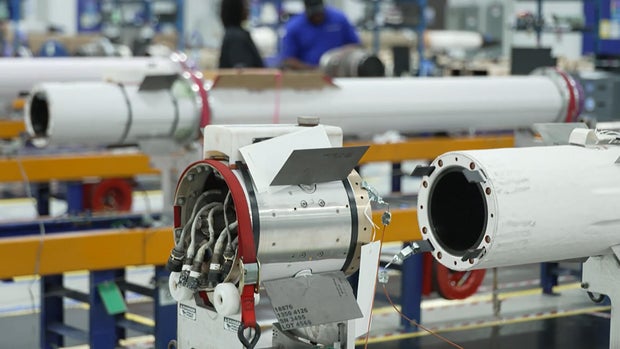
The latest development at Lockheed Martin’s facility in Camden, Arkansas, highlights the ingenuity in missile defense. Tim Cahill, head of the missile division, introduced the advanced Patriot air defense missile, designed to neutralize ballistic threats through direct impact.
“It’s going to vaporize pretty much whatever it hits,” Cahill stated.
The production of Patriot missiles is set at 750 units annually, costing $4 million each. However, the demand to replenish used supplies from conflicts, like the war with Iran, challenges production capacity. The estimated expenditure on munitions in that conflict reaches $25 billion.
Mark Cancian from the Center for Strategic and International Studies has tracked the use of key weapons systems, including the Tomahawk and THAAD, during the conflict. He points out the shortage of high-tech weapons as a significant concern.
“The war in Ukraine was the wake-up call,” Cancian mentioned, indicating inadequate inventories for extended conflicts.
From February, the U.S. engaged with Iran, depleting stockpiles by striking over 13,000 targets by early April. Cancian warns of challenges in maintaining munitions once conflicts involve nations like China.
The Pentagon, however, disputes claims of shortages, asserting strong stock levels. Defense Secretary Pete Hegseth urges increased production to a “wartime footing.” Lockheed Martin aims to boost Patriot output to 2,000 annually through extended shifts and assembly automation, despite supply chain challenges.
Rocket motors, crucial for Patriots, are manufactured under strict safety regulations by L3Harris. This includes using ovens for curing missile components, significantly impacting production time.
CoAspire, based in Manassas, Virginia, represents an innovative edge in missile production, developing affordable cruise missiles. Their modular design is priced at $200,000, unlike traditional models, with plans for the Pentagon to acquire 10,000 units.
“If you have thousands of these, it’s very challenging for sophisticated air defense systems to counter,” said Doug Denneny of CoAspire.
Addressing replenishment timelines, Cancian estimates it could take one to five years to restore stockpiles to pre-war levels, with additional years needed to reach comfortable reserves for potential conflict with China.
Lockheed Martin’s massive contract to build high-performance Patriots underscores the scale of investment in defense, alongside smaller ventures like CoAspire that promise cost-effective solutions.
 Data Centers Stir Controversy in Texas Amid Growth Boom
  The Technology Rivalry: Trump’s Meeting with Xi and the AI Ecosystem Clash
  Ways to Protect Your Finances from Cyber Threats
  Interview with Nvidia CEO Jensen Huang: AI Outlook and Business Strategy
  Concerns Rise Over Addictive Design of Sports Betting Apps
  Seton Hall National Security Graduate Fellowship Provides Hands-On Experience