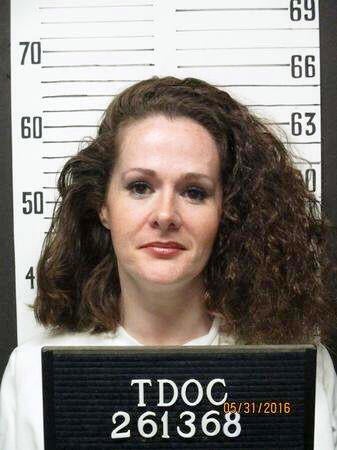
Attorneys for Christa Pike, an inmate on Tennessee’s death row, are urging for her sentence to be commuted after a failed execution attempt by lethal injection. This incident took place on Wednesday night, when the execution faced complications described as ‘cruel’ and ‘torturous’ by her lawyers.
Randy Spivey, one of Pike’s attorneys, stated during a news conference on Thursday, “The state of Tennessee demonstrated again their inability to conduct an execution with the dignity required. The process was not only inefficient but also cruel and torturous.”
Legal representatives, including Spivey and Steve Ferrell, alerted state officials months prior, concerning the potential for suffering during the execution due to Pike’s health condition and previous difficulties in establishing veins.
“Christa has endured punishment greater than any other American facing the death penalty,” Spivey asserted. “The governor must commute her sentence now.”
As of Thursday afternoon, Pike was in critical condition and was receiving intensive medical care. However, specific details on her health condition were sparse at the time.
The execution has been suspended following an order by Governor Bill Lee to halt pending executions for the year. He has called for an independent review to understand the failures that occurred.
Pike, who was set to be the first woman executed in Tennessee in two centuries, was convicted of the 1995 murder of Colleen Slemmer. Both were students at the Job Corps Center in Knoxville when Pike, then 18, reportedly tortured and killed Slemmer, 19.
During the flawed execution, the process to establish an IV line endured for an hour. Spivey reported counting at least seven unsuccessful needle attempts, with one needle visibly bent.
Pike attempted to assist by suggesting possible insertion sites and expressed gratitude when it seemed successful, retaining composure throughout as corroborated by Spivey.
Previously, Pike had not sought to impede or delay her execution, desiring a humane and rapid procedure instead. “Her greatest fear was not death itself but a drawn-out and painful ordeal,” Ferrell noted.
A spiritual adviser accompanying Pike was removed twice during the procedure, despite her being conscious, which added to the distress. The curtain to the viewing room was also lowered unexpectedly.
Communication during the execution run was subpar. Spivey experienced a lengthy delay in reaching a phone to alert Pike’s legal team, happening 40 minutes after the initial drug administration.
Unavailable contact with the governor’s office or the anticipated court route, furthered complications for the defense team. Eventually, they accessed the court through electronic filing to secure phone contact.
The attorneys could not predict the forthcoming actions in Pike’s case. They expressed aspirations that she could be part of future legal proceedings. The state’s future actions remain uncertain, with an electric chair being a potential alternative among available options.
“She is in a league of her own concerning what she has experienced,” Spivey said. “Pike has undergone over two decades in solitary confinement and a complete lethal injection attempt. That is without precedent and cruel, demanding change.”