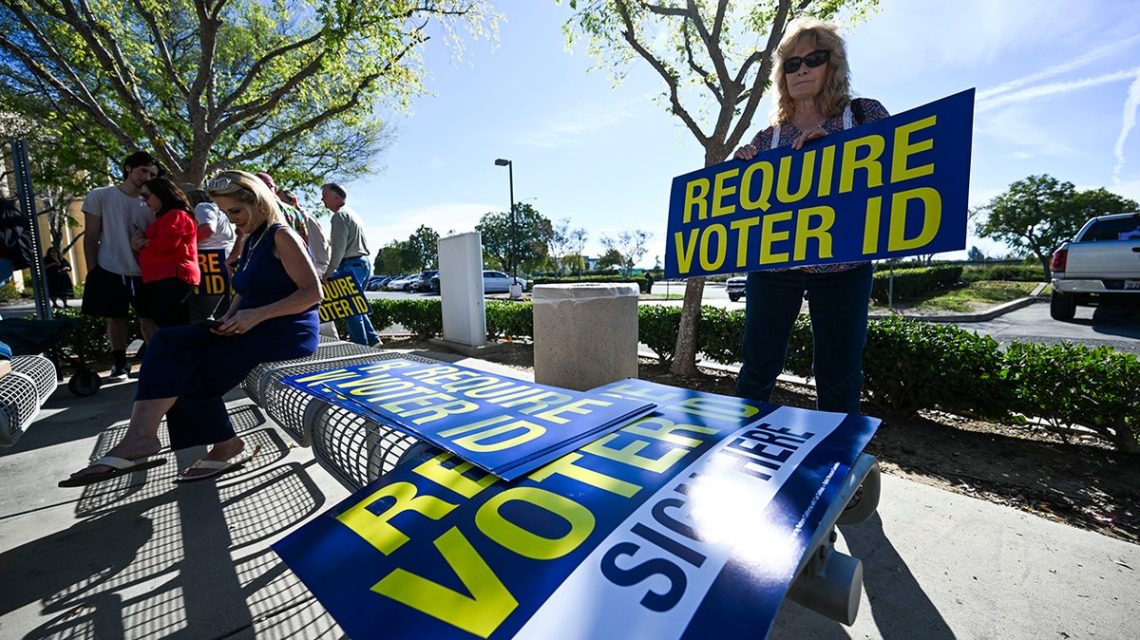
In California, a proposed measure on voter identification has captured attention due to its politically charged language. Proposition 39 is a citizen-driven initiative led by Californians for Voter ID, which successfully gathered 1.3 million signatures, surpassing the required 875,000 signatures for it to qualify as a ballot measure.
The initiative, set to be voted on in November, mandates the use of government-issued identification cards or numbers for voters, both in-person and by mail, and necessitates election officials to confirm U.S. citizenship.
Online users have reacted to the political language used by opponents of the measure in the California voters guide. A photograph captured at a press conference in Riverside, California, on March 2, 2026, shows volunteers and GOP lawmakers supporting the voter ID measure. In contrast, groups opposing Prop. 39, like the ACLU California Action and the League of Women Voters of California, argue that it advances a “voter suppression agenda” associated with the Trump administration. They claim it could lead to identity theft and misuse of taxpayer funds.
The voters guide breaks down the financial implications, suggesting costs in the tens to hundreds of millions annually to implement new voting requirements. It provides insights into the outcomes of voting “yes” or “no.” Voting “yes” would require additional identification at each voting occasion, while “no” allows for identity verification through signatures.
Supporters of the measure include the Transparency Foundation and the Howard Jarvis Taxpayers Association, promoting it as a “bipartisan solution” that strengthens trust in elections. A Pew Research study from 2025 indicated strong public support for voter ID, with 83% of Americans in favor.
Comments on social media reflected mixed views on the official guide’s language and implications for democracy in California. As early voting continues and Election Day nears, discussions on Prop. 39 remain heated.
If approved, Proposition 39 will enforce government-issued ID requirements. For mail-in voting, it mandates using the last four digits of a government-issued ID. Election officials will need to verify U.S. citizenship and conduct regular audits to ensure compliance, with annual reports published on registration verification.
 The Shadow Primary for the 2028 Presidential Race
  Nevada Governor Race Intensifies as Election Day Approaches
  Ken Paxton Questions Talarico’s Absence
  Reforming Child Welfare Financing to Preserve Family Unity
  Trump Initiates Inquiry into Federal Reserve Governor Lisa Cook
  Federal Shooting Sparks Controversy in New York