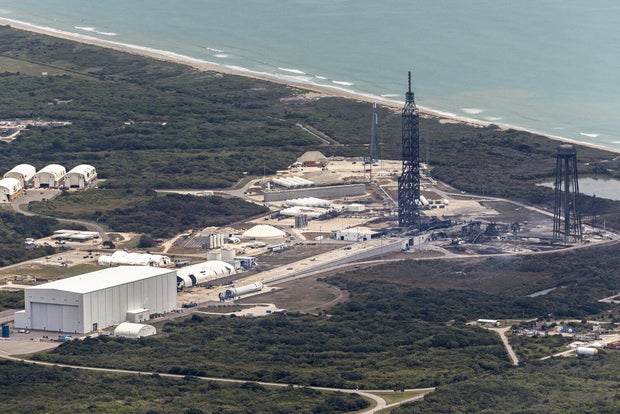
Despite a launch pad explosion last week, Blue Origin plans to resume New Glenn rocket launches by the end of 2026. CEO Dave Limp stated that although the damage was significant, the propellant tanks at the Cape Canaveral Space Force Station launch pad were intact, along with a nearby processing hangar. The damaged main support gantry is repairable.
Limp noted the importance of the intact propellant farm, including oxygen, liquid hydrogen, and LNG tanks, as these components are expensive and have long lead times. He emphasized that the water tower remains functional, and the main support tower can be repaired on-site rather than replaced.
“We’ve accessed the pad and integration facility, and there’s good news,” Limp shared. “The propellant farm is in good shape, which is fortunate as these items have long lead times.”
The destroyed New Glenn rocket and its transporter-erector will not delay Blue Origin’s transition to an alternative vertical rocket assembly, eliminating the need for a new transporter-erector.
Last week’s explosion occurred during a routine hot-fire test of the seven BE-4 engines, which ignited before the fire broke out. No official cause has been determined yet, but Limp remains committed to resuming flights with the motto “Gradatim Ferociter.” Blue Origin aims to launch another New Glenn later this month to deploy Amazon Leo internet satellites.
Though the explosion was intense, the company remains hopeful due to their intact launch facilities and plans for additional launch pads. This incident is particularly crucial for NASA’s Artemis moon program, reliant on both SpaceX and Blue Origin to achieve the goal of landing astronauts on the moon before 2028.
If successful, NASA aims to conduct astronaut moon landing missions in 2028, followed by regular flights, using Blue Origin’s lunar lander as an alternative to SpaceX’s Starship variant. Blue Origin’s New Glenn is also contracted to launch moon rovers and scientific experiments.
NASA Administrator Jared Isaacman highlighted the collaboration in resolving the explosion’s root cause and accelerating pad recovery. Space Center Director Brian Hughes reaffirmed NASA’s focus on lunar lander technology and achieving the 2028 lunar landing goal.
The implications for United Launch Alliance (ULA), using Blue Origin’s BE-4 engines for its Vulcan rocket, hinge on whether an engine design flaw is discovered. ULA’s progression depends on the outcome of the investigation.
 Challenges Revealed in Drone Deliveries: Conor McGregor’s Experience
  Efforts to Limit AI Content Gaining Momentum on Popular Platforms
  Challenges and Opportunities: The Illinois Quantum and Microelectronics Park Development
  Closed-door AI Framework Surprises Tech Policy Sector
  FAA Orders Inspections for Boeing 737 Max Planes Over Structural Concerns
  AI Stethoscope and Innovative Toilet Seat Transform Heart Condition Diagnostics