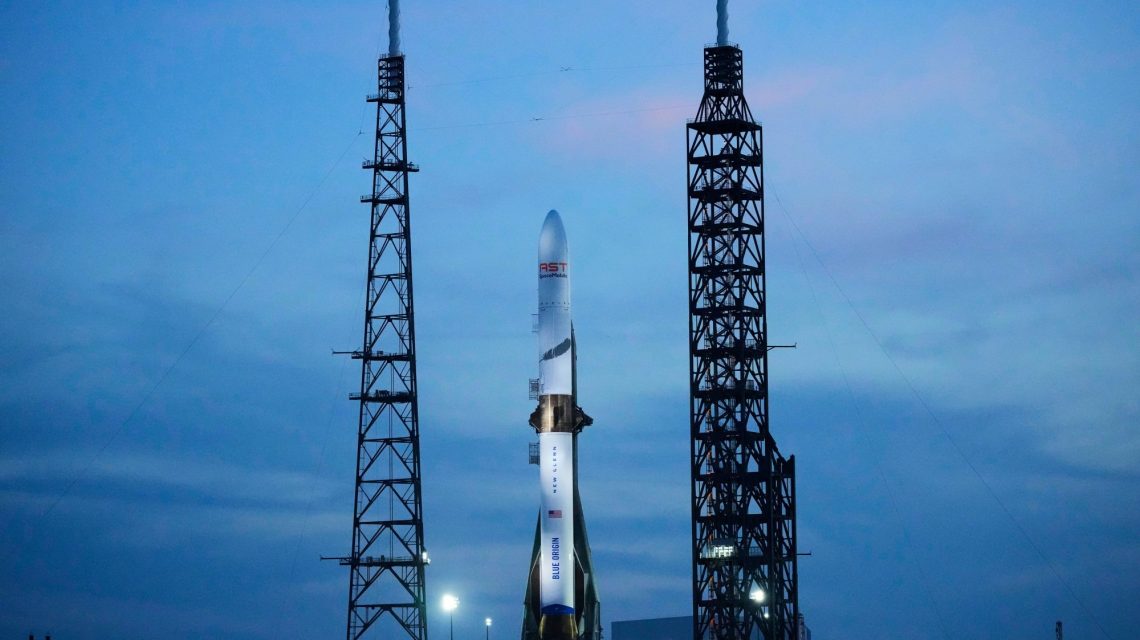
A Blue Origin New Glenn rocket exploded at the launch pad during a test on Thursday night, shaking homes near Cape Canaveral, Florida. The explosion briefly illuminated the night sky in orange.
The incident occurred as Blue Origin was preparing for a satellite launch planned for the upcoming week. Officials at Cape Canaveral Space Force Station reported no injuries. Jeff Bezos, founder of Blue Origin, expressed on X that while the cause of the explosion is yet unknown, investigations are underway. He reassured that the company is determined to resume its operations.
This setback comes after the New Glenn rocket was grounded in April following an engine failure that affected a satellite launch. The rocket’s recent flight was only its third, as Blue Origin aims to use it for deploying landers for NASA’s lunar missions, including transporting astronauts to the moon.
Blue Origin anticipated launching a prototype lunar lander for testing this fall. In recent developments, NASA awarded the company a substantial contract to deploy two moon buggies as part of the Artemis program in the coming years. NASA Administrator Jared Isaacman commented on the complexities of spaceflight, noting the challenge of developing new heavy-lift capabilities, and assured updates on any potential effects on the Artemis program.
Residents in the nearby areas of Cape Canaveral and Cocoa Beach reported feeling the explosion around 9 p.m. Social media was soon filled with images of the orange fireball visible from the beach near Launch Complex 36.
The New Glenn rocket was scheduled to launch next week, carrying internet satellites for Amazon’s Leo constellation. Despite the explosion, officials confirmed no threat from fumes or other hazards. Other scheduled launches from the area, such as United Launch Alliance’s Atlas V rocket, set to launch Friday with similar satellites, remain unaffected.
Elon Musk of SpaceX extended his condolences to Blue Origin, acknowledging the challenges faced by those developing rocket technology.
The 321-foot tall New Glenn made its first flight in 2025 and is named after John Glenn, the first American to orbit Earth. It surpasses Blue Origin’s smaller New Shepard rockets, which have been used for suborbital tourism flights.
The Associated Press Health and Science Department contributed to this report, supported by the Howard Hughes Medical Institute’s Department of Science Education and the Robert Wood Johnson Foundation.
 NASA’s Challenges Amid Goddard Space Flight Center Relocations
  Lost City Linked to Jesus Discovered Near the Sea of Galilee
  NASA’s Launch of the Nancy Grace Roman Space Telescope
  NASA Launches Nancy Grace Roman Space Telescope to Explore Universe’s Mysteries
  Trump Engages with Astronauts and Honors Artemis II Crew
  NASA’s Nancy Grace Roman Telescope Prepares for Launch