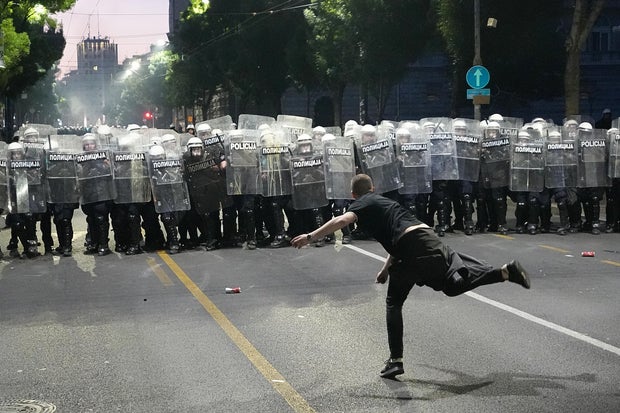
On Saturday, a massive anti-government protest took place in Belgrade, Serbia, where tens of thousands of protesters opposed President Aleksandar Vucic’s leadership. Although the initial rally was peaceful, tensions escalated as young demonstrators clashed with riot police.
Demonstrators hurled flares, rocks, and bottles at police, who responded by using pepper spray to disperse the crowds. The situation intensified when protesters rolled trash cans into the streets, prompting police equipped with shields to attempt containment. By deploying anti-riot vehicles, authorities managed to quell the unrest in the central part of the city.
Earlier, an influx of protesters filled central Belgrade, with many displaying banners and wearing T-shirts featuring the slogan “Students win,” a rallying cry representing the youth movement. Supporters traveled from other towns to join the demonstration in Belgrade.
President Vucic has tried to suppress the continuous protests that have challenged his rule, originating from demands for accountability following the fatal train station incident in November 2024. A video on Instagram showed Vucic asserting that protesters were violent and unable to tolerate political opposition, while he was en route to China for a state visit.
The protest movement has previously forced the resignation of then-Prime Minister Milos Vucevic in January 2025. Many allege corruption fueled the renovation negligence at the train station, involving Chinese companies, ultimately leading to the disaster.
During Saturday’s event, students called for early elections and adherence to the rule of law, accusing the government of corruption and crime. Prosecutor Bojana Savovic addressed the crowd, emphasizing that selective law implementation renders the state akin to a mafia organization.
Ana Brnabic, the Parliament Speaker, downplayed the student rally, arguing it lacked new propositions. She cited a police estimate of 34,300 attendees and claimed democracy was thriving in Serbia.
Clashes initially occurred near a camp of Vucic loyalists, who had been stationed outside the presidency. Riot police, in full gear, surrounded the area while folk music played in an attempt to counter protest momentum. To hinder travel to Belgrade, Serbia’s state railway company canceled all trains to and from the city.
International scrutiny has intensified against Vucic’s hard-line measures, including arbitrary arrests and excessive force against protesters. Council of Europe Commissioner for Human Rights, Michael O’Flaherty, has criticized Serbia’s government, noting reports of police shielding unidentified attackers targeting journalists and protesters.
While Serbia pursues European Union membership, its close connections with Russia and China may jeopardize funding prospects. The EU enlargement official warned that continued democratic regression could cost Serbia approximately 1.5 billion euros ($1.8 billion) in EU aid.
Belgrade’s Slavija Square recently served as a protest venue yet again, previously known for a significant anti-government protest disrupted by an alleged sonic weapon, although this was denied by the government.
The youth movement’s advocacy for justice and law has resonated deeply among citizens, weary of long-standing political crises. Students now aim to challenge Vucic in the forthcoming elections, hoping to dismantle the right-wing populist administration. Vucic mentioned the elections might take place between September and November.
Pro-government rhetoric has labeled critics as foreign agents intent on destabilizing Serbia, exacerbating political tensions.
Protestor Maja Milas Markovic expressed appreciation for the students’ energy, stating, “I really believe that we have [the] right to live normally.”
 Influence Concerns Surround California Political Donors
  Michigan Senate Race Sees Influences from Soros-Linked Funding
  Trump Seeks Diplomatic Success at the U.N. Amid Challenges
  North Carolina Senate Race Influenced by Abortion Policy Messaging
  Trump Pressures Republicans on Filibuster Threat
  Rep. Golden Endorses Rep. Lawler for Re-election