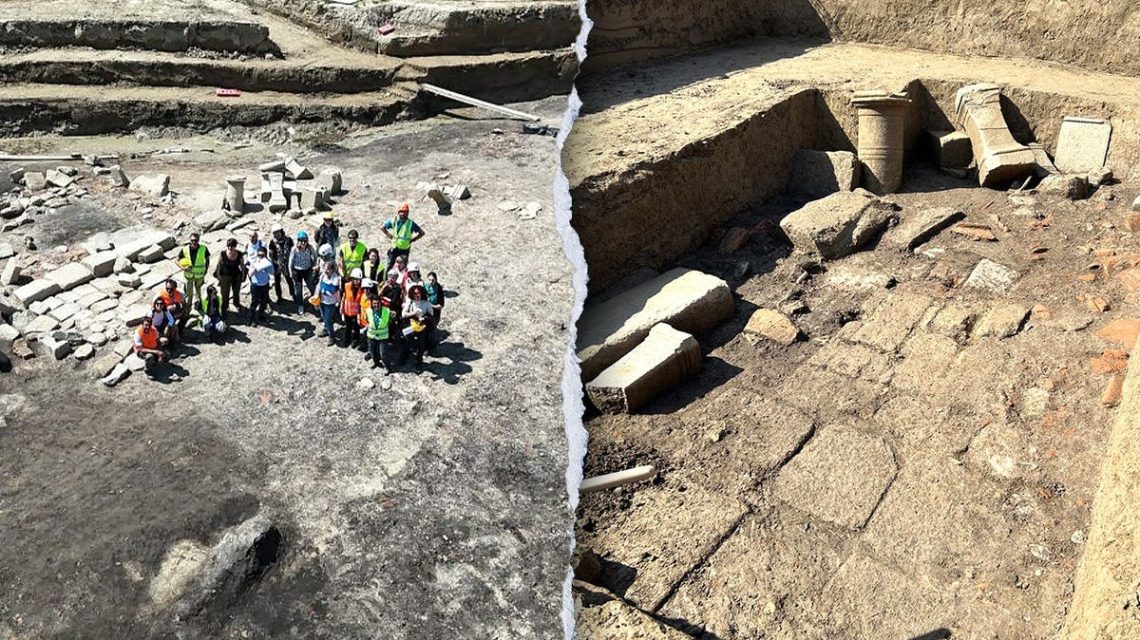
Construction crews working on a highway in Italy made a significant discovery. They uncovered the remains of an ancient sanctuary, sparking an archaeological investigation. The Italian Superintendency of Archaeology, Fine Arts and Landscape confirmed the discovery in a press release dated May 19.
The sanctuary was found in Ponso, roughly 45 miles southwest of Venice. The site emerged unexpectedly during road construction by Veneto Strade S.p.A., as workers were creating a new route from Borgo Veneto to Carceri. This find dates back to the fifth century B.C.
The initial discovery occurred while workers performed wartime ordnance clearance operations. Large rectangular foundation structures, believed to be temples, were unearthed. One temple structure features a surrounding row of columns.
Though some inscriptions are in Latin, many more utilize Venetic script, tied to the Veneti people of northeastern Italy before Roman times. Notably, some stones inscribe this script, showing reuse in a floor structure. Its function remains uncertain.
The paving dates to the 1st century A.D., as ongoing studies suggest.
Photos from the excavation site display Venetic inscriptions, along with partially buried columns and stone blocks likely linked to the temple complex. Some inscriptions hold a religious context, indicating a votive purpose.
Archaeologists propose that the area saw flooding by a branch of the Adige River in ancient times. The sanctuary may offer insights into ancient religious practices in the northeastern Italian region.
Findings indicate the site’s continued importance throughout history, showing adaptation rather than desertion. The Roman period saw a transition in function and cultural context.
Actively explored by researchers, the site is part of numerous recent archaeological discoveries across Italy. Last year, a significant Iron Age necropolis was uncovered in Trento, and earlier in 2026, an ancient Roman city was excavated near the Appian Way.
 New Species of Wild Cat Discovered: Tilcayo Tiger Cat
  Ancient Warhorse Unearthed in Egypt: A Glimpse into Military Life
  Insights into Grief Observed in Humpback Whales
  Scientists Discover Enormous Crater on Moon
  Fat Bear Week 2026: A Celebration of Alaska’s Largest Brown Bears
  Challenges in AI Development