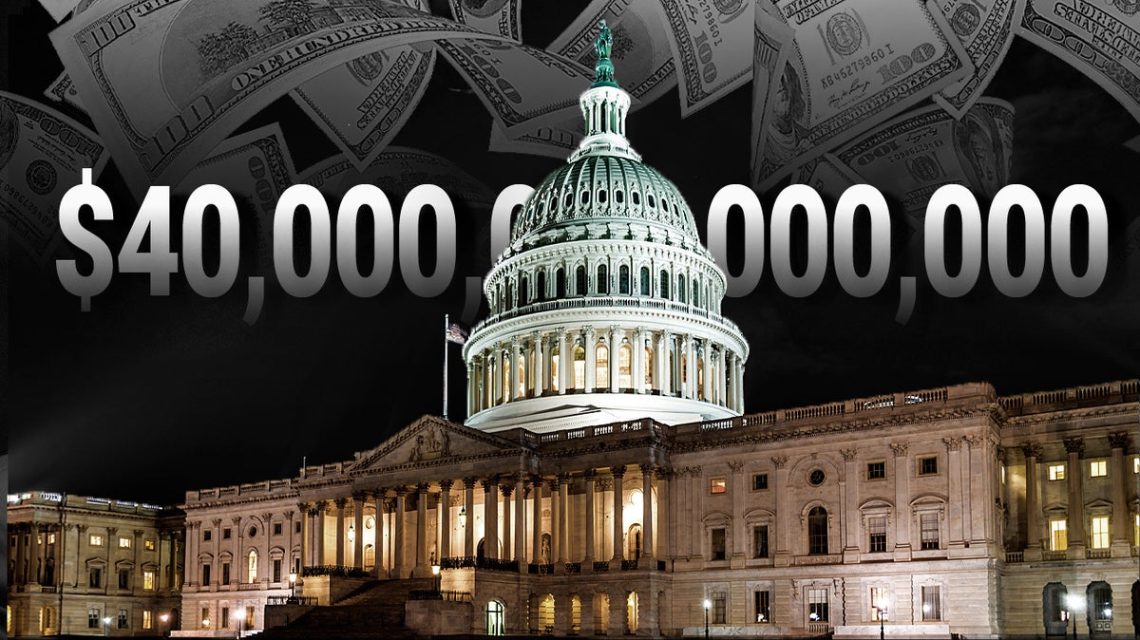
The Dire State of America’s National Debt
America is witnessing an unprecedented rise in its national debt. For the first time ever, total public debt has exceeded $40 trillion, which translates to nearly $300,000 per household. This staggering figure demands urgent attention, as political promises of easy fixes have long dulled the public’s urgency to address it.
The Debt-to-GDP Ratio: A Concerning Benchmark
The debt-to-GDP ratio is a common measure of a country’s economic health. Currently, the United States’ public debt surpasses 124% of its GDP. Few countries fare worse, including Sudan, Venezuela, and stagnant economies like Japan, Greece, and Italy.
Debt held by the public stands at over $32 trillion, nearing 100% of GDP. According to the Congressional Budget Office, this figure is anticipated to reach 120% by 2036. Such a rising debt-to-GDP ratio indicates America’s diminishing capacity to service its obligations without heavily relying on borrowing.
Implications of Rising Debt
The overwhelming national debt has tangible economic repercussions. It slows growth, increases inflation and interest rates, erodes investor confidence, diminishes the American dollar’s global standing, and can lead to a fiscal crisis. These are not mere theoretical risks; they produce real economic damage.
One significant impact is the crowding-out effect. The government borrows by selling bonds to finance deficits, which reduces the supply of available market funds. Consequently, interest rates rise, and private investment suffers. Businesses find it harder to borrow money for job creation and innovation, while individuals face challenges in securing loans.
Private investment declines by 33 cents for every dollar the deficit increases, according to the Congressional Budget Office. Moreover, a $1 trillion increase in debt reduces long-run U.S. capital stock by 0.7-0.8%. More government debt means less private capital formation and, ultimately, less money for Americans.
Political Perspectives and Economic Realities
Some politicians have dismissed the debt’s dangers, arguing that America can spend without limits. This view, influenced by Modern Monetary Theory (MMT), suggests that the U.S. can always spend its way out of a crisis, relying on its powerful fiat currency. However, they overlook the crowding-out effect, consumer confidence erosion, and that currency depends on real economic value.
This perspective risks runaway inflation and loss of fiscal credibility. Prudent policy requires tackling deficit spending and high debt levels before they further spiral out of control. Net interest costs already exceed $1 trillion annually and are projected to surpass $2 trillion within a decade.
Actionable Steps for Change
The straightforward solution is eliminating federal deficits and balancing the budget. Recent data projects a $1.8 trillion deficit by 2025. The government must aim to run a surplus and start repaying its debt obligations.
Restricting spending growth, especially in entitlement programs causing long-term imbalances, and enabling the economy through policies that boost the productive private sector are vital. While incremental efficiency efforts, like state-level DOGE reform, help at the margin, structural reforms are crucial for a sustainable budget.
This $40 trillion issue stems from bipartisan spending, making it imperative for lawmakers to commit to decisive fiscal action. Failing to act will lead to higher interest payments, reduced investment, less fiscal flexibility in crises, and heavier tax or inflation burdens on future generations.
The choice is clear: Act now to secure America’s future.
Michael Bicksel is a former member of the Heritage Foundation’s Young Leaders Program. Nicole Huyer is a senior research associate in The Heritage Foundation’s Thomas A. Roe Institute for Economic Policy Studies.
 A Mother’s Tragic Journey Under Abortion Ban
  U.S. Strategic Goals Remain Unmet Amid Prolonged Conflict
  The Impact of Arts and Closure on Democracy
  U.S. Ambassador Comments on Iran War Duration Amid Political Concerns
  US-China Relations Under Scrutiny: Expert Warns of Escalating Tensions
  No Timeline for End of Iran Conflict