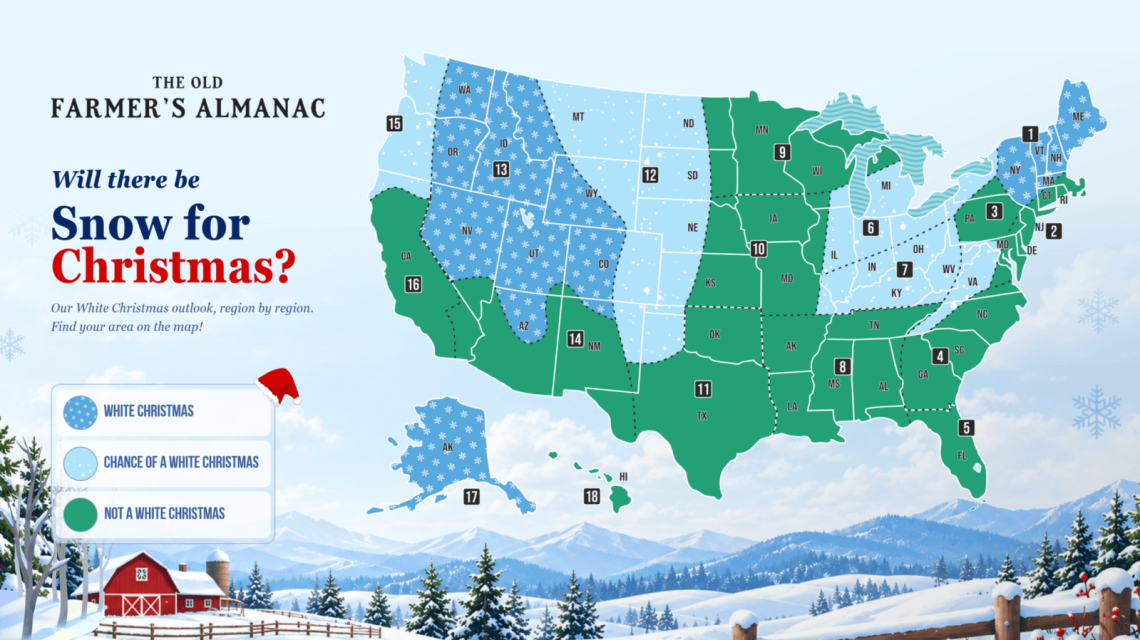
Americans hoping to see snow on Christmas morning in 2026 have better prospects in three main regions, according to The Old Farmer’s Almanac’s long-range forecast. The Northeast, Intermountain region, and Alaska are the most promising areas for a white Christmas. Meanwhile, regions like the Pacific Northwest, High Plains, Lower Lakes, and Ohio Valley have a possibility of experiencing snow.
The outlook is less favorable for much of the South and central U.S. regions. Areas like the Atlantic Corridor, Southeast, Florida, Deep South, Upper Midwest, Heartland, Texas-Oklahoma, Desert Southwest, and the Pacific Southwest are not expected to see snow. Hawaii also isn’t forecasted to have a white Christmas.
In the Appalachians, a split forecast suggests that northern areas might miss a white Christmas while southern parts have a chance.
A “white Christmas” does not mean snow must fall on December 25 itself. The National Weather Service (NWS) defines it as having at least 1 inch of snow on the ground at 7 am local time on Christmas Day. So, snow from earlier can contribute to a white Christmas if it remains on the ground.
Why Some Areas Have Better Chances
The regions with the best chance for snow generally align with parts where the Almanac predicts above-normal snowfall this winter. These include sections of the Northeast, Appalachians, some western U.S. areas, and Alaska.
In the Northeast, the southern area is expected to receive snowfall above the norm, with snowiest periods predicted for mid-to-late December. This could allow snow to settle before Christmas, making an official white Christmas more likely. Northern sections may see below-normal snowfall, reducing their chances.
The Intermountain region is likely to get more snow than usual, enhancing its prospects, while the Pacific Northwest should also expect above-average snowfall. However, the Almanac gives only a “chance” of a white Christmas there rather than an outright prediction.
Carol Connare, editor-in-chief of The Old Farmer’s Almanac, noted that winter looks different across the country. Some areas are in for a milder season, but others will still face significant cold and snow.
Understanding The Old Farmer’s Almanac
The Old Farmer’s Almanac, established in 1792, has a long tradition of offering long-range weather forecasts. Initially designed to aid farmers and gardeners, it now combines solar science, climatology, and meteorology. Historic weather patterns, solar activity, climate data, and large-scale climate signals all play a role in shaping the Almanac’s predictions.
For official long-range forecasts, the NWS’s Climate Prediction Center (CPC) offers U.S. climate outlooks for periods of eight to fourteen days, monthly, and seasonal outlooks. These give probabilities for temperature and precipitation trends.
The Almanac’s forecast provides early clues rather than definitive predictions of Christmas morning conditions. However, as the date nears, short-term forecasts will clarify expected conditions.
Historical Snow Data
The Almanac’s predictions align with historical data on where snow commonly appears on Christmas. National Oceanic and Atmospheric Administration (NOAA) data indicate states like Minnesota, Maine, upstate New York, Idaho, and various mountain regions often have snow on December 25. Alaska typically experiences a white Christmas as well.
Weather experts advise that historical probabilities serve as guidelines since actual snow cover can vary widely year to year, depending on pre-Christmas weather patterns. The Almanac reiterates that it identifies general trends rather than precise conditions months in advance, thus the predicted Christmas outlook might shift as December draws closer.
 Tragic Car Crash in Southern California Claims Teen Life
 Custody Dispute Involving Rep. Max Miller Delayed
 Historical Events in the Chicago Area on November 9
 University of Mississippi Investigates Racist Incident Caught on Ring Camera
 Hidden Camera Discovery in Tokyo Hotel Raises Privacy Concerns
 Death Row Advisor Urges Texas Governor-Elect to Halt Executions