In Alaska, political discussions often include the term ‘Lower 48,’ referring to candidates accused of being influenced by forces in the contiguous United States rather than representing local interests. This has emerged as a significant theme in Alaska’s U.S. Senate race, an important contest that could determine control of the Senate in the upcoming elections.
Republican Senator Dan Sullivan has made this issue central to his campaign against Democrat Mary Peltola, a former congresswoman. Sullivan accuses Peltola of aligning with ‘Lower 48 liberals,’ who oppose the expansion of oil and gas drilling in Alaska, a state that depends on the energy sector. Peltola, an Alaska Native, counters that she challenged then-President Joe Biden to secure approval for the massive Willow oil project in 2023, despite environmentalist opposition. She claims readiness to confront any Democrat from the Lower 48 who doesn’t understand Alaska’s needs.
The ‘Lower 48’ label taps into a sense of uniqueness about Alaska, sometimes called ‘The Last Frontier.’ As a state for less than seven decades, Alaska is famous for its natural beauty, wildlife, and extensive landscapes. Its remote nature, with many communities accessible only by air or water, fosters a culture of self-reliance. Residents often hunt and fish to stock up for winter, emphasizing their independent spirit.
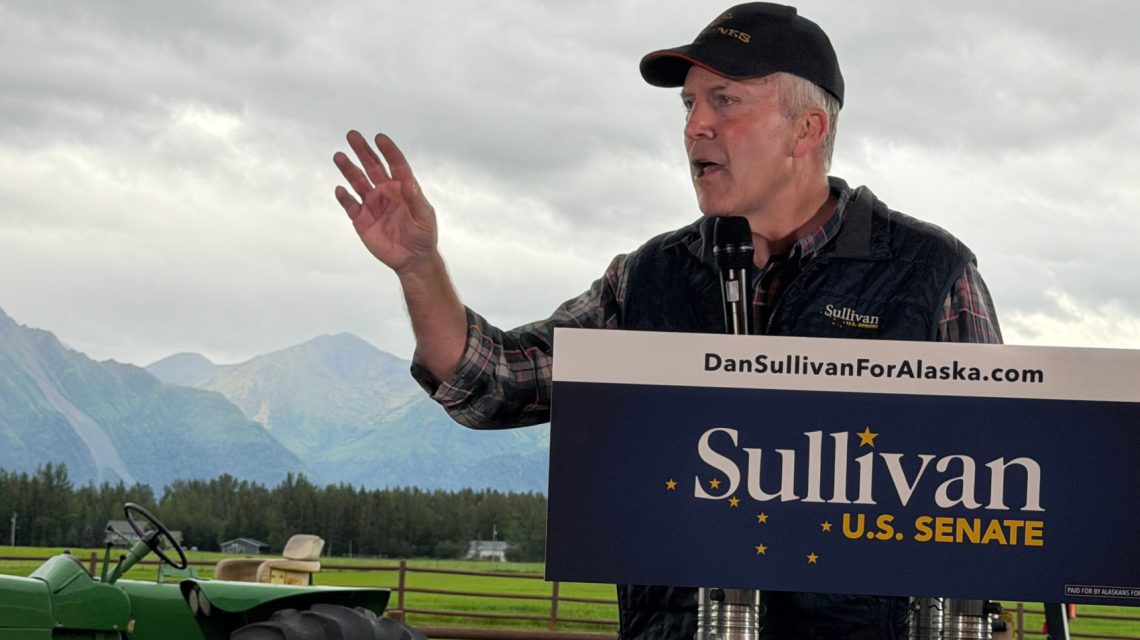
Sen. Dan Sullivan, R-Alaska, speaks at a get-out-the-vote event held at a farm in Palmer, Alaska, in August. Photo by Mark Thiessen/AP
Sullivan’s campaign, along with third-party groups, capitalizes on this sentiment, portraying their candidates as genuine advocates for Alaskans. Republican Andrew Halcro, a political podcast host and former state lawmaker, reflects on Alaska’s tough living conditions, which contribute to its distinct persona.
Alaska’s richness in natural resources has created friction with the federal government. The federal body owns approximately 60% of the state’s land, a relationship strained by Democratic administrations limiting development opportunities due to environmental concerns. Policies can shift noticeably between administrations. Under Obama and Biden, leasing was banned on half of the National Petroleum Reserve-Alaska, home to diverse wildlife. Trump rolled back these restrictions, facilitating oil and gas development, including Arctic National Wildlife Refuge leases.
Another dispute involves road building and logging in areas such as the Tongass National Forest, dating back to the Clinton administration. Additionally, Alaska’s share of royalties from oil and mineral activities on federal land continues to be contentious, with some lawmakers insisting the state was promised a larger share at its inception.
Despite dwindling oil production compared to its late 1980s peak, leaders highlight signs of a revival. Companies showed strong interest in leasing petroleum reserve land earlier this year, location of the Willow project. Communities are heavily affected by fluctuating fuel prices due to geopolitical tensions like the Iran war, notably remote areas relying on flown or barged fuel before rivers freeze.
Oil development is crucial for residents like Darryl Hugo of Anaktuvuk Pass on the North Slope. He supports Sullivan for the oil revenue that sustains vital services like the health clinic, school, and public departments in his town.
The election has candidates vying to be seen as Alaska’s authentic spokesperson. Robert Sewell, a Juneau-area independent, regards the ‘Lower 48’ claims as candidates vying for Alaska’s true representation. Peltola avoided endorsing Democratic nominee Kamala Harris amid her 2024 congressional race, dismissing support from national figures. In videos, she conveyed commitment to partnering with Trump on energy projects while keeping her distance from Lower 48 endorsements.
Sewell, backing Peltola, believes her stance on energy does not reflect support for Trump’s other policies.
‘Lower 48’ rhetoric permeates media and social channels, but its impact on voters seems uncertain. Peltola resonates with Alaska’s values through her slogan ‘Fish, Family, Freedom,’ drawing on her upbringing along the Kuskokwim River. Sullivan, originally from Ohio, moved to Alaska in the late 1990s, now advocating for Alaskans by opposing ‘Lower 48 liberals.’
Mary Peltola addresses supporters at an Aug. 18 election watch party in Anchorage, Alaska. Photo by Mark Thiessen/AP
PACs supporting Sullivan emphasize Peltola’s alleged disconnect from Alaska. Peltola’s campaign counters with ties linking Sullivan to ‘Lower 48 special interests.’ Halcro remains skeptical about the weight voters place on these alignments, considering broader political instability and the need for pragmatic leadership.
 Challenges in Addressing Global Crises
  Key Updates on U.S. Politics and International Relations
  Art Collective Challenges Presidential Policies with Satirical Installations
  Democrats’ Key Opportunities to Regain Senate Control
  U.N. Report Highlights U.S. Airstrike on Iranian School
  Immigrant Labor in Idaho’s Dairy Industry: Challenges and Impact