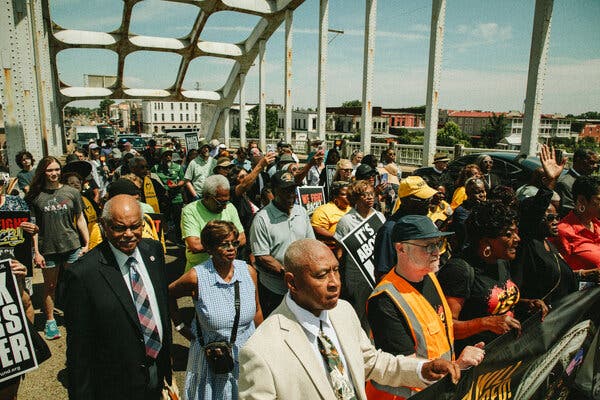
Earlier this month, individuals from across the United States gathered in Selma, Ala. Their mission was to march for voters’ rights, starting at Tabernacle Baptist Church and concluding on the far side of the Edmund Pettus Bridge. This event has drawn attention and different sentiments from various groups.
Republican officials are expressing satisfaction, while some voters feel confused and concerned about the implications. Civil rights activists are preparing for what they consider a significant battle.
Reporters Emily Cochrane and Rick Rojas, who specialize in Southern coverage, provided insights directly from Montgomery, Selma, Ala., Baton Rouge, Nashville, and Atlanta.
Political Landscape in Transition
The present moment is a perplexing one for voters residing in the South. Republican leaders in this region have rapidly redrawn congressional maps following the Supreme Court’s recent decision that weakened the Voting Rights Act. This led to the postponement of primaries, the withdrawal of a veteran House member from his re-election bid, and new candidates entering races ahead of the November midterms.
The potential outcomes of these changes could result in a comprehensive reshaping of the South’s political landscape. This area, already leaning red, may become further entrenched in the Republican column, which could threaten the careers of numerous Black Democrats.
In the midst of these changes, the rapid push for redistricting has ignited intense debates over the nature of representation in the South. It also raises pragmatic questions about the shifting district boundaries, which might soon make voters feel uncertain about their positions.
“They have literally created chaos,” remarked Mayor Chaz Molder of Columbia, Tenn. A Democrat, Molder found his home redrawn out of the Tennessee district where he spent months campaigning for Congress following the adoption of a new map by Republican state lawmakers in early May. “The voter is the one who loses in this kind of partisan gamesmanship.”
Wider Redistricting Efforts
Although recent redistricting is not confined to the South, and not all efforts are led by Republicans, President Trump urged the party to pursue this strategy before the Supreme Court’s ruling. This approach was intended to counter the challenges Republicans faced in maintaining their narrow House majority during the midterms.
Texas initiated the latest redistricting battle last summer at Trump’s suggestion, aiming to convert five House seats to Republican control. Democrats in California responded similarly, with other states soon following. The Supreme Court’s late-month ruling catalyzed a frenzy in the South, where the Voting Rights Act had previously upheld districts with a significant Black voter majority who favored Black Democratic candidates.
 President Trump Warns of Escalating War with Iran at UN Assembly
  Tariffs and Their Impact on Everyday Products
  Senator Criticizes Drug Policy After Ohio Tragedy
  Israeli Leader’s Upcoming U.N. Assembly Speech Marked by Controversy
  Republicans Call for Quick Resolution to Iran Conflict
  United States Secures Arctic Defense Pact