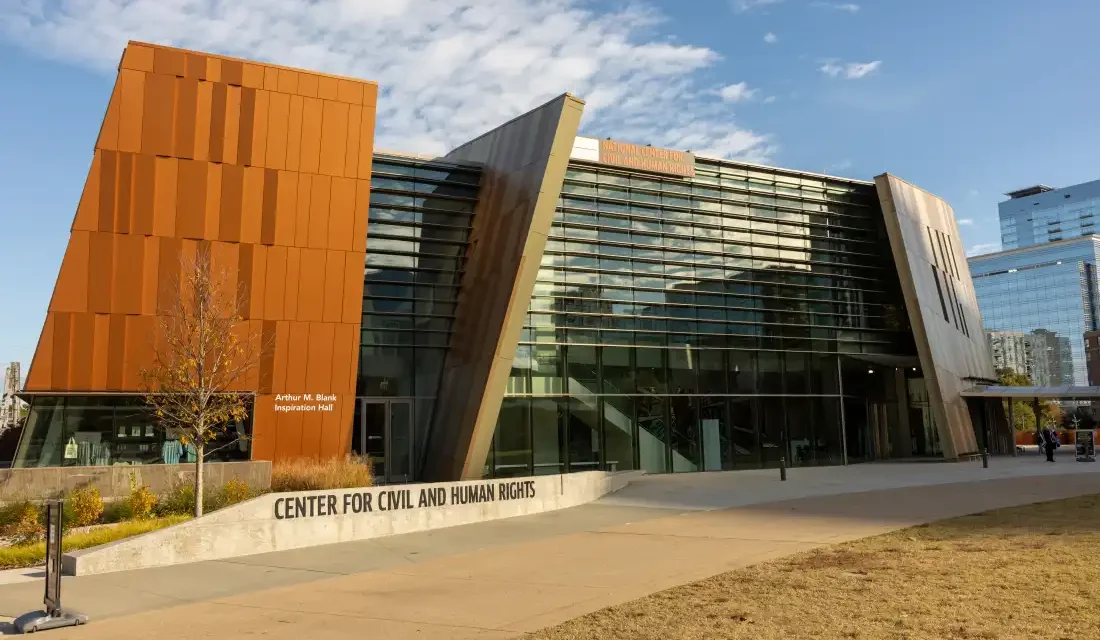
ATLANTA, GA – THURSDAY, NOVEMBER 19, 2026 – The exterior of the National Center for Civil and Human Rights serves as the backdrop for a historical exhibition. For the first time, the only known draft of one of America’s most renowned speeches is on public display. This draft is Martin Luther King Jr.’s handwritten version of his remarks at the 1963 March on Washington for Jobs and Freedom.
Jill Savitt, CEO of the National Center for Civil and Human Rights in King’s hometown of Atlanta, emphasized the artifact’s significance. “For just a few days, we have this incredible artifact here,” she said. “It is Doctor King’s handwritten, final draft of the speech that would become known as the ‘I Have a Dream’ speech.” The document evokes a profound connection, displaying his process of refining one of the most iconic speeches in U.S. history.
The draft, penned with blue ink on yellow legal paper, shows King’s edits as he worked through his thoughts. Savitt remarked on his struggle to convey a message to America about the nation’s unfulfilled ideals. The seven-page document remains on display through Sunday, housed in a glass case in the March on Washington gallery. Above the display, footage shows the massive crowd of 250,000 on the National Mall on August 28, 1963.
“Doctor King originally titled the speech ‘Normalcy Never Again,'” Savitt shared. The famous “I Have a Dream” lines were improvised during the speech. “The preacher in him connected with the crowd,” she added.
King’s spontaneous words at the Lincoln Memorial included: “I have a dream that my four little children will one day live in a nation where they will not be judged by the color of their skin but by the content of their character. I have a dream today.” In the pre-dawn hours from the Willard Hotel, King sent the draft to be typed on the day of the speech.
The handwritten copy was found by Xernona Clayton, an Atlanta civil rights leader who worked closely with King and his wife, Coretta Scott King. Her late husband, Edward Clayton, had been a speechwriter for King. She discovered the manuscript in the late 1990s, tucked in a manilla envelope in an old desk. “I recognized King’s handwriting immediately,” Clayton recalled, aware of the document’s importance.
Rediscovered a few years ago, she decided to share it with the world. Clayton plans to auction the manuscript through Christie’s in New York in January, with expectations that bids will exceed $10 million. Before that, it will be displayed in Chicago. Clayton hopes the document inspires people by reflecting on King’s enduring message.
For Shirley Franklin, former Mayor of Atlanta, the exhibit is personal. Recalling her presence at the March, she remarked on King’s meticulous attention to his speech. “Even with the brilliance of his words, he sought refinement,” Franklin said. “What remains memorable came straight from his heart.” Franklin, a witness to civil rights progress, acknowledges the ongoing nature of this work. “We’ve made some progress,” she said, “but much remains to achieve a truly free and loving community.”
Having contributed to the founding of the National Center for Civil and Human Rights, Franklin finds significance in Atlanta hosting the debut of this foundational document. “This is one of my favorite rooms,” she stated, as the ending of King’s famous speech echoed: “In the words of the old Negro spiritual, ‘Free at last, free at last. Thank God almighty we are free at last.'”
 The History of American Profanity
 Notable Chicago Figures and Their Impact
 Exploring The Sixth Floor Museum at Dealey Plaza
 Holiday Celebrations in Evanston, Glencoe, Skokie, Wilmette, and Winnetka
 Miss Universe Vietnam 2026 Nguyen Quynh Anh Loses Title
 Arnold Schwarzenegger’s Unique Journey from Austrian Tank Operator to Hollywood Star