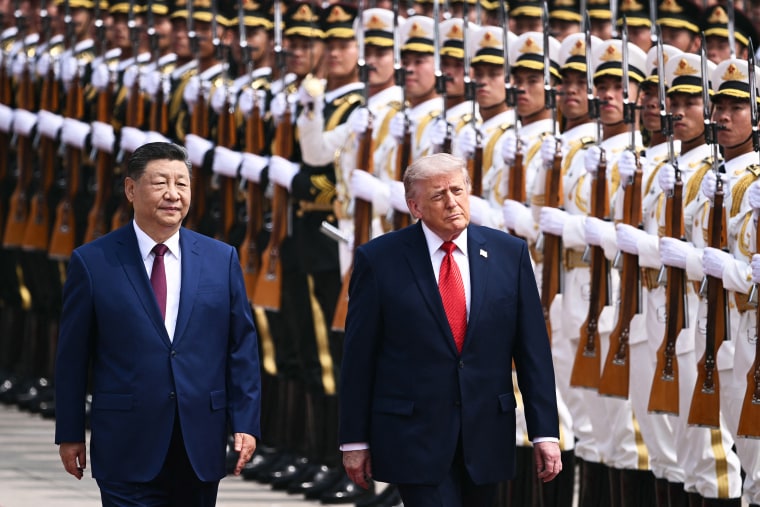
BEIJING — President Donald Trump met with Chinese President Xi Jinping at a summit in Beijing, tackling significant issues including the Iran conflict and the Strait of Hormuz blockade. Secretary of State Marco Rubio shared details in an NBC interview, clarifying that the U.S. was not seeking China’s assistance on Iran. “The Chinese are against militarizing the Strait of Hormuz and a tolling system, aligning with our stance,” Rubio stated after the two-hour discussion between Trump, Xi, and their teams.
Rubio, who traveled despite Chinese sanctions, described the summit’s discussions, which included Taiwan and the imprisonment of Jimmy Lai in Hong Kong. Lai’s 20-year sentence followed a national security trial marked by controversy. NBC News is providing live updates on President Trump’s activities in China.
Before the summit, there were expectations Trump might request Xi’s help to ease tensions in the U.S.-Israeli conflict with Iran. The blockade at the Strait of Hormuz has significantly impact global energy supplies, driving up gas prices. Trump previously credited China with facilitating Iran’s recent ceasefire negotiations. Rubio noted, “Global oil prices affect us since we’re part of the global market, but other nations face even higher costs.” However, he asserted, “We’re not asking for China’s help. We don’t need it.” Despite Rubio’s ongoing sanctions, China permitted his travel as they apply to his senator activities.
The trip—delayed initially due to the Iran conflict—spotlights China’s ties with Iran. China criticized U.S. and Israeli strikes starting February 28, advocating for diplomacy. Rubio explained Trump and Xi agreed on opposing Iran’s nuclear weapon development.
China’s readout from the discussions lacked mentions of Iran but acknowledged exchanges over “major international and regional issues” like the Middle East, according to Xinhua.
Rubio defended Trump’s recent dismissals of domestic financial stress during Iran talks, stressing Trump’s unwillingness to yield to Iranian pressure via U.S. politics.
No Change on Taiwan
Tensions over Taiwan remain central to U.S.-China relations, and Xi cautioned that mishandling Taiwan could lead to conflict. The U.S., while formally unaligned, supports Taiwan with defense arms, adhering to “strategic ambiguity” over military defense in case of Chinese aggression. “Our policies remain consistent,” stated Rubio. Concerns arise over Trump’s demands for Taiwan to bolster defense spending and accusations against its semiconductor industry for job losses.
Trump’s remarks fueled fears he might concede to Xi, shifting U.S. policy from “non-support” to “opposition” of Taiwan’s independence—a change Beijing desires. Rubio reported that arms sales to Taiwan were not a substantial topic during the Trump-Xi meeting.
In December, a record $11 billion arms deal with Taiwan was announced and a larger package seems forthcoming, despite China’s mounting military pressure on Taiwan, including frequent warplane and vessel deployments. “Any forced status quo change would harm both countries,” Rubio warned.
Trump Presses Xi on Jimmy Lai
Trump addressed Jimmy Lai’s situation with Xi, aiming for a positive outcome. Lai represents Beijing’s suppression of dissent, having drawn substantial attention. “The president consistently brings up such cases hoping for a favorable resolution,” Rubio remarked. When asked about Lai’s potential move to the U.S. post-release, Rubio responded, “We’d consider any workable arrangement that ensures his freedom.”
 Navigating Republican Challenges in Upcoming Midterm Elections
  Bobby Pulido: A Latin Grammy Winner in Congress?
  Illinois Struggles with Immigration Enforcement Post-Operation Midway Blitz
  Confronting the Challenges of Far-Right Fame
  Hungary’s New Government: Policy Shifts and International Relations
  Challenges Facing Prince Harry and Meghan Markle’s Return to the U.K.