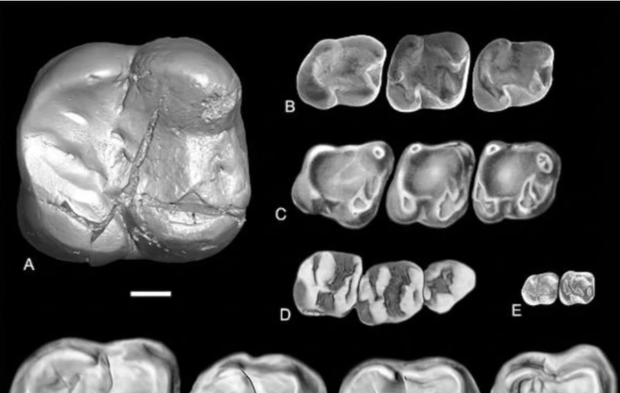
On November 5, 2026, scientists revealed the discovery of a giant rodent that lived in what is now southern Thailand about 33 to 35 million years ago. This previously unknown species, identified from two fossilized teeth, provides insights into the evolution of early rodents. The findings, published in Scientific Reports, are based on fossils found in 2004 at a coal mine in Krabi province.
Pannipa Tian, a geologist from Thailand’s Department of Mineral Resources, initially misidentified the incisor due to its large size. She described it as resembling a “giant rat’s tooth.” Another team member discovered a molar. The cream-colored incisor stood out among the dark coal deposits, leading to its identification as a fossil.
The Krabi basin has yielded other fossils, including ancient primates, carnivores, and hoofed mammals. However, at the time of discovery, researchers lacked the technology to identify the species. Now, over two decades later, a team from Thailand, France, and Canada achieved this through detailed analysis.
The giant rodent, named Yakamys sirindhornae after Thailand’s Princess Sirindhorn, is estimated to have weighed around 66 pounds. It belonged to the extinct Ischyromyidae family, distinct from the living capybara. This discovery suggests that ancient rodents may have evolved in Thailand before spreading worldwide.
While the new species appears large, other prehistoric rodents were even bigger. In 2020, scientists found a human-sized rat in the Amazon rainforest. Additionally, Uruguayan researchers uncovered a 1-ton rodent species in South America, while a 1,545-pound “Rat-zilla” was identified in 2003.
 Meteor Lights Up Skies Over North Carolina and Tennessee
 Can AI Possess Consciousness and Emotion?
 NASA Opens Applications for Aspiring Astronauts
 Scrutiny and Leadership in Focus
 NASA Seeks Next Generation of Astronauts for Moon and Mars Missions
 Restoring Confidence in American Scientific Careers