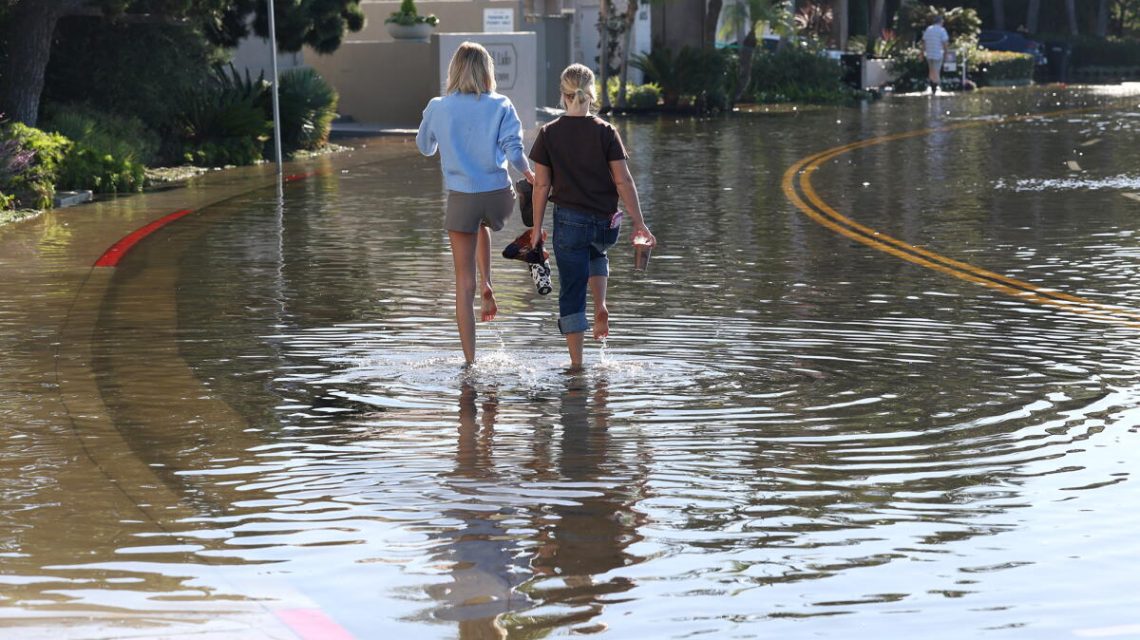
Recent coastal flooding in Southern California illustrates the potential severity of an El Niño-driven winter. This scenario is heightened by the expected rise in sea levels.
The recent flooding was exacerbated by two main factors: record-high ocean temperatures, which increase sea levels, and higher-than-normal tides. A third factor, powerful storms, could further boost wave height.
Last week’s tides themselves were moderately high. Combined with the high ocean temperatures, they significantly elevated sea levels.
Data showed that sea levels were 1.4 feet higher than normal in San Diego, 1.3 feet higher in Los Angeles, and 1.1 feet higher in San Francisco for the week ending Friday, according to National Oceanic and Atmospheric Administration oceanographer William Sweet.
Records for maximum sea levels were broken in Los Angeles, San Diego Bay, Santa Barbara, and La Jolla. At the San Pedro gauge in L.A., the sea level reached 8.02 feet on October 26 and 8.19 feet a day later, surpassing the previous record of 7.93 feet from January 10, 2005, during an El Niño winter.
Warmer water raises sea levels due to increased volume from heat. Unusually hot ocean water contributed to the sea level rise observed during the last week’s high tides, with temperatures expected to stay above normal this winter. “The king tides will increase flooding risk,” stated Dillon Amaya, assistant professor at North Carolina State University’s Department of Marine, Earth and Atmospheric Sciences. The ocean is forecasted to remain warmer than usual until spring.
As of Saturday, sea surface temperature at Scripps Pier in La Jolla registered at 75.4 degrees, 11.1 degrees above the historical average for Halloween, marking a record for the hottest Halloween since record-keeping began in 1916.
Flooding from last week saw 114 structures damaged in Huntington Beach, with parts of Pacific Coast Highway inundated. In Northern California, Marin County faced flooding up to 2 feet in bayside areas.
The sea level rise experienced now may shock some Californians, but in some ways, it has been a long time coming.
Kelvin waves, a key El Niño feature, transport warm water across the Pacific Ocean to California, raising sea levels and lasting for months. Robbie Munroe, a meteorologist with the National Weather Service, noted that Kelvin waves contribute to the high probabilities of coastal flooding.
The National Oceanic and Atmospheric Administration has reported new water level records in California due to oceanic Kelvin waves. These waves were instrumental in last week’s flooding, where sea levels rose nearly 2 feet beyond typical astronomical tides, per analysis by Amaya of North Carolina State University.
This elevated sea level has become more pronounced in California during El Niño events. Sweet, an oceanographer, explains that when these Kelvin waves hit, they can represent decades of sea level rise occurring in a month.
King tides, which align with lunar cycles, compound the issue by bringing some of the highest astronomical tides possible. The 18.6-year lunar node tidal cycle and the 4.4-year lunar perigee tidal cycle will align, causing exceptionally high tides in California soon.
Last week’s tides were substantial, albeit not “king tides”, said Daniel Swain, a climate scientist at UC Agriculture and Natural Resources. He attributes the record-breaking water levels mainly to extraordinary ocean level increases due to the marine heatwave and El Niño, combined with moderately high astronomical tides.
This winter could signal what California’s coast faces in the future. From 2000 to 2070, projections suggest more than 1 foot of additional sea level rise in Los Angeles under moderate estimates and nearly 3 feet under severe scenarios.
“California has already experienced significant background sea level rise,” Amaya explained, pointing to recent increases. “This serves as a precursor to a warmer future — our new reality.”
El Niño impacts are also felt inland. Arizona and the Four Corners region, which includes New Mexico, Utah, and Colorado, saw extreme rainfall attributed to excessive atmospheric moisture from the marine heatwave along Baja California, spurred by El Niño and climate change, according to Swain.
 Severe Smog Engulfs New Delhi After Diwali Celebrations
 North Siders Debate Over Proposed Electrical Substation
 Cumberland Island Land Swap Proposal Sparks Controversy
 Rethinking Flood Risk in Residential Areas
 Increasing Wildfire Risks and Strategies for Protection
 Community Activist Reshapes Local Politics in Prince George’s County