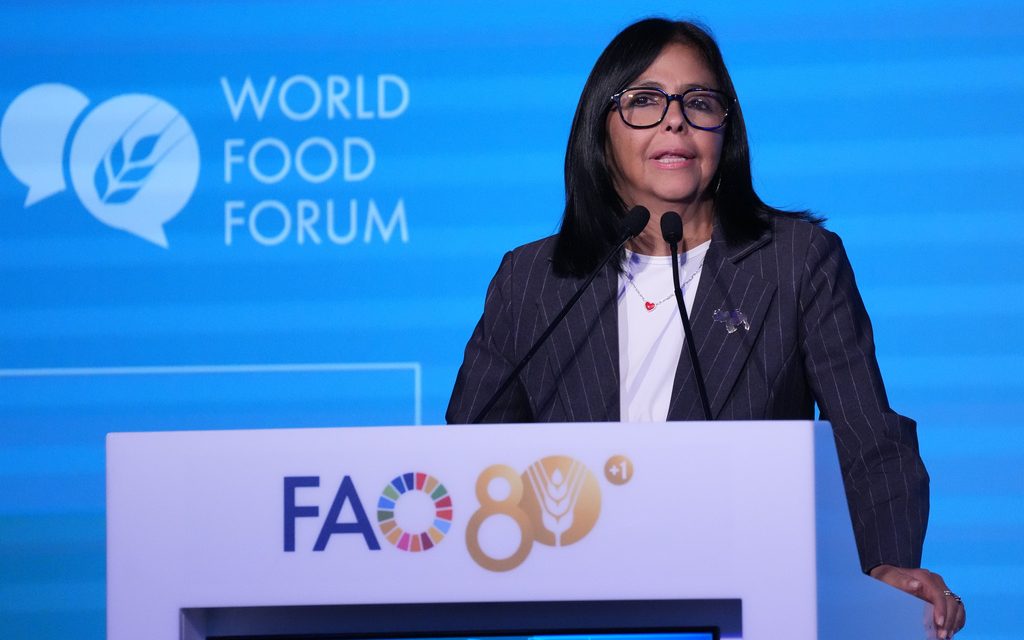
Delcy Rodríguez, the acting president of Venezuela, recently delivered a speech at the World Food Forum 2026 in Rome. Her country faces a significant challenge as the largest armed presence there is Colombian militia dissidents from the ELN and FARC, dominating border regions with destructive territorial conflicts.
These groups finance their operations by exploiting Venezuela’s critical minerals. They sell these resources to Chinese buyers, generating substantial profits and causing the displacement of over 56,000 people due to the violence.
Speaking from Barranquilla, Colombia, Secretary of State Marco Rubio acknowledged that these terrorists operate without restraint in the area. They cross into Colombia, commit violent acts, and return to Venezuela, where they find shelter. Rubio emphasized the need for decisive action against the corrupt officials in Venezuela who provide protection to these criminals.
The Trump administration faces a critical decision. It must apply pressure on the Rodríguez government, which Rubio criticizes for being treated as a security partner despite the region’s status as a haven for dangerous terrorists.
Venezuela’s cartels, notably Tren de Aragua, profit substantially from the extraction of gold and other critical minerals. In the Orinoco region, a network of officials and military commanders collaborates with various criminal entities, offering trading permits and equipment access for bribes.
The extracted minerals include tin, rare earths, and coltan, which are vital for numerous technologies. However, instead of supporting the U.S. defense sector, these resources head to Chinese intermediaries at high prices.
Armed groups manage to smuggle these minerals to ports for shipment to China. Their activities often involve corrupt practices such as falsifying export paperwork at La Guaira and bribing officials at the Colombian border.
Such activities hinder U.S. economic security and bolster Beijing’s control over mineral processing. While Venezuelan minerals could help the U.S. reduce reliance on China, the collaboration between Venezuelan officials and terrorists undermines American interests.
U.S. regulations, intended to promote investment, inadvertently exacerbate the problem. Sanctions allow American companies to buy Venezuelan minerals, presuming a legitimate market, which does not exist. The Treasury Department’s exemption for U.S. banks from the Bank Secrecy Act in Venezuela points to the economy’s opacity.
Despite attempts to facilitate investment, American businesses remain cautious. A Trump administration-brokered deal to import Venezuelan gold has stalled, as refiners hesitate due to links with criminal entities.
The current U.S. policy concerning Delcy Rodriguez inadvertently favors Chinese buyers and criminal networks. It encourages corruption and violence, while failing to establish conditions for legitimate business operations.
Washington must choose between continuing to support the Rodriguez regime, which protects terrorists, or targeting the corrupt system that fuels these crises. Rubio warns that this situation is unsustainable and demands confrontation.
Josh Birenbaum and Cristina Vollmer Burelli, experts in economic power and illegal mining advocacy, urge reconsideration of current strategies.
 Lessons from the Briefing Room
  Tensions Rise Between U.S. and Ukraine Over Intelligence and Support
  Rashida Tlaib’s Surveillance Bill Targets Federal Funding for License Plate Readers
  Religious Groups Oppose Hate Speech Training Law in California
  Macron Faces Criticism Amid French Protests
  Addressing the High Recidivism Rates in the U.S.