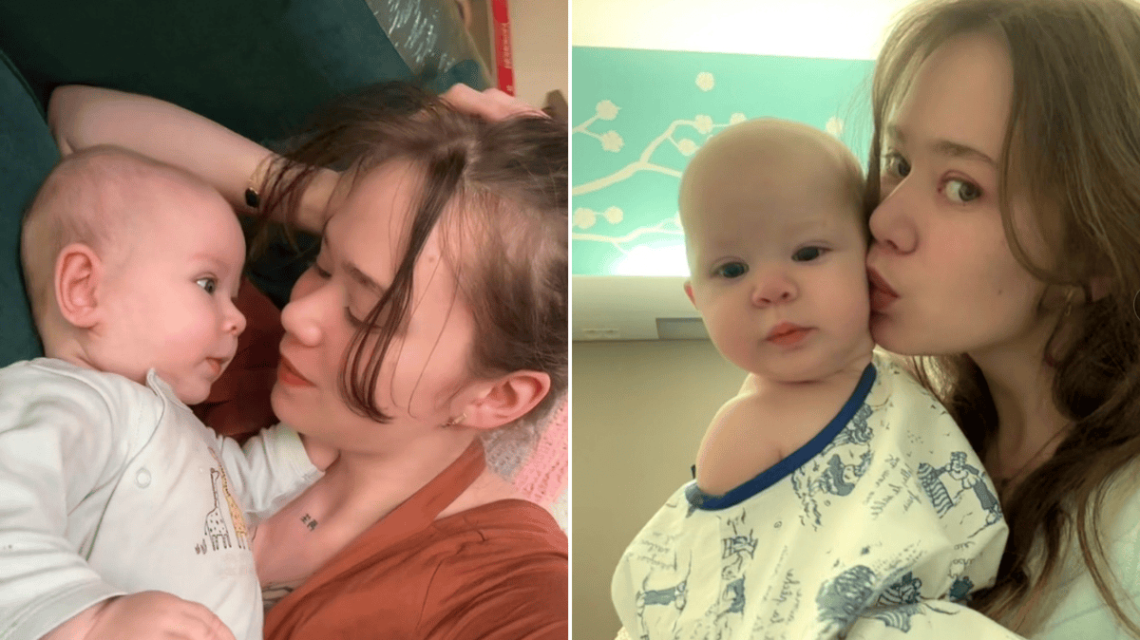
Marcelle Miller faced a life-changing moment with the diagnosis of a rare congenital condition in her three-month-old daughter. Until then, her pregnancy had been smooth. She told Newsweek, “My pregnancy was great. I only had a slight placental hematoma that resolved with rest. I didn’t have morning sickness. It was a dream pregnancy.” Miller, a young mother and a thriving realtor in Europe, delivered her daughter healthy after 42 weeks, with minimal labor complications.
When her daughter was three months old, Miller noticed something unusual. “I saw a small cloudy ring in her right eye,” she shared, which led her to seek medical advice. Her research introduced her to congenital cataracts, a rare condition affecting three to four out of every 10,000 U.S. births. Babies with this condition have a cloudy lens, possibly causing vision issues, a white-looking pupil, and misaligned eyes. Treatment often requires early surgery, followed by visual aids and therapies.
Miller recalls her devastation upon receiving the diagnosis of bilateral congenital cataracts. “My life felt like it crashed,” she said. “As parents, we all have dreams for our children. We never want them limited. Realizing my daughter’s future is unknown was the hardest part.” Although the exact cause often remains unidentified, doctors suspect a genetic mutation found in Miller’s partner may have influenced the cataracts. The family is still awaiting final information.
Miller quickly took action to secure treatment, emphasizing the condition’s seriousness. Her daughter was referred to a specialist, and since then, she has undergone four surgeries to replace the clouded lenses with artificial ones. Though she needs visual aids, her daughter has yet to regularly use contacts or glasses.
Miller acknowledges the emotional strain her daughter’s condition has placed on her. “Seeing her go through surgery was heartbreaking,” she admitted. Despite potential future surgeries, Miller remains hopeful for her daughter’s limitless life. She encourages other parents in similar situations to hold onto hope. “I’ve seen the worries of parents and felt it myself,” she expressed. “Our children, knowing only their reality, will lead regular lives. It’s a change in our expectations that’s needed.”
 Vicky Titcomb’s Cancer Journey and Treatment Advances
  A Necessary Solution for Alzheimer’s Disease
  The Urgency of Treating Ectopic Pregnancies Safely
  Concerns Over Reimbursement Cuts for Autism Care in Georgia Medicaid
  AI’s Role in Enhancing Human Connection Through Innovative Ventures
  Addressing Poverty in Medical Practice