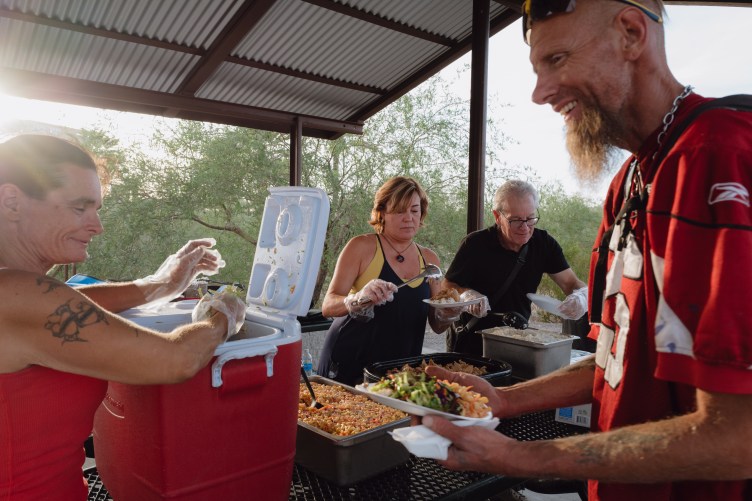
For approximately a year, Austin Davis’ phone has been overwhelmed with requests for help from individuals across the Phoenix metropolitan area. Davis, a 26-year-old poet and advocate for homeless individuals, has become an unofficial hotline for emergency shelter requests.
A school employee contacted him to help a homeless family since space wasn’t available at shelters. A mother of five living in a storage unit reached out after receiving a referral from a homeless services organization. People such as a mother panhandling with her six children have been directed to Davis by passersby who believe he could provide shelter.
These individuals usually first reached out to the official help channel, 211, but were often told that shelter or housing placements could take months. Consequently, Davis has become the last resort, receiving calls and texts from caseworkers, teachers, social workers, police, and hospital staff. Even official channels like 211 and the Family Housing Hub have referred individuals to his nonprofit organization, AZ Hugs.
A study revealed that using the official channel to address family homelessness seldom leads to offers of help.
Davis runs AZ Hugs outside the traditional system, organizing daily meals for homeless individuals at a suburban Phoenix park. However, this has resulted in 35 citations against him by Tempe officials. In 2024, he reached a deal to plead guilty to one permit violation, and the city dismissed the other citations.
In 2025, Davis and other advocates sued Tempe, alleging free speech violations due to citations for feeding people in parks. After the city’s ordinance revision, Davis withdrew the lawsuit.
Recently, Davis has focused on the “family homelessness crisis,” raising money via social media. This effort is to pay for hotel rooms for homeless families, often with young children, to prevent them from sleeping outdoors or in cars.
He acknowledges that assistance is insufficient and emphasizes the need for a larger effort involving nonprofits and local and state officials, although such efforts remain lacking.
Maricopa County reports the number of homeless families now stands at 2,103, its highest level since 2015. This figure is believed to be an undercount, as the tally occurs on a single night by volunteers who can miss those hiding from sight.
As of late September, nearly 200 families are on the shelter waitlist. Excluded are families who couldn’t get on the list or those dismissed as not actually homeless.
Research indicates that homelessness negatively impacts children by disrupting brain development and causing permanent changes in both brain and body.
Candice Ortiz sought stable shelter and housing since spring, as her situation devastated her 8-year-old son, who suffered from heat exhaustion and missed school.
She repeatedly contacted 211, only to receive information easily accessible online. At one point, she was told her situation wasn’t considered homelessness despite sleeping in a car. This led her to seek other options.
In June, Ortiz visited Phoenix cooling centers for reprieve and was directed to UMOM’s emergency shelter, but was informed no systems had her information, leaving her without accommodation.
UMOM set aside 23 units and tents for families during extreme temperatures, receiving government grants exceeding $7 million, and assisted nearly 300 households as part of Phoenix’s heat relief efforts.
In early April, Davis initiated an online petition urging Gov. Katie Hobbs to declare a state of emergency for family homelessness. Garnering over 5,000 signatures, it argued that such a declaration might unlock emergency shelter funding.
Hobbs has allocated over $245 million statewide for efforts like eviction prevention and emergency shelter. Nonetheless, Davis continues to advocate for more vigorous responses and urges greater action.
Recently, Davis launched an overnight shelter at the First United Methodist Church of Mesa, accommodating at least six families. Despite these efforts, Davis perceives these as temporary solutions to an extensive problem.
On-site at the church, families arrived with belongings packed in vehicles. Volunteers set up tents inside a large room, providing meals and supplies. As the families settled in, the space became silent; however, by 6 a.m., everyone needed to vacate.
The number of homeless individuals with families in Maricopa County reached its peak since 2015, highlighting the ongoing struggle and need for comprehensive strategies.
 A Mother’s Journey with Her Son Born with Clubfoot
  The Journey of Hersh Goldberg-Polin: A Tribute to an Ordinary Life
  Understanding Family Estrangement Over Boundaries
  Sam McDowell: A Baseball Legend’s Triumph Over Adversity
  Randy Moss: From Football Legend to Avid Fisherman
  Significant Events in Chicago History on October 6