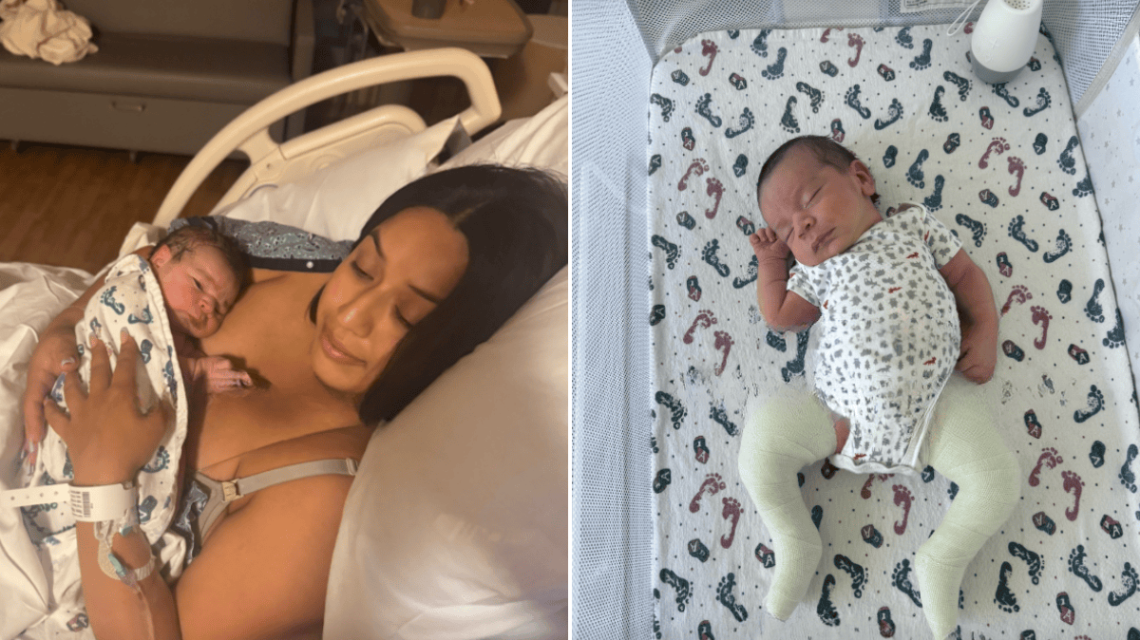
From the moment her son arrived in the world, Michelle Reyes noticed he was different. Reyes, a mom of three from Buena Park, California, recalls her third pregnancy as being particularly challenging. ‘My pregnancy with Tommy was really hard on my body,’ she explained. ‘I needed a chair at work due to difficulty standing for long periods.’
Despite the pregnancy challenges, doctors did not identify any concerns. Reyes mentioned, ‘All of my tests were good.’ She believed she was expecting a healthy baby boy. Yet, upon giving birth to Tommy, Reyes’s concerns grew. ‘The first thing I noticed was his feet; they were severely turned inward,’ she remarked. Nurses reassured her, attributing it possibly to Tommy’s womb position.
Days later, while recovering in the hospital, Reyes encountered a specialist who wanted X-rays of Tommy’s feet. ‘That’s when we learned Tommy had severe bilateral clubfoot,’ Reyes said. Clubfoot is a birth defect affecting both feet, impacting approximately 1 out of 1,000 babies in the US. Reyes was shocked, having recently seen clubfoot mentioned in a random social media video. ‘I had never heard of clubfoot before,’ she recalled.
‘I started blaming myself,’ Reyes admitted, wondering about her pregnancy habits. Her doctor clarified that clubfoot happens without specifics regarding parental actions. An appointment was scheduled for Tommy with a specialist.
Tommy was only 6 days old when casts were applied to his legs. ‘The casts were from thighs to toes,’ Reyes explained. Every two weeks, new casts were applied, gradually correcting the condition. After five adjustments, Tommy underwent an Achilles tenotomy—minor surgery to enhance foot position. Post-surgery, he wore boots connected by a metal bar.
Initially, Tommy wore these boots 23 hours a day for six months. ‘After that, he went down to 14 hours daily, mostly during sleep,’ said Reyes. The aim is to reduce the boot-wearing time, depending on progress. The Ponseti method has high correction rates, around 90 to 100 percent. A related study reported a 93 percent success rate when the complete protocol is followed.
‘The whole process has been amazing to watch. Tommy’s improvement since birth has been remarkable,’ Reyes noted. He engages in typical baby activities, crawling, attempting to walk, swimming, and more.
Reyes holds hope that Tommy’s start will not restrict him. ‘I want him to remember his story, his bravery during procedures and challenges,’ she said. Reyes wishes her journey offers hope to similar parents. ‘It’s okay to be overwhelmed initially, but there’s plenty of hope,’ she encouraged.
For related inquiries, Newsweek editors Marc Vargas and James Debens can be contacted.
Reference: Abdelgawad A., Lehman W.B., van Bosse H.J.P., Scher D.M., Sala D.A. ‘Treatment of idiopathic clubfoot using the Ponseti method: minimum 2-year follow-up.’ Journal of Pediatric Orthopaedics B. 2007;16(2):98–105. DOI: 10.1097/BPB.0b013e32801048bb.
 Efforts in Maricopa County to Address Family Homelessness
  Building Resilience: Learning from Crisis Management in Healthcare
  The Journey of Hersh Goldberg-Polin: A Tribute to an Ordinary Life
  Understanding Family Estrangement Over Boundaries
  Bruce Arians Promotes Prostate Cancer Awareness Through NFL’s Crucial Catch Initiative
  Trump to Speak with Putin Amid Suspected Plague Case in Russia