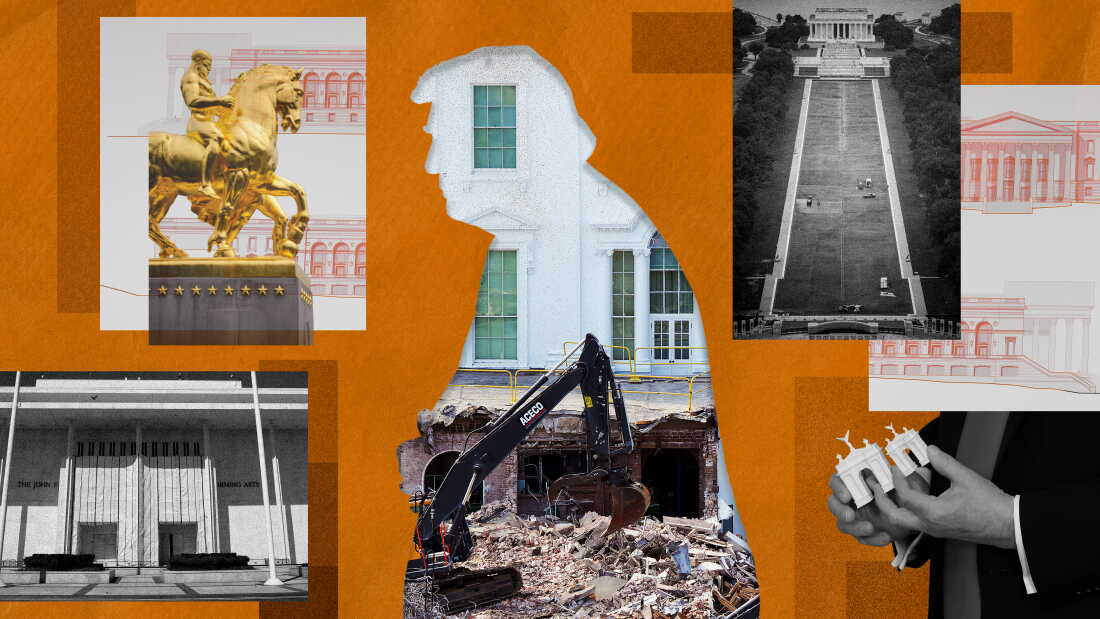
President Donald Trump’s second term has been marked by extensive construction efforts in Washington, D.C., earning him the nickname “builder-in-chief.” From creating a larger ballroom by demolishing the East Wing of the White House to installing a helipad on the South Lawn, his projects are numerous and ambitious.
“The best thing I do in life is build,” Trump stated in May.
Under Trump’s leadership, the Lincoln Memorial Reflecting Pool was repaved with a blue hue symbolic of the American flag, a project still incomplete due to errors and legal complications. New sculptures were installed, and existing ones restored, all contributing to a design he calls a “national heroes” sculpture garden in West Potomac Park.
Trump’s vision extends to transforming the East Potomac Golf Links into a championship-level venue and affixing his name to the Kennedy Center, with wild plans to demolish it if denied. A large arch project near Arlington National Cemetery has morphed from a tribute to himself into a military complex. Greg Werkheiser, a lawyer engaged in opposing lawsuits, comments on Trump’s mindset: “Much of his self-worth is tied to this mythology of Trump as a builder.”
The White House spokesperson stated that Trump continues to deliver on his campaign promises and enhance the nation’s capital: “No other president has done more to beautify our Nation’s interior than President Trump.” Despite positive messaging, Trump’s intense pursuit to memorialize his presidency has resulted in widespread opposition, protests, and lawsuits.
According to Barbara Res, a former executive within the Trump Organization, Trump’s disregard for historical preservation is rooted in his real estate past. Trump has rebranded the arch project near Arlington as a military complex, claiming: “Nobody will do it once I’m gone.” His career as a developer in New York City informs these decisions, although past ventures faced similar obstacles.
Barbara Res provides context, saying Trump’s early projects used financial loopholes and faced legal challenges. Critics argue that these D.C. projects risk memorializing Trump himself rather than representing historical American figures. Historians worry about the precedent being set, as Trump’s unilateral moves avoid congressional authorization, challenging traditional balance of power.
The Trump Tower is an illustrative example of these concerns, with Trump’s early career marred by similar conflicts. During its construction, Trump disregarded agreements to preserve valuable art on the facade, leading to destructive removal despite the art’s historical significance.
Res recalls Trump’s attitude as indifferent and dismissive of preservation, equating it to an “experience of the negative delights of power.” Cultural preservation expert Charles Birnbaum warns that current administration efforts mirror Trump’s disregard for historical safety, instead damaging historical sites.
Naftali argues previous presidents acted as custodians of D.C. monuments, collaborating with Congress to honor national leaders while Trump’s actions suggest ownership rather than stewardship of these sites, influenced by his developer background.
Across the political landscape, figures point to a pressing need to balance power as Trump rushes to mark his legacy. Trump’s plans, including a potential presidential library hotel in Miami, are unlike traditional presidential memorials focused outside D.C.
As Trump refocuses on Washington’s architecture and his legacy, concerns grow over lost historical integrity. Observers warn of potential shifts in Congress post-midterms impacting the longevity of these projects.
Experts advocate for maintaining the separation of powers to ensure fair governance up to America’s 300th birthday, amid fears that Trump’s self-driven projects could overshadow public interests and historic preservation.
 Foiled Attack Near RAF Fairford Raises NATO Tensions
  Heightened Risks at U.S. Military Bases in U.K. Amid Iran Conflict
  AOC Event at Cornell University Sparks Controversy
  Rahm Emanuel Advocates for Ethics Reform and Educational Accountability
  President Trump to Make Major Announcement
  Reflecting on Legislative Achievements and Future Challenges in Congress