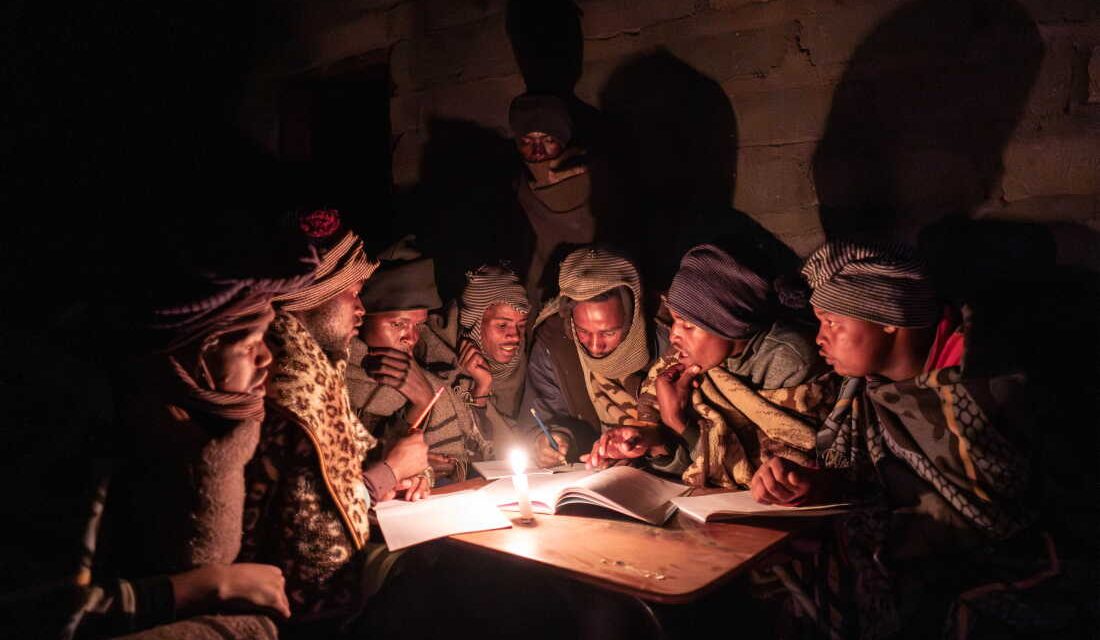
As the sun sets behind the peaks of central Lesotho, Kabelo Mohai and Lepeli Maapesa begin their journey to school. The two young men, wrapped in wool blankets for warmth, navigate rocky paths nearly 8,000 feet high. They are among many who attend night classes at the Good Shepherd School in Semonkong, a beacon of education for shepherds.
Shepherding is a way of life in Lesotho, deeply intertwined with the country’s economy. Wool and mohair constitute nearly 60% of agricultural exports, supporting many rural livelihoods. However, this tradition often disrupts education. A World Bank report found almost half of the boys in the country involved in herding. For many, herding means missing out on school.
Mohai and Lepeli are two of many shepherds who walk long distances to attend night school. Mohai, who started working with animals at nine, finished only primary school. He lives in a basic hut high in the mountains, sharing his life with his dog and his flock of sheep and goats. Despite the hardship, he appreciates the independence herding offers.
To help youth like Mohai and Lepeli, several dedicated night schools operate across Lesotho. Often run by volunteers with minimal resources, these schools offer basic education—reading, writing, and counting. For many young shepherds, night school is their only chance to envision a different future.
At the age of 15, Mohai began living in a cattle post to herd full-time. Despite the challenges of mountain life, he values the opportunity to learn. Every weekday, after a day of herding, he walks to class and dreams of future possibilities, including becoming a soldier.
The classroom at Good Shepherd Night School bustles by 8 p.m. Mohai and Lepeli share a desk as Sister Rosemary Mokebe teaches. Founded in 2003 by the Good Shepherd Sisters, the school serves over 40 students, offering classes for different age groups. Sister Mokebe emphasizes the importance of educating shepherds, noting their critical role in Lesotho’s economy.
The government estimates there are 155 such schools nationwide. Initially supported by NGOs, these schools are now overseen by the Ministry of Education, although financial support faces delays. Sister Mokebe’s persistence ensures the school remains open, providing education and social opportunities for shepherds.
Shepherding can be isolating, hindering social skills and leading to issues like violence. Night schools offer both education and a social hub for shepherds. In addition to lessons, social workers educate students on health issues, including HIV and tuberculosis.
In the Thaba-Tseka district, teacher Mampho Makha knows the impact of illiteracy well. Inspired by teaching her father to read, she opened a school in 2003. She now teaches 35 students, including shepherds, farmers, and others, aiming to empower them through literacy.
Despite challenges, Makha continues her mission, driven by her desire to see everyone become literate. Night falls, and students disperse, but Makha, a flashlight in hand, begins her long walk home, ready to return the next day.
Julie Bourdin is a freelance journalist focusing on human rights and climate stories in Africa and Europe. Tommy Trenchard, an independent photojournalist in Cape Town, has contributed photos and stories to NPR, receiving accolades for his work.
 Nor’easter Hits U.S. East Coast, Bringing Severe Weather and Flooding
  The Scope of Accountability in Missouri’s Education System
  Challenges in Addressing NYC Specialized High School Admission Policies
  Addressing Student Loneliness in the Digital Age
  Supreme Court Blocks Missouri Congressional Map Favoring Republicans
  Unexpected Discovery of Fake IDs by TSA Officers at LaGuardia Airport