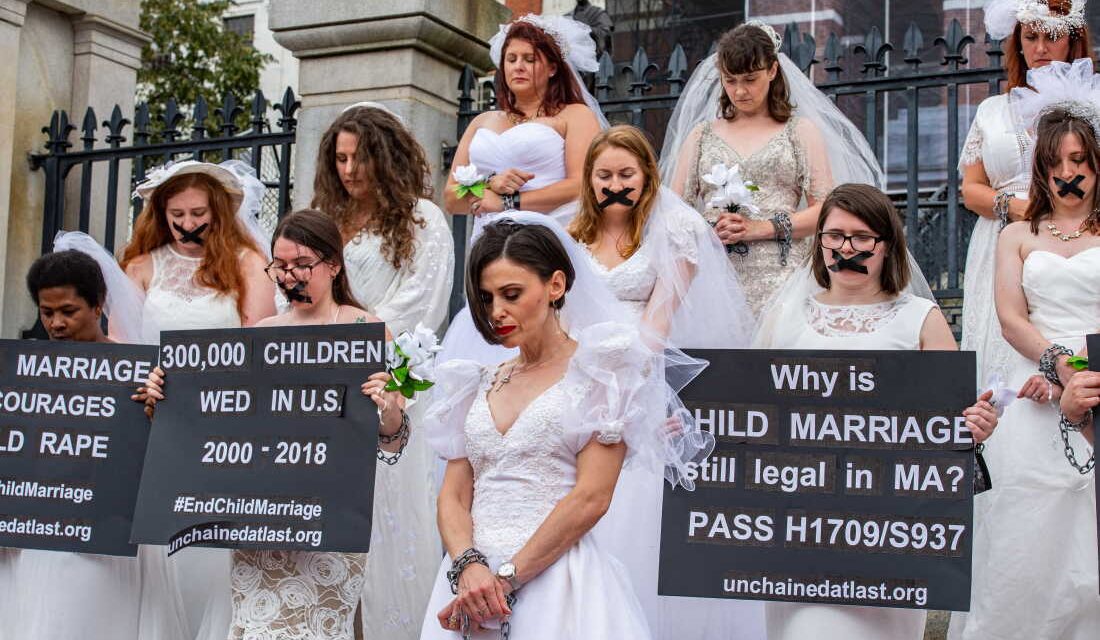
Advocates and survivors of child marriage recently gathered in Boston, urging an end to the practice. Child marriage remains legal in over 24 U.S. states under specific conditions. A new bill in Congress proposes a national ban. Around 12 million girls become child brides annually, according to the U.N. The organization calls it a human rights violation, with issues like early pregnancy, schooling interruptions, and increased risk of domestic violence.
Child grooms also face pressure to abandon education and support families prematurely. The U.N. aims to end child marriage by 2030. The U.S. Congress introduced a bill in July to make child marriage illegal nationwide. A U.N. resolution adopted on September 4 has established November 27 as the International Day to End Child, Early, and Forced Marriage.
This initiative is part of a series exploring long-standing global health challenges. We explore progress toward ending child marriage worldwide.
Various nations, including Sierra Leone, England, the Philippines, and the Dominican Republic, have moved to set the legal marriage age at 18 without exceptions. In the U.S., the national law proposal sparks debate, with critics questioning provisions and overall approach. Enforcement, not legislation, is often the challenge. In India, despite outlawing underage marriage, the practice persists. UNICEF estimates 1.5 million minors are married annually in India.
U.S. Representative Gwen Moore, along with Senators Dick Durbin, Brian Schatz, and Kirsten Gillibrand, introduced the Child Marriage Prevention Act on July 16. This federal bill advocates for a nationwide minimum marriage age of 18. Moore highlighted, “In 34 states, including Wisconsin, child marriage is legal. Many marriages involve young girls and adult men. It’s time we end this predatory practice.” Advocates have struggled to push for state-level reform; this federal effort could support those changes and provide states with data to understand the problem’s scope better.
Between 2000 and 2021, over 314,000 minors were legally married in the U.S., many to adults. Unchained At Last, a nonprofit focused on ending forced and child marriage, estimates a fifth of these marriages involved brides too young for consensual sexual relations. In many cases, state statutory-rape laws’ marital exemptions prevent prosecuting adult spouses. Young spouses face legal hurdles in hiring attorneys, filing for divorce, or seeking protection from abuse.
The Tahirih Justice Center supports the proposed legislation. Casey Carter Swegman, the center’s Public Policy Director, stresses that apparent consent from a minor doesn’t guarantee free choice. “Pressure from family could make a minor claim consent, risking denial could lead to punishment or violence at home,” she explains.
While the bill has support, some question its sufficiency. Fraidy Reiss from Unchained At Last criticizes sections allowing states to study rather than ban child marriage and permitting minors to qualify for U.S. spousal visas. “If states are incentivized to examine rather than outlaw child marriage, it would be devastating,” she warns.
Some Republican lawmakers, like Missouri representative Dean Van Schoiack, oppose the bill, citing government overreach and interference with parental rights. This opposition persists in states like Oklahoma and Missouri.
Globally, countries are adopting firm restrictions. Sierra Leone’s Prohibition of Child Marriage Act sets the marriage age at 18 without exceptions. Colombia and Bolivia have also passed laws eliminating loopholes and banning child marriage. Despite strict laws, enforcement remains weak in regions like sub-Saharan Africa and India, where cultural traditions often prevail.
Renu Singh of Young Lives India emphasizes the need for cultural change alongside legal reforms. In India, child marriage persists despite laws against it, driven by cultural practices like dowries and safety concerns for girls. Boys are married early too, motivated by financial reasons across various income groups. Community norms must shift to see meaningful progress.
The international movement to elevate child marriage on the global agenda continues. Bhuwan Ribhu, from Just Rights for Children, highlighted the U.N.’s role in intensifying efforts to eradicate child marriage by 2030. His organization reinterprets child marriage as child rape in legal terms, pushing for children’s legal protections.
Overall, achieving progress toward ending child marriage requires systemic changes, legal measures, and cultural transformation. Establishing an International Day to End Child, Early, and Forced Marriage sets a platform for global accountability.
 Patrick Clancy Shares Insights into Tragic Family Loss
  Midair Altercation on Bangladesh to London Flight
  Revival of Organized Labor in 2026
  Community Relief Efforts at New Orleans Free Store
  Girl Scout Troop 35579 Project: Pet Pantry for Woodland Park
  Children’s YouTube Star Ms. Rachel Draws Scrutiny Over Links to Palestinian Photojournalist