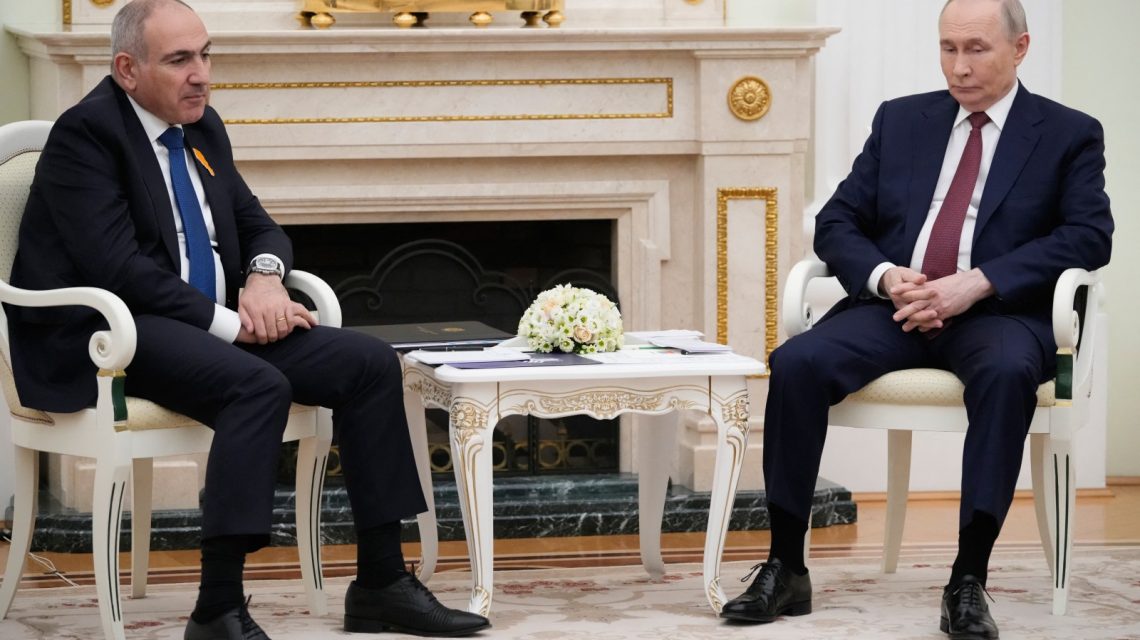
Armenia is considering leaving the Collective Security Treaty Organization (CSTO), raising questions about Russia’s historical influence in the region. Armenian Prime Minister Nikol Pashinyan announced plans to halt cooperation with the CSTO due to its failure to support Armenia in conflicts with Azerbaijan. He expressed willingness to accept any decision by the CSTO to expel Armenia, stating, “I will be very pleased if the organization decides to expel the Republic of Armenia from the Collective Security Treaty Organization.”
Kremlin spokesperson Dmitry Peskov acknowledged Armenia’s right to exit if it no longer sees the CSTO as beneficial. Richard Giragosian, director of the Regional Studies Center in Yerevan, noted the CSTO’s limited reliability in protecting Armenian territories against Azerbaijani aggression. Giragosian indicated that Armenia remains cautious to avoid provoking Russia unnecessarily, opting to suspend CSTO participation instead.
Historical Context
Russia’s influence over Armenia began with an 1828 treaty that integrated much of modern Armenia into the Russian Empire. Armenia joined the Soviet Union in 1920 before gaining independence in 1991. Despite independence, Armenia maintained military ties with Russia and joined the CSTO as conflict over Nagorno-Karabakh with Azerbaijan intensified. Azerbaijan and Georgia joined the Collective Security Treaty but left before the CSTO was formed in 2002. Uzbekistan joined briefly before leaving in 2012.
The Nagorno-Karabakh issue has long complicated Armenia-Azerbaijan relations, resulting in skirmishes and significant conflicts. Russia deployed peacekeepers but was hesitant to fully back Armenia, especially as its own challenges, like the 2022 Ukraine invasion, emerged.
Armenia’s Position
Despite longstanding ties, Pashinyan acknowledges Russia’s limits in fulfilling its role as Armenia’s security guarantor. The CSTO includes Armenia, Belarus, Kazakhstan, Kyrgyzstan, Russia, and Tajikistan. Of these, only Belarus has actively supported Russia’s conflict in Ukraine. Russia continues to advocate for CSTO cooperation. Mher Sahakyan from the China-Eurasia Council noted the CSTO’s diminished importance for Armenia’s security since internal changes in 2018. Sahakyan pointed to Azerbaijan’s attacks on Armenian territory and increased ties between Russia and Turkey as factors in Armenia’s CSTO stance.
Armenia has opted to suspend CSTO participation as a political signal of dissatisfaction while preserving strategic options. Russia’s increased pressure on Armenia to choose sides, using economic and energy leverage, complicates this decision.
U.S. Involvement
As Russia’s grip loosens, the U.S. seeks a stronger partnership with Armenia. Former U.S. President Joe Biden enhanced diplomatic ties, and Donald Trump continued these efforts, hosting Armenian and Azerbaijani leaders in 2025 to advance the “Trump Route for International Peace and Prosperity” (TRIPP). TRIPP involves a rail route linking Azerbaijan to Nakhchivan via Armenian territory, a project reaffirmed by U.S., Armenia, and Azerbaijan. Pashinyan aims to distance from the CSTO and seek EU membership, yet still values ties with Russia’s economic bloc, the Eurasian Economic Union.
Armenia faces the challenge of balancing its Western interests with Russian reliance. Its policy aims to diversify security partners without falling into a binary confrontation. Sahakyan suggested that while U.S.-Armenia partnerships can bring economic gains, the region remains a lower priority for Washington.
Navigating Geopolitical Alignments
Tensions remain high in the region. The U.S. is involved in military operations against Iran, whose territory lies near the planned TRIPP. Armenia must carefully recalibrate its geopolitical strategies. Sahakyan emphasized the need for Armenia to engage with global actors without taking sides, combining balancing and hedging strategies. He doubted Armenia’s potential to join NATO, given its current stance. While the U.S.-Armenia partnership is significant, Sahakyan stressed that the South Caucasus is not a top U.S. priority, affecting long-term regional involvement.
 Investigation into Lion Deaths in Tanzania
  Merz Stays Resolute Amid Electoral Shifts in Germany
  The Impact of Arts and Closure on Democracy
  U.S. Ambassador Comments on Iran War Duration Amid Political Concerns
  U.S.-Iran Relations and Diplomacy at Upcoming U.N. Assembly
  US-China Relations Under Scrutiny: Expert Warns of Escalating Tensions