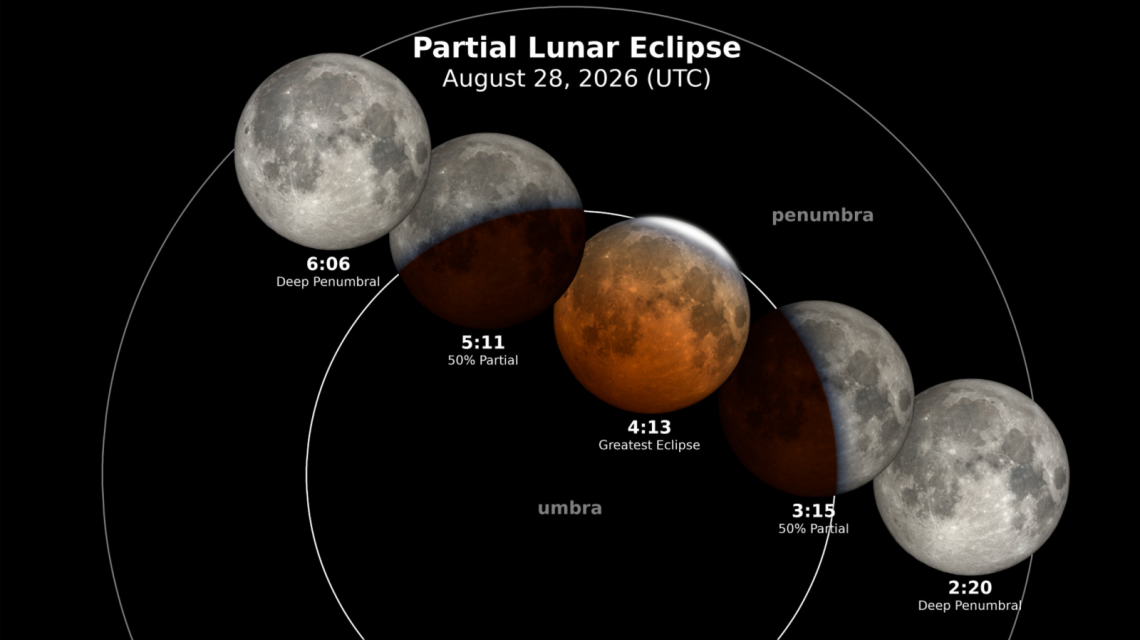
The upcoming week offers a treat for skywatchers, with a rare deep partial lunar eclipse visible across much of the United States. Overnight on August 27 or 28, Earth’s shadow will cover over 96 percent of the moon’s surface, as the planet passes directly between the sun and a full moon.
According to NASA, the moment of greatest eclipse will occur when 96.3 percent of the moon’s visible disk is within Earth’s central shadow, known as the umbra. Although not a total eclipse, this event comes close. At peak eclipse, only a thin sliver of the moon remains in sunlight.
Understanding the Eclipse’s Rarity
While partial lunar eclipses are quite common, those of such deep magnitude are rare. This eclipse is part of Saros 138, a series repeating every 18 years, 11 days, and 8 hours. The last eclipse in this series was on August 16, 2008, with the next one set for September 7, 2044.
Astronomers highlight this event as one of the most dramatic lunar eclipses visible soon, due to its near-total coverage of the moon, which could give the lunar surface a reddish or copper glow.
Observing the Eclipse
During the eclipse, observers will see Earth’s shadow gradually cross the full moon. Initially, as the moon enters Earth’s penumbra, a subtle dimming will occur. In the partial phase, the darker umbral shadow will appear to take a growing ‘bite’ from the moon.
Near peak eclipse, remaining sunlit areas reduce to a narrow crescent. The shadowed portion might glow red, orange, or copper hues due to sunlight filtered through Earth’s atmosphere, similar to red sunsets. NASA notes the coppery color becomes more noticeable as eyes adjust to darkness.
Visibility Timing
The eclipse’s maximum occurs at 4:13 a.m. UTC on August 28, translating to:
- 12:13 a.m. EDT (U.S. East Coast) on August 28
- 11:13 p.m. CDT on August 27
- 10:13 p.m. MDT on August 27
- 9:13 p.m. PDT (U.S. West Coast) on August 27
Viewing Locations across the U.S.
Much of the United States offers favorable viewing conditions. Areas include Los Angeles, Portland, New York, and Jacksonville. The eclipse will also be visible throughout South America and parts of western Europe and Africa.
How to Watch
Unlike solar eclipses, lunar ones can be safely viewed with the naked eye. EarthSky states no special glasses or equipment are needed. Finding a clear, low-light location enhances the experience. Binoculars or a telescope can add detail, but clear weather is crucial for optimal viewing.
For those unable to view in person, Time and Date provides a live webcast from multiple global locations.
 NASA’s Challenges Amid Goddard Space Flight Center Relocations
  Lost City Linked to Jesus Discovered Near the Sea of Galilee
  NASA’s Launch of the Nancy Grace Roman Space Telescope
  NASA Launches Nancy Grace Roman Space Telescope to Explore Universe’s Mysteries
  Trump Engages with Astronauts and Honors Artemis II Crew
  NASA’s Nancy Grace Roman Telescope Prepares for Launch