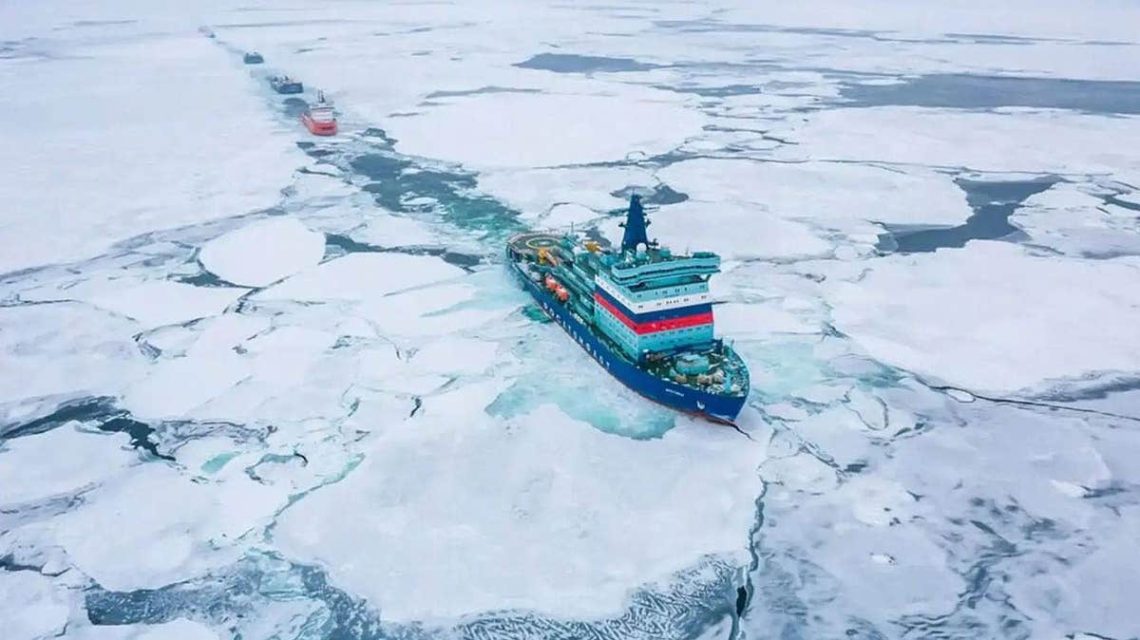
China is testing the potential of the Arctic to become a strategic trade corridor, initiating seasonal container shipping to Europe through Russia’s Arctic. This development reflects the strengthening commercial and military ties between Beijing and Moscow. Meanwhile, the U.S. sees heightened activity in the Arctic region as critical to its national security.
The current service remains limited, with just over eight voyages planned this season. Nonetheless, China analyst Gordon Chang highlighted that the move signals China’s strategic interest in exploiting the Arctic for several reasons. The melting Arctic ice is making the Northern Sea Route, which runs along Russia’s northern coast, viable for a few months during the summer.
On August 15, the Sea Legend Shipping’s Dubai Tower departed from the Ningbo-Zhoushan Port, bound for Europe on a journey estimated to take around 20 days, according to China Daily. This route circumvents traditional shipping routes like the Strait of Malacca and Suez Canal, which are strategic chokepoints.
“We need to be in the Arctic, and President Trump has authorized more icebreakers,” Chang stated. “We are woefully short in that department.”
As tensions continue, a U.S. congressional report warns of Russia’s growing isolation and its increasing reliance on Beijing. This dynamic grants China more influence in the Arctic, where both nations are expanding their commercial shipping capacities and forming joint ventures to build ice-class vessels, expected to start operations in 2027.
The White House emphasized the Arctic’s significance to U.S. security and economic interests. A fact sheet by the U.S.-China Economic and Security Review Commission explained how Russia’s invasion of Ukraine has led Moscow to accept a stronger Chinese presence in the Arctic, a region long seen by Russia as key to its national defense.
Furthermore, China holds a 20% stake in the strategically significant Arctic LNG 2 project, which is under U.S. and EU sanctions. The Pentagon’s Arctic Strategy for 2024 also warns of changing conditions that enhance access to the Arctic, thereby raising concerns about China’s proposed “Polar Silk Road.” This initiative aims to foster infrastructure and resource investments, potentially affecting the region’s stability.
The Northern Sea Route offers an alternative to the traditional trade paths, avoiding several chokepoints. Chang notes this is strategic for China, as their influence in China-Europe trade grows. The U.S.-China commission’s report indicates that China’s relationship with Russia post-Ukraine invasion has allowed China to buy discounted energy and access military technology. Despite Russia’s significant oil exports to China, Chinese imports from Russia represent only a fraction of what China consumes.
Russia aggressively uses the Arctic passage for oil transport. Reuters reported on August 11 that Russia dispatched seven shipments totaling around 6 million barrels this season. This is nearly half of what was transported during the entire previous season, with China the primary recipient.
The Bering Strait poses a potential choke point, as it separates Russia from Alaska. Chang pointed out that this gives some leverage to the United States.
China and Russia’s military cooperation is also increasing. Their joint exercises have involved advanced capabilities, highlighting greater military interaction. Chang argues this growing presence means the U.S. must also assert itself in the Arctic.
Fox News Digital attempted to contact the Chinese and Russian embassies for comments. Notably, Efrat Lachter, a veteran journalist at Fox News Digital, has detailed experience covering conflicts globally. Her insights provide valuable context for these developments.
 Accountability for Presidential Actions
  Iranian Executions Amid Protests
  The Global Implications of Weakening Public Health Infrastructure
  U.S. Signs Revised Health Deal with Zambia
  Russian Strike Hits Civilians in Kramatorsk
  New Indictment Against Nicolás Maduro and Wife