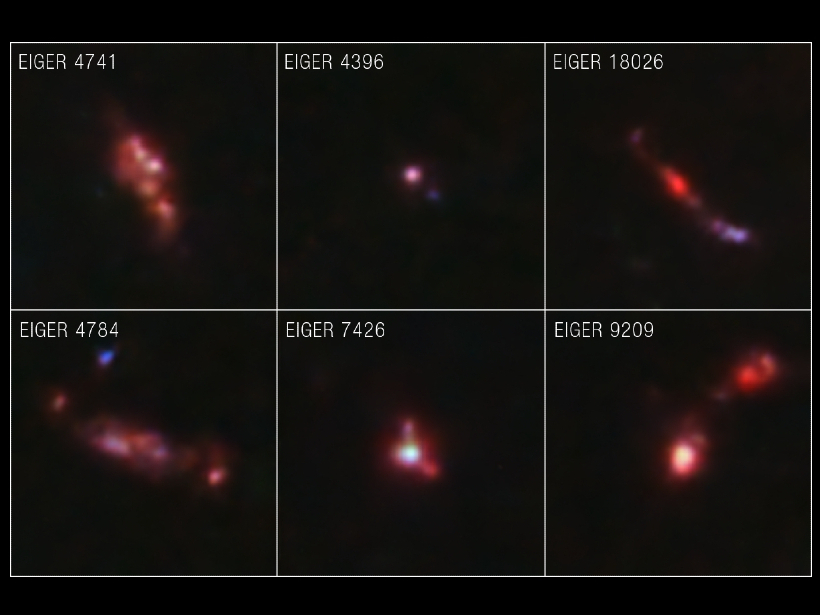
The James Webb Space Telescope (JWST) has produced groundbreaking images and spectra, revealing galaxies as they appeared when the universe was only 900 million years old. Since its launch, JWST has offered a significant leap forward in astrophysics, enabling astronomers to study galaxies farther and earlier than ever before.
Observing the Early Universe
Jorge Moreno from Pomona College likens the work of astronomers to that of paleontologists, who dig deeper to find ancient fossils. Astronomers look deeper into the cosmos to study its history, observing distant galaxies to understand the universe’s origins.
Scientists have discovered galaxies appearing earlier in cosmic history than expected, causing excitement and confusion among astronomers worldwide. JWST has identified galaxies forming just 200 to 500 million years after the Big Bang, which appear larger and brighter than anticipated.
Using Light to See the Past
The telescope detects the faint light from these distant galaxies, much of which falls in the infrared spectrum due to cosmological redshift. This redshift occurs as the universe expands, stretching light wavelengths.
Light from these galaxies has traveled for billions of years to reach JWST. To compare, sunlight reaches Earth in about eight minutes, while light from Proxima Centauri, our nearest star, takes more than four years to arrive.
Discovering such early, bright galaxies challenges prior models of galaxy formation, which assumed galaxies couldn’t achieve such mass so rapidly.
Unexpected Galaxy Structures
Most known galaxies fall into two categories: spirals and ellipticals. Scientists initially thought early galaxies were undefined blobs. However, JWST is revealing structured galaxies with spiral arms similar to local universe galaxies.
Such structure and brightness in early galaxies spur some researchers to question the universe’s age, with one suggesting it could be 26.7 billion years old. This theory combines conventional expansion models with the discredited “tired light” model, which lacks scientific evidence.
Reflecting on Galactic Discoveries
While creative models and new hypotheses intrigue the scientific community, experts like Moreno caution against abandoning established theories without compelling evidence. The current lack of observations supporting an older universe supports the conventional age estimate of 13.8 billion years.
Daily data from JWST continues to provide fresh possibilities for research. Moreno emphasizes the importance of reflection and thoughtful analysis when interpreting these vast and complex galactic observations, highlighting a balance between discovery and careful consideration.
 SpaceX Launches Cargo Mission to Space Station with Stunning Visuals
  SpaceX Crew 13 Launches to the ISS with International Team
  NASA and Boeing Collaborate for Starliner Upgrades
  SpaceX Starship Completes Orbital Test Flight and Satellite Deployment
  NASA’s Challenges Amid Goddard Space Flight Center Relocations
  Lost City Linked to Jesus Discovered Near the Sea of Galilee